Bangkok culture and heritage: the complete honest guide
Bangkok: Chinatown and Talat Noi Guided Walking Tour
What do I need to understand about Bangkok's culture before visiting?
Bangkok culture rests on three pillars: Theravada Buddhism (about 93 percent of Thais), deep respect for the monarchy (protected by strict lèse-majesté law), and a code of everyday courtesy built around the wai greeting, the idea that the head is sacred and feet are lowly, and a strong dislike of public confrontation. Cover shoulders and knees at temples, remove your shoes, stand for the royal anthem, and stay calm and smiling — get those right and you will be welcomed warmly.
Bangkok rewards visitors who understand it. Beneath the traffic, the malls and the rooftop bars sits one of Asia’s most layered living cultures — a society organised around Theravada Buddhism, a revered monarchy, and an unspoken code of courtesy that governs everything from how you greet a stranger to where you point your feet. This guide explains what actually matters: the religion you will see everywhere, the customs that will make or break your interactions, the festivals worth planning a trip around, and the cultural lines you must never cross. It is honest about what is genuinely moving and what is a tourist performance.
| Core beliefs | Theravada Buddhism (around 93% of Thais), monarchy, community/family |
| Legal line | Lèse-majesté (Section 112) — never joke about or insult the royal family |
| Dress code | Shoulders and knees covered, shoes off at temples and some homes |
| Free to experience | Alms-giving at dawn, spirit houses, most neighbourhood temples |
| Best intro | An early-morning temple visit before a festival or Jim Thompson House |
The three pillars: nation, religion, monarchy
Modern Thai identity is often summarised as three pillars — chat (nation), satsana (religion) and phra maha kasat (monarchy) — represented by the three coloured bands of the national flag. You do not need to memorise the theory, but understanding that these three concepts are emotionally central explains almost every cultural rule you will encounter.
Religion means Buddhism in practice, and Buddhism is not abstract here — it is woven into the calendar, the architecture, and the rhythm of the day. The monarchy is treated with a reverence that can surprise first-time visitors; it is protected by law and by genuine affection, and it is the single subject where a careless foreigner can get into real trouble. Nation ties the two together in public ritual: the royal anthem, the national flag raised each morning, and the shared festivals that bring the city onto the streets.
For the deeper picture of how the monarchy works and why the law around it is so strict, see the Bangkok monarchy and lèse-majesté guide. For the religious foundation, the Buddhism in Bangkok guide goes well beyond what most visitors ever learn.
Buddhism you will actually see
About 93 percent of Thais are Theravada Buddhist, the older and more austere of the two main Buddhist branches, the same tradition found in Sri Lanka, Myanmar, Laos and Cambodia. What this means for a visitor is concrete and visible.
At dawn, saffron-robed monks walk barefoot through neighbourhoods collecting alms (food, not money) from lay people who earn merit by giving. You will see this most clearly in older districts like Rattanakosin old city and Talat Noi around 06h00 to 07h30. Outside almost every home, shop and office stands a spirit house — a small ornate shrine, often with offerings of red Fanta, marigold garlands and incense, meant to house the spirits displaced by the building.
Merit-making (tham bun) drives much of the visible religious activity: releasing caged birds or fish, applying gold leaf to Buddha statues, donating to temples, offering lotus buds and incense. None of this requires you to participate, but understanding it turns a confusing scene into a legible one.
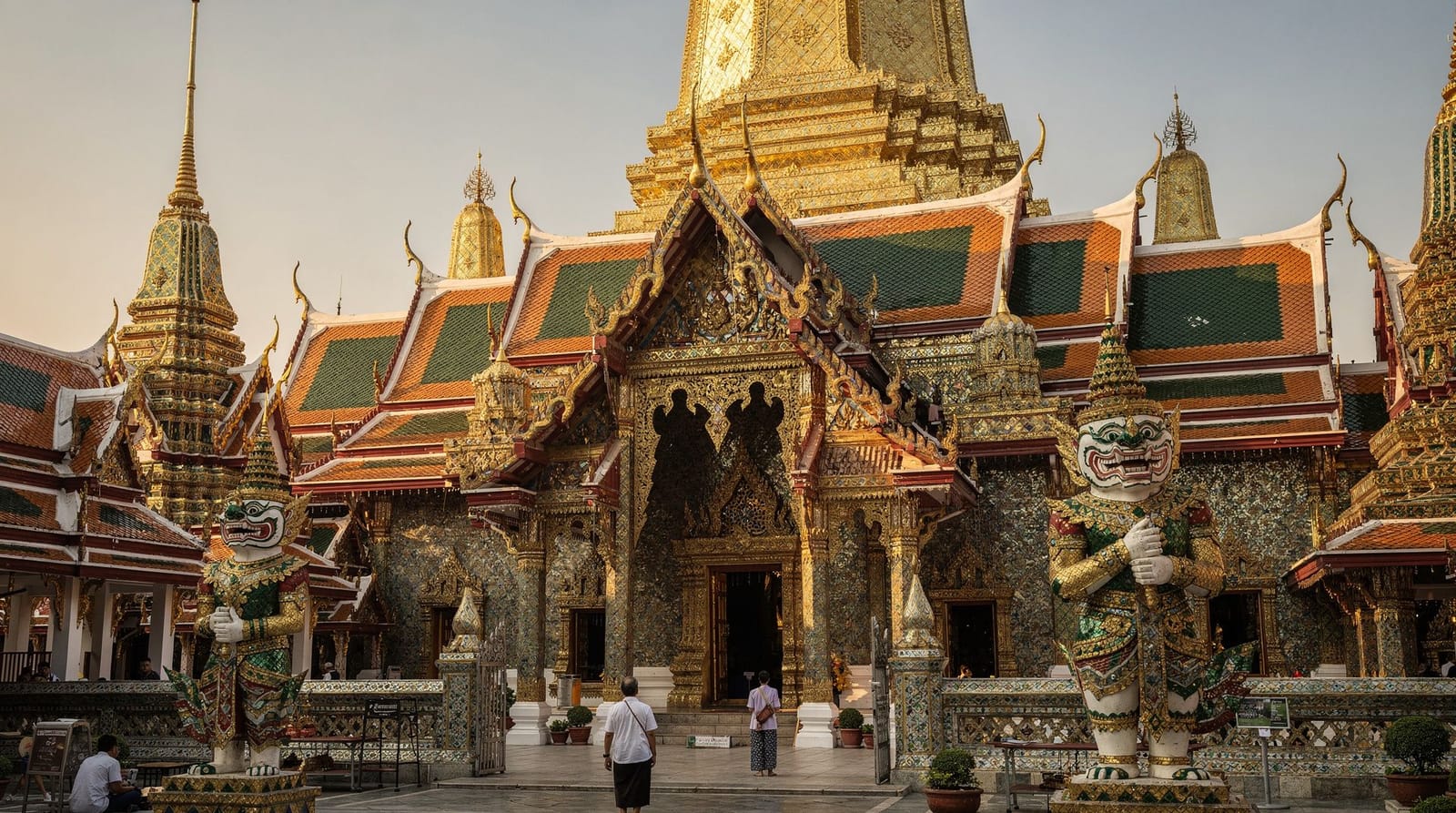
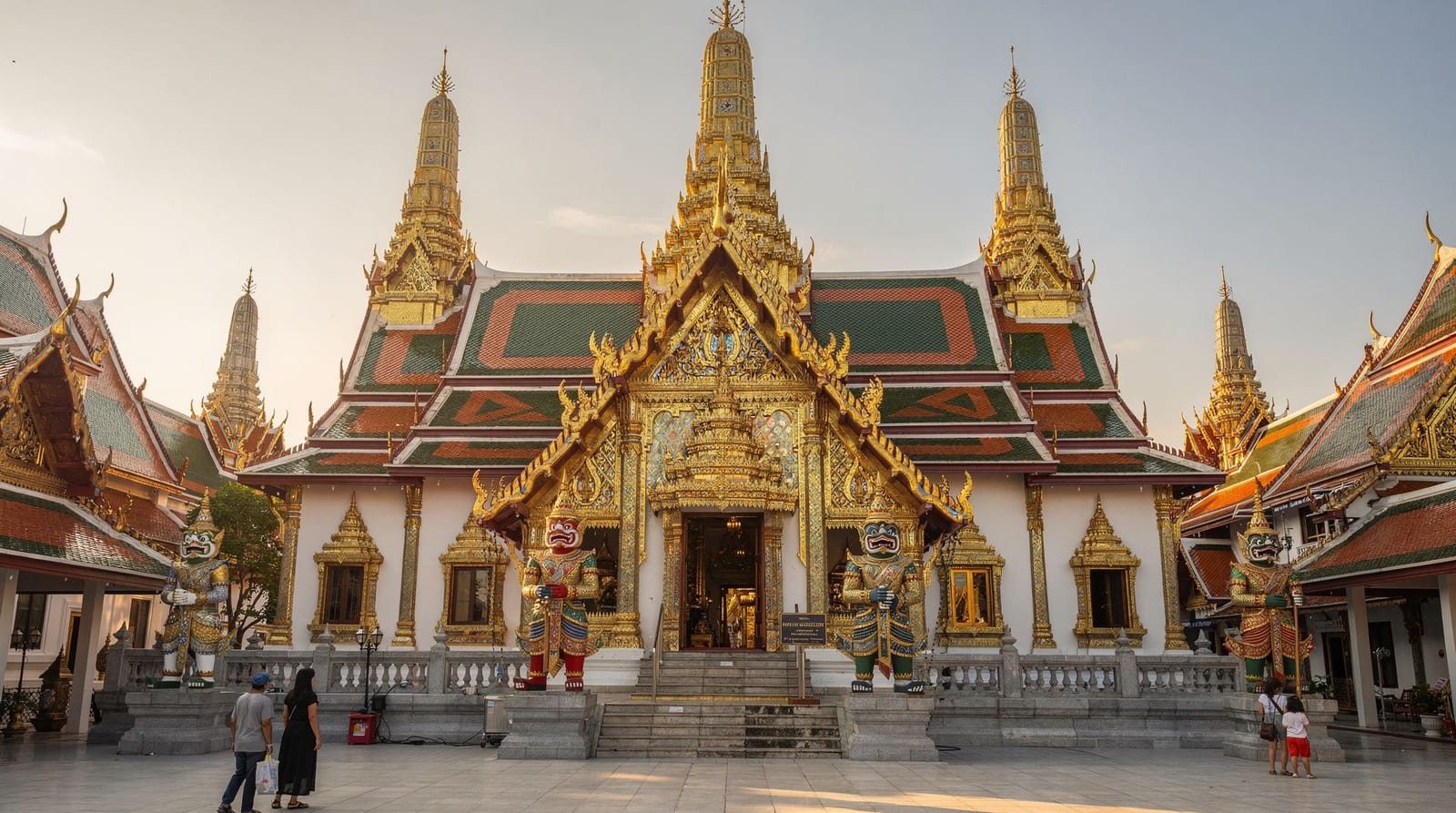
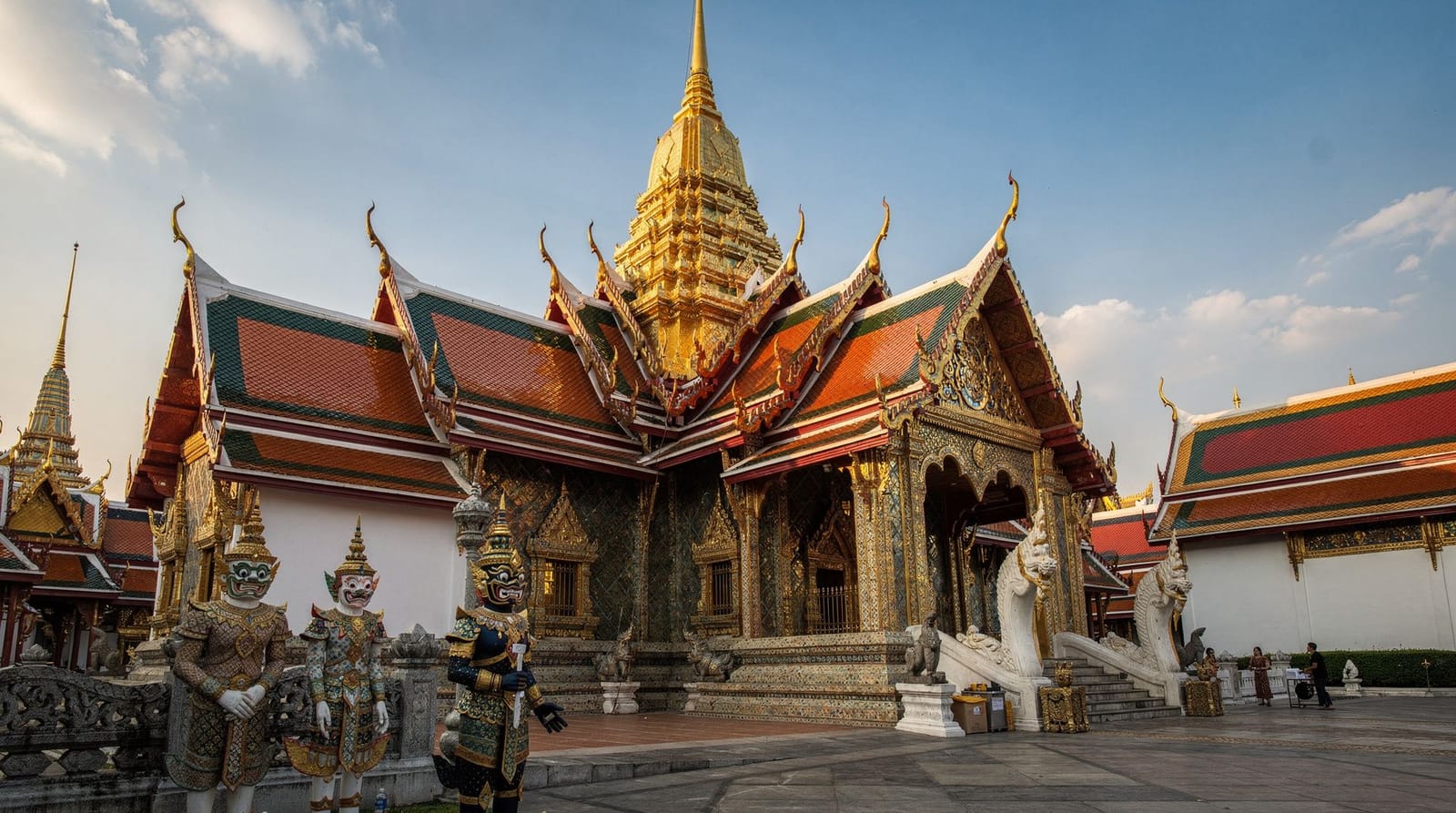
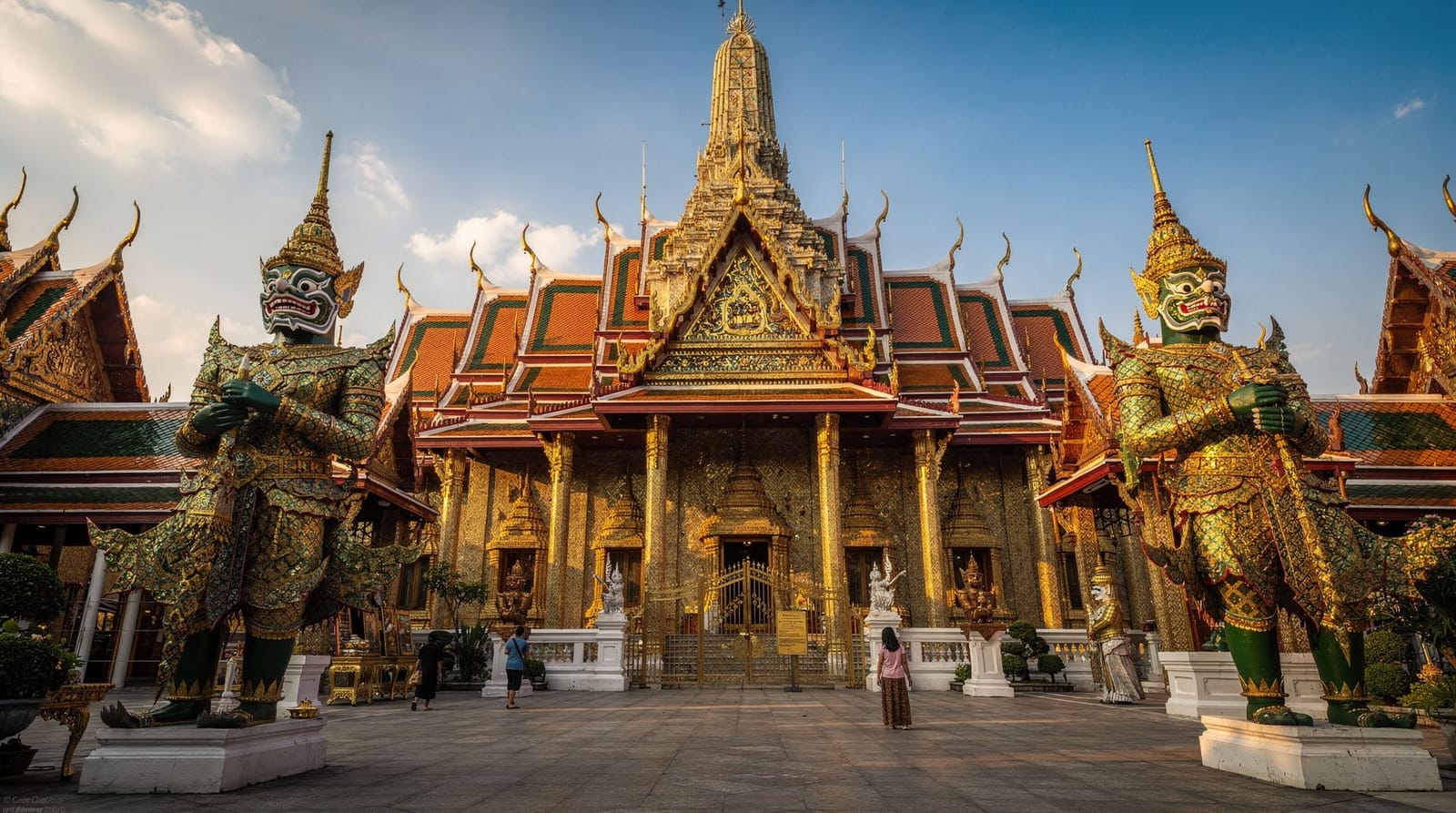
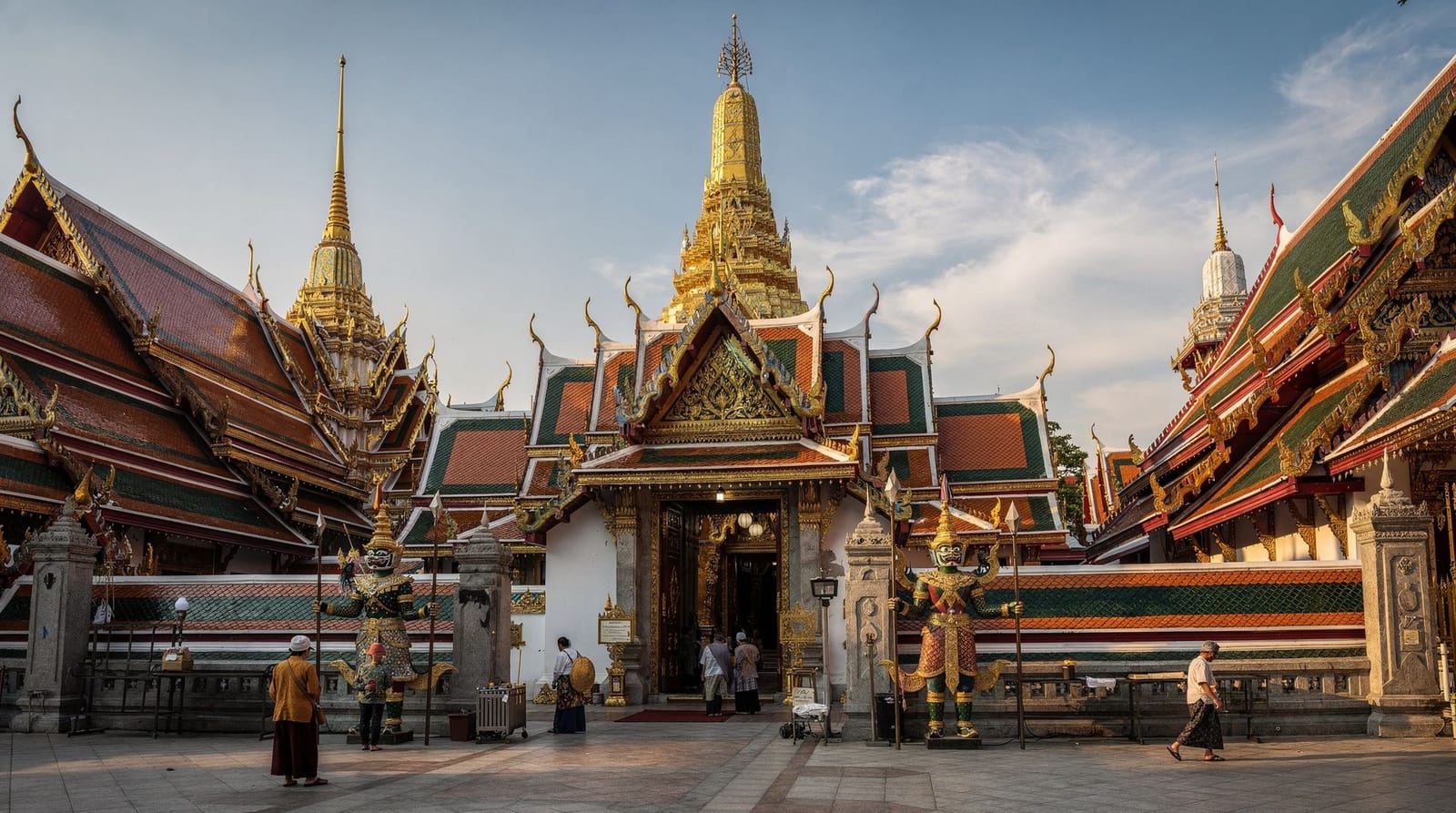
Bangkok’s great temples are working religious sites first and tourist attractions second. The most important is Wat Phra Kaew, home of the Emerald Buddha, inside the Grand Palace complex — covered in detail in the Wat Phra Kaew Emerald Buddha guide. Just south, Wat Pho holds the colossal Reclining Buddha and the country’s most respected traditional massage school. Across the river, the porcelain-encrusted spires of Wat Arun catch the late sun. The full list of which are worth your limited time is in the best temples in Bangkok guide.
The wai and the rules of the body
The wai — palms pressed together, a slight bow of the head — is the standard Thai greeting, thank-you and apology. As a visitor, the single rule to remember is to return a wai when one is offered, but not to initiate it toward people serving you (waiters, drivers, hotel staff) or toward children. A returning nod with hands at chest height is plenty.
Thai etiquette maps respect onto the body itself. The head is the most sacred part of a person — never touch anyone’s head, even a child’s, and never reach over someone’s head. The feet are the lowest and dirtiest part — never point your feet at a person, a monk, or a Buddha image, and never use your foot to point at or move anything. When sitting in a temple, tuck your feet behind you in the polite “mermaid” position rather than crossing your legs toward the altar.
There is also the concept of “face” (saving face and not causing others to lose it). Public anger, raised voices and visible frustration are seen as a loss of self-control and rarely get results — a calm smile and patience almost always work better. The full set of day-to-day customs, including dining, gift-giving and the meaning of the Thai smile, is in the Thai customs and etiquette guide.
Temple etiquette in practice
Temples have a strict but simple dress code: shoulders and knees covered, no sheer or skin-tight clothing, and shoes removed before entering any building (you will see racks or piles of shoes at the threshold). The Grand Palace enforces this most aggressively and turns away anyone in shorts, sleeveless tops or short skirts — the Grand Palace dress code guide covers exactly what passes and what does not, and warns about the overpriced sarong-rental touts at the gate.
Inside, women must never touch a monk or hand anything to him directly; a monk passing something to a woman will place it down or use a cloth. Sit lower than monks and Buddha images where you can. Point your feet away from the altar. Keep your voice low. The complete checklist, with what to wear in 35-degree heat and how to handle gold-leaf offerings, is in the temple etiquette and dress code guide. For an efficient route through the old-city temples without backtracking, use the temple hopping route and the dedicated Bangkok temples itinerary.
A practical honest warning: the Grand Palace “it’s closed today” scam is the most common in Bangkok. A friendly stranger near the gate tells you the palace is shut for a holiday or a ceremony and offers a cheap tuk-tuk tour to “other temples” — which ends at gem and tailor shops paying commission. The Grand Palace is almost never closed during its posted hours. Read the Grand Palace scam warning before you go.
The monarchy: where the rules turn legal
Respect for the monarchy is the one cultural area where a casual mistake can become a criminal matter. Section 112 of the Thai Criminal Code — the lèse-majesté law — makes insulting the King, Queen, heir apparent or regent punishable by three to fifteen years in prison per count, and it applies to foreigners as much as to Thais.
In daily life this translates into a few firm rules: stand still and respectful when the royal anthem plays (it is broadcast in many public spaces and BTS/MRT stations at 08h00 and 18h00, and always before films in cinemas); never deface, tear or step on Thai banknotes or coins, which carry the King’s portrait; do not make jokes or critical comments about the royal family, even in private conversation with strangers; and treat portraits of the King, which hang everywhere, with respect. This is not theatrical — Thai people feel it sincerely, and the law is enforced. The full explanation, including what is genuinely fine to do, is in the monarchy and lèse-majesté guide.
The cultural calendar: festivals worth planning around
Two festivals are worth structuring a trip around, and both are genuine, not tourist inventions.
Songkran, the Thai New Year, runs 13 to 15 April 2026. Officially it marks the new year with water-pouring rituals — gently pouring scented water over Buddha images and the hands of elders as a blessing. In practice, on the streets it becomes the world’s largest water fight, with Khao San Road and Silom turning into soaking-wet block parties. April is also the hottest month of the year, so the water is welcome. The full survival guide — what to protect, where to go, how to handle the heat and crowds — is in the Songkran guide and the seasonal Songkran in Bangkok page.
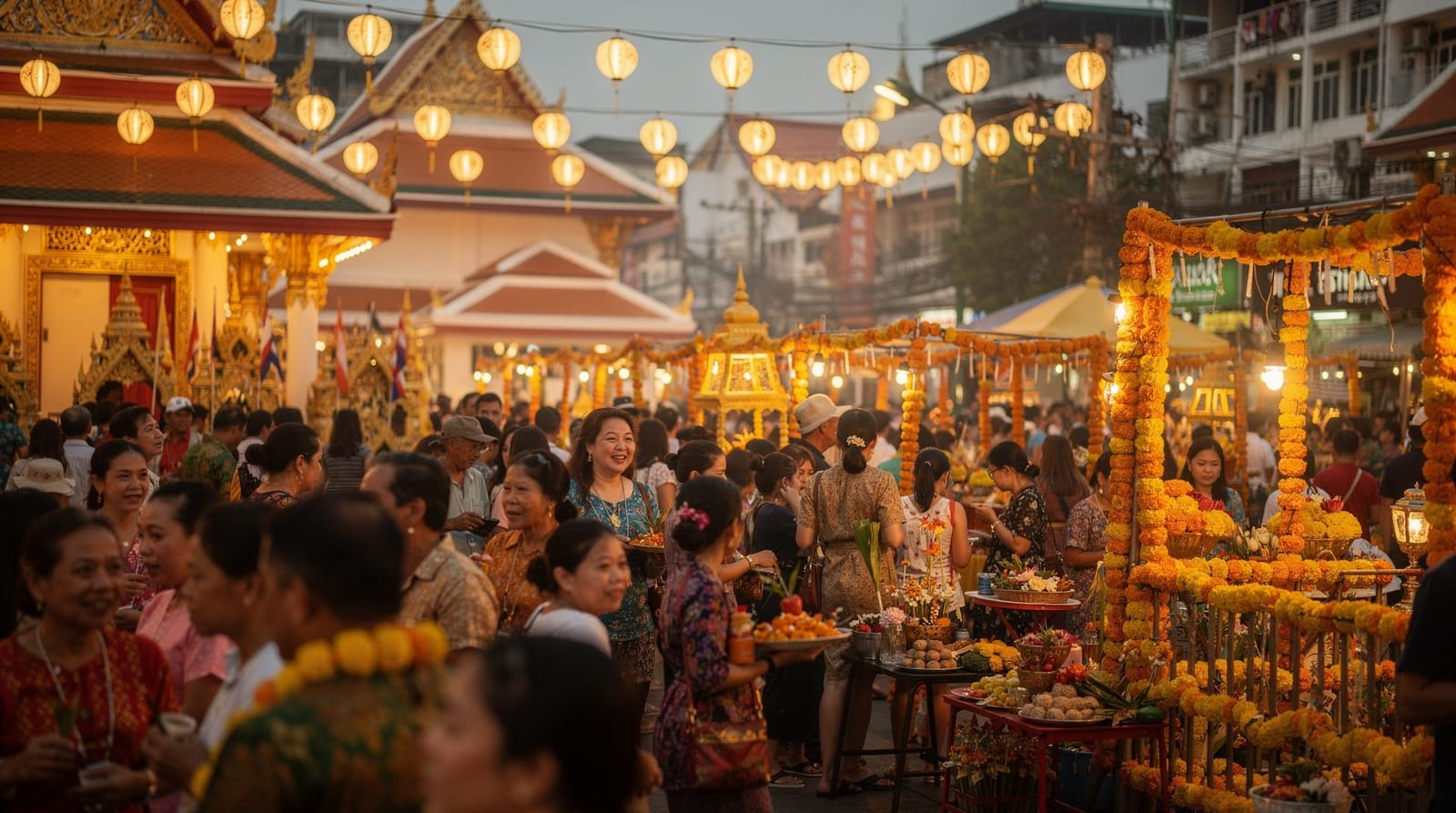
Loy Krathong, the festival of floating lights, falls on 25 November 2026, on the full moon of the twelfth lunar month. People release small decorated baskets (krathong) made of banana leaves, flowers, a candle and incense onto the river and canals, floating away bad luck and giving thanks to the water goddess. The Chao Phraya river and the city’s canals are the heart of it in Bangkok. One honest clarification many visitors get wrong: the mass sky-lantern release seen in photographs (Yi Peng) is a Chiang Mai tradition in the north, not a Bangkok event. Full details are in the Loy Krathong guide and the Loy Krathong in Bangkok page. The complete year is mapped in the Bangkok festivals calendar.
Living heritage beyond the temples
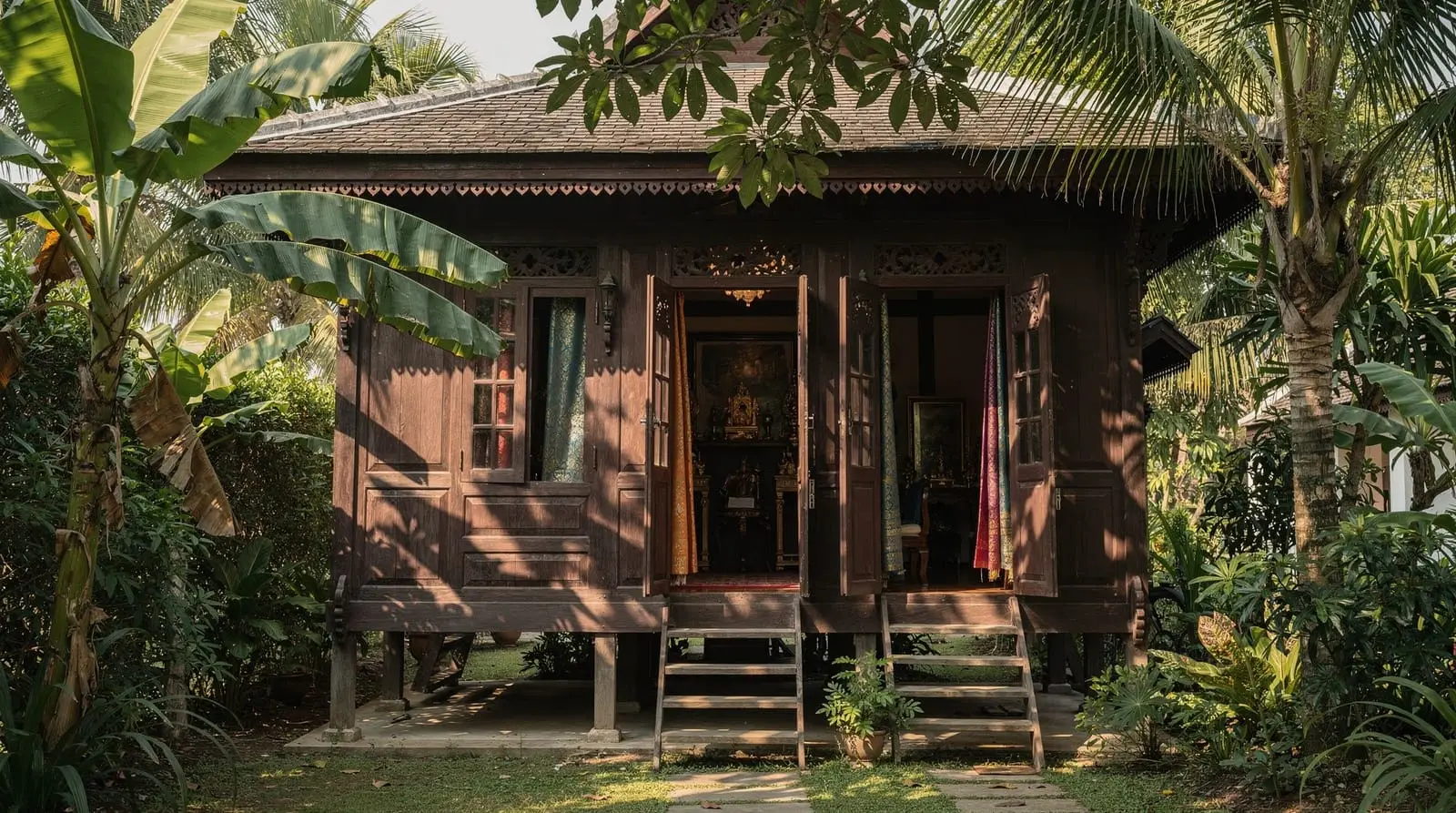
Culture in Bangkok is not only religious. The single best museum experience for understanding Thai craft and design is the Jim Thompson House, the teak-house home of the American who revived the Thai silk industry after the Second World War before vanishing mysteriously in 1967. It is a beautiful, honest introduction to Thai architecture and textiles — the full story is in the Jim Thompson and Thai silk guide.
For Thai history compressed into a single visit, the open-air Ancient City (Muang Boran) on Bangkok’s edge recreates the country’s great monuments at near-full scale across a vast park you explore by bicycle.
Ancient City (Muang Boran) entry ticket — Thailand’s monuments in one parkFor a sense of how communities actually lived, the riverside Talat Noi district preserves Sino-Thai shophouses, hidden shrines and craft workshops, best explored slowly on foot. Chinatown (Yaowarat) layers Chinese-Buddhist temples, gold shops and the Golden Buddha of Wat Traimit over one of the most atmospheric street-food zones on earth.
Chinatown and Talat Noi walking tour — heritage shophouses and shrinesPerforming arts add another layer: traditional khon masked dance-drama, classical Thai dance, and the global phenomenon of cabaret shows. For a clear-eyed look at the latter, see the cabaret shows in Bangkok guide. And the country’s national sport, Muay Thai, is as much ritual as combat — the pre-fight wai khru dance honours teachers and spirits before any blows land. The Muay Thai in Bangkok guide explains the ceremony as well as the sport.
Cultural neighborhoods beyond the old city
Culture in Bangkok is not confined to the temple zone. A newer, equally genuine layer of Thai creativity lives in neighbourhoods that rarely make a first-timer’s list. Ari, a leafy district north of Chatuchak, has grown into a hub for independent galleries, design studios and a generation of Thai artists and chefs reworking tradition rather than repeating it — the Ari neighbourhood guide covers where that scene concentrates. Thonglor and Ekkamai, further east, mix contemporary Thai design shops, listening bars and a food scene that treats Thai cuisine as fine dining rather than street snacks — see the Thonglor-Ekkamai guide for specifics. Neither neighbourhood photographs like a temple, but both are honest evidence that Thai culture is a living, evolving thing rather than a museum piece. This contemporary strand also shows up annually in events like Bangkok Design Week, when the old riverside shophouse districts turn into pop-up galleries and installations for a couple of weeks — see the Bangkok festivals calendar for the current dates.
Cultural experiences at a glance
For travellers deciding where to spend limited time, here is how the main cultural experiences compare:
| Experience | Time needed | Cost | Best for |
|---|---|---|---|
| Grand Palace & Wat Phra Kaew | 2–3 hours | ~500 THB | Essential first-time icon, most crowded |
| Wat Pho & Wat Arun | 2–3 hours combined | ~300–500 THB | Working temples, less rushed than the Palace |
| Jim Thompson House | 1–1.5 hours | ~200 THB | Craft, architecture, a quieter pace |
| Dawn alms-giving walk | 30–45 minutes | Free | The most authentic, least staged experience |
| Muay Thai at a real stadium | 2–3 hours | ~1,000–2,500 THB | Living ritual as much as sport |
| Hotel cultural dinner show | 1–2 hours | Varies, often pricey | Convenient but the most staged option |
A few Thai words that go a long way
You do not need fluency, but a handful of words change how people respond to you, because effort at the language is itself read as a form of respect. Sawasdee khrap (men) or sawasdee kha (women) is hello, paired with the wai. Khop khun khrap/kha is thank you — use it constantly, at every stall and taxi. Mai pen rai roughly means “no worries” or “it’s fine,” the phrase behind Thailand’s famous easy-going temperament, useful when a plan falls through. Khrap and kha themselves are polite particles added to the end of almost any sentence by men and women respectively; sprinkling them in, even with English words, softens everything you say. Aroy mean delicious, essential praise for a street-food vendor. None of this replaces the wai and the etiquette above, but the two together — the gesture and a word or two — is what actually earns a warm reaction rather than a transactional one.
What’s authentic and what’s a performance
An honest culture guide should say which experiences deliver and which are staged for tourists.
Genuinely worthwhile: visiting working temples in the early morning before tour groups arrive; watching alms-giving at dawn in an old neighbourhood; spending an evening at Loy Krathong on a quieter canal rather than the most crowded riverside; a real Muay Thai card at Rajadamnern or Lumpinee stadium; and the Jim Thompson House for craft and architecture.
Often overhyped or staged: hotel “cultural dinner shows” with rushed dance performances; tiger or elephant photo attractions (avoid any elephant experience that is not a credible sanctuary — see the ethical elephant tourism guide); and the floating-market spectacle at Damnoen Saduak, which is heavily commercialised and packed by mid-morning — the is Damnoen Saduak worth it page gives the honest verdict and better alternatives.
To weave all of this into an actual trip, the things to do in Bangkok guide and the must-see first-time guide sequence the cultural highlights around the logistics.
Putting it together: a respectful cultural day
A culturally rich day that respects the etiquette above might run like this. Start before 08h00 at Wat Pho — shoulders and knees covered, shoes off, feet tucked away from the Reclining Buddha — while the air is cool and the crowds thin. Cross the river on the public ferry to Wat Arun. Mid-morning, walk into Rattanakosin old city and visit Wat Saket, the Golden Mount, for the climb and the view. Pause for a calm, smiling lunch in the old town. In the afternoon, see the Jim Thompson House for craft and shade, then end in Chinatown for the evening street-food crawl. Throughout, you greet with a returned wai, keep your feet pointed away from altars, lower your voice in sacred halls, and stand still if the royal anthem plays. Get those reflexes right and Bangkok opens up.
Frequently asked questions about Bangkok culture and heritage: the complete honest
What religion is dominant in Bangkok?
Is it rude to wai (the prayer-like greeting) as a foreigner?
What are the most important cultural rules to follow in Bangkok?
Are the temples free to enter in Bangkok?
When are Bangkok's main cultural festivals in 2026?
How serious is the lèse-majesté law for tourists?
Do I need to cover my shoulders and knees everywhere in Bangkok?
Is it OK to take photos inside temples?
Top experiences
Bookable activities with verified prices and instant confirmation on GetYourGuide.