Buddhism in Bangkok: a visitor's guide to the living faith
Bangkok: Ancient City (Muang Boran) Entry Ticket
What kind of Buddhism is practised in Bangkok and how visible is it?
Bangkok practises Theravada Buddhism, the older, more traditional branch followed by about 93 percent of Thais. It is intensely visible in daily life: saffron-robed monks collecting alms at dawn, spirit houses outside every building, merit-making at hundreds of temples, and ornate wats anchoring every neighbourhood. You do not need to be Buddhist to engage respectfully — visit temples covered up and shoeless, watch alms rounds quietly, and you can even take part in small acts of merit like offering lotus or applying gold leaf.
Buddhism is not a museum exhibit in Bangkok — it is a living faith you will encounter on every street, from monks walking their dawn alms rounds to the spirit houses outside every shop. About 93 percent of Thais are Theravada Buddhist, and understanding the basics of that faith transforms a confusing scene into a legible one and a temple visit into something meaningful. This guide explains what Theravada Buddhism is, how it shapes daily life in the city, the role of monks and merit-making, the temples that best illustrate it, and how to engage respectfully — whether you are simply observing or want to take part.
| Where | temples citywide; alms rounds in older residential lanes |
| Cost | free to observe; small optional donations/offerings |
| Time needed | 30 min to witness alms; a morning for several temples |
| Getting there | MRT Sanam Chai for the old city temple cluster |
| Best time | 06h00–07h30 for alms rounds; temple mornings before 10h00 |
Theravada Buddhism: the older path
Thailand follows Theravada Buddhism, the oldest surviving school, sometimes called the Doctrine of the Elders. It is the same tradition practised in Sri Lanka, Myanmar, Laos and Cambodia, and it differs from the Mahayana Buddhism of China, Japan and Tibet in being more monastic and, in some ways, more austere. Theravada emphasises the historical Buddha’s teachings, the monastic community (the sangha), individual effort toward enlightenment, and the law of karma — that actions have consequences across this life and future ones.
In Thailand, though, pure Theravada doctrine coexists with older layers of belief. Animism — the worship of land and nature spirits — survives in the ubiquitous spirit houses. Hindu-Brahmin elements remain in shrines like the busy Erawan Shrine at a city-centre intersection, where people pray to a four-faced Brahma image. Thais see no contradiction in honouring all of these; the result is the rich, layered religious life you observe across the city. This blend sits within the three-pillar national identity — nation, religion, monarchy — explained in the Bangkok culture guide.
Monks and the dawn alms round
The most visible expression of the faith is the daily alms round. Theravada monks own almost nothing and do not cook; they depend entirely on the lay community for food. Each morning before dawn, monks leave the temple and walk a quiet route barefoot, carrying an alms bowl. Lay people wait with prepared food — rice, curries, fruit, sweets — and kneel to place it in the bowl. The monk accepts in silence and does not thank the giver, because in Theravada belief it is the act of giving that earns the donor merit; the monk is providing the opportunity, not receiving a favour.
You can witness this respectfully around 06h00 to 07h30 in older residential districts like Rattanakosin old city, Talat Noi and the lanes near major temples. Watch quietly from a distance, do not block the monk’s path, and never photograph intrusively or with flash. If you wish to offer alms yourself, buy a prepared set from a vendor, remove your shoes, kneel, and place it in the bowl — and if you are a woman, place items in the bowl directly rather than handing them to the monk, who must not be touched by a woman. The temple-conduct details are in the temple etiquette and dress code guide.
Many Thai men also ordain as monks temporarily — for a few weeks or months, often before marriage or to make merit for their parents, especially during the three-month rains retreat (Phansa). This temporary monkhood is a respected rite of passage rather than a lifelong vocation for most.
Merit-making: the engine of daily practice
If one concept unlocks Thai religious life, it is merit-making (tham bun) — performing good deeds to accumulate positive karma for this life and the next. It is constant and woven into ordinary days, and much of the activity you see at temples is merit-making in action.
Common acts include offering food to monks, donating money to temples, releasing caged birds or fish to give them freedom, applying thin sheets of gold leaf to Buddha statues, offering lotus buds and lighting incense, lighting candles, and listening to dharma teachings. Behaving ethically and generously is itself merit. None of this requires you to be Buddhist, and visitors are welcome to take part in the small, public acts: buy a lotus bud and three incense sticks at a temple stall for a few baht and make an offering, or press a square of gold leaf onto a Buddha image. Do it quietly and with respect, and you have shared genuinely in the practice. The broader everyday customs that frame all this are in the Thai customs and etiquette guide.
Spirit houses and the animist layer
Look outside almost any Thai home, shop, office or hotel and you will find a spirit house — a small, ornate shrine, often miniature-temple-shaped, raised on a pillar, decorated with figurines, garlands, incense and offerings of food and brightly coloured drinks (red Fanta is a favourite). This is the san phra phum.
The belief is that building on a piece of land displaces the spirits who reside there, so a dwelling is provided for them and they are honoured daily. Kept happy with offerings, they protect the occupants and bring good fortune; neglected, they may cause trouble. The placement, the daily offerings and the rituals around spirit houses are taken seriously, and you will see people pausing to pay respect at them throughout the day. It is the clearest everyday survival of the animist beliefs that predate and now blend with Buddhism — a reminder that Thai religion is layered, practical and lived rather than purely doctrinal.
The temples that explain the faith
Bangkok’s great temples each illuminate a different facet of Thai Buddhism, and visiting a few thoughtfully teaches more than any text. The complete shortlist is in the best temples in Bangkok guide, but a few are essential.
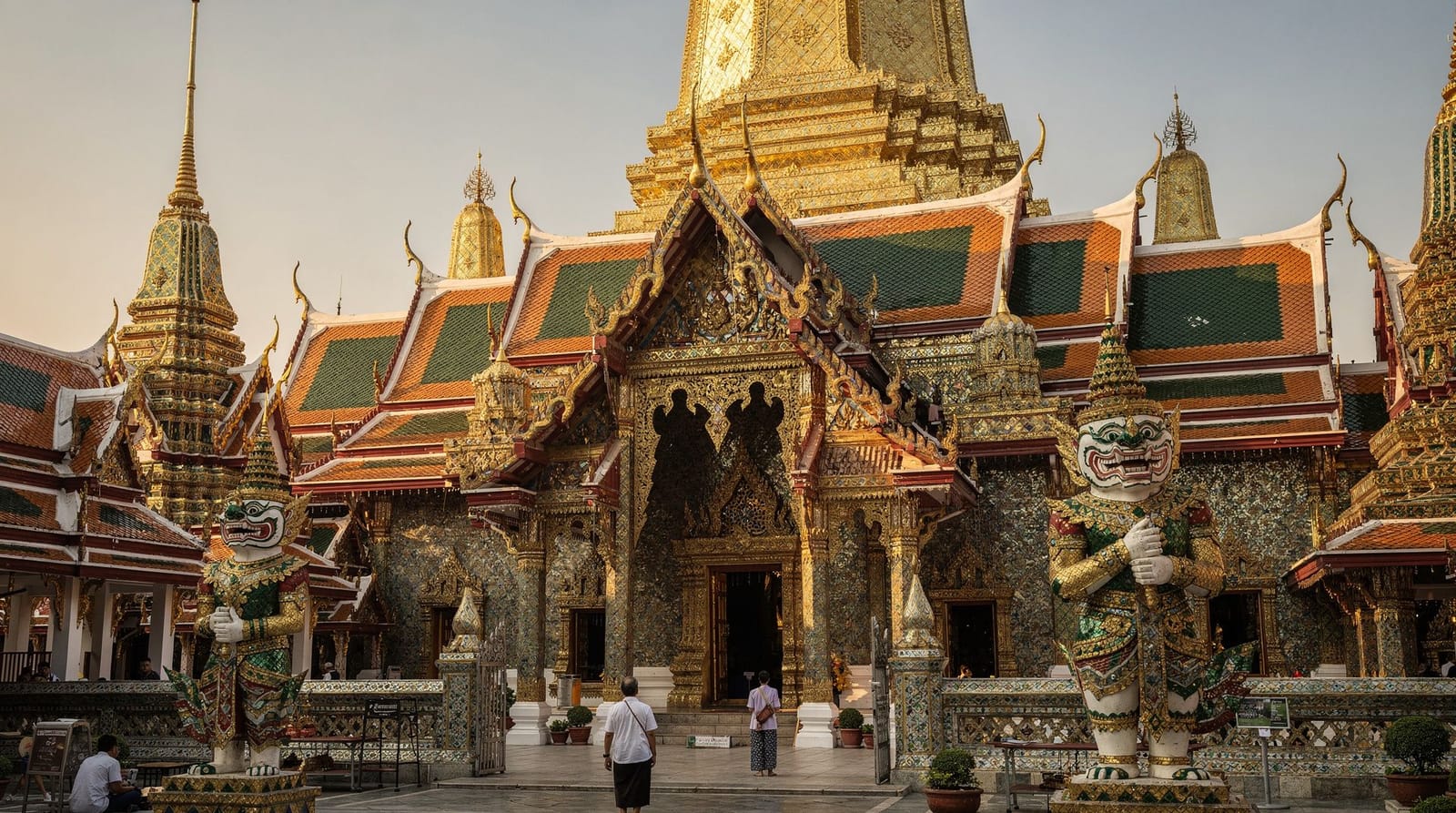
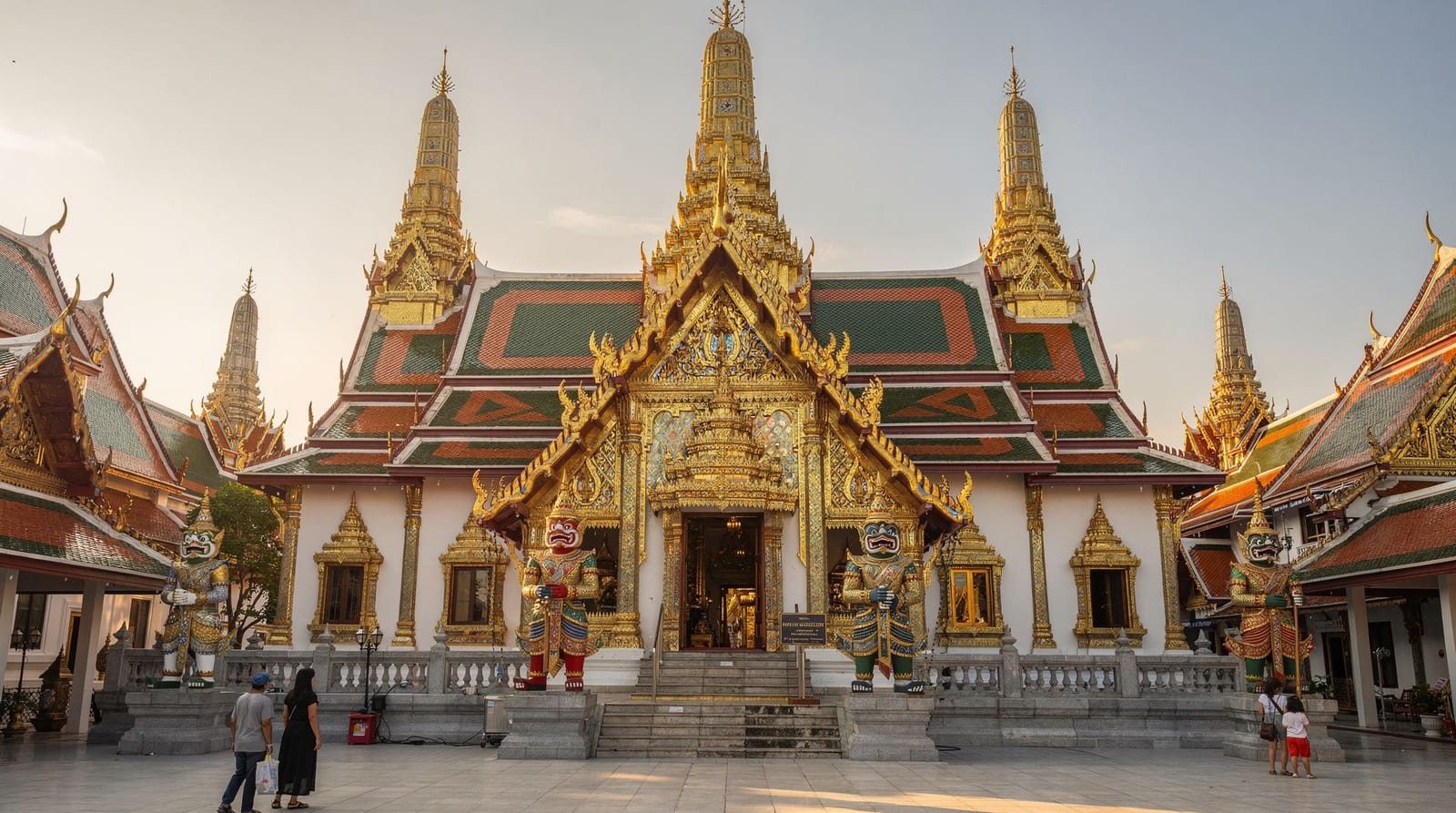
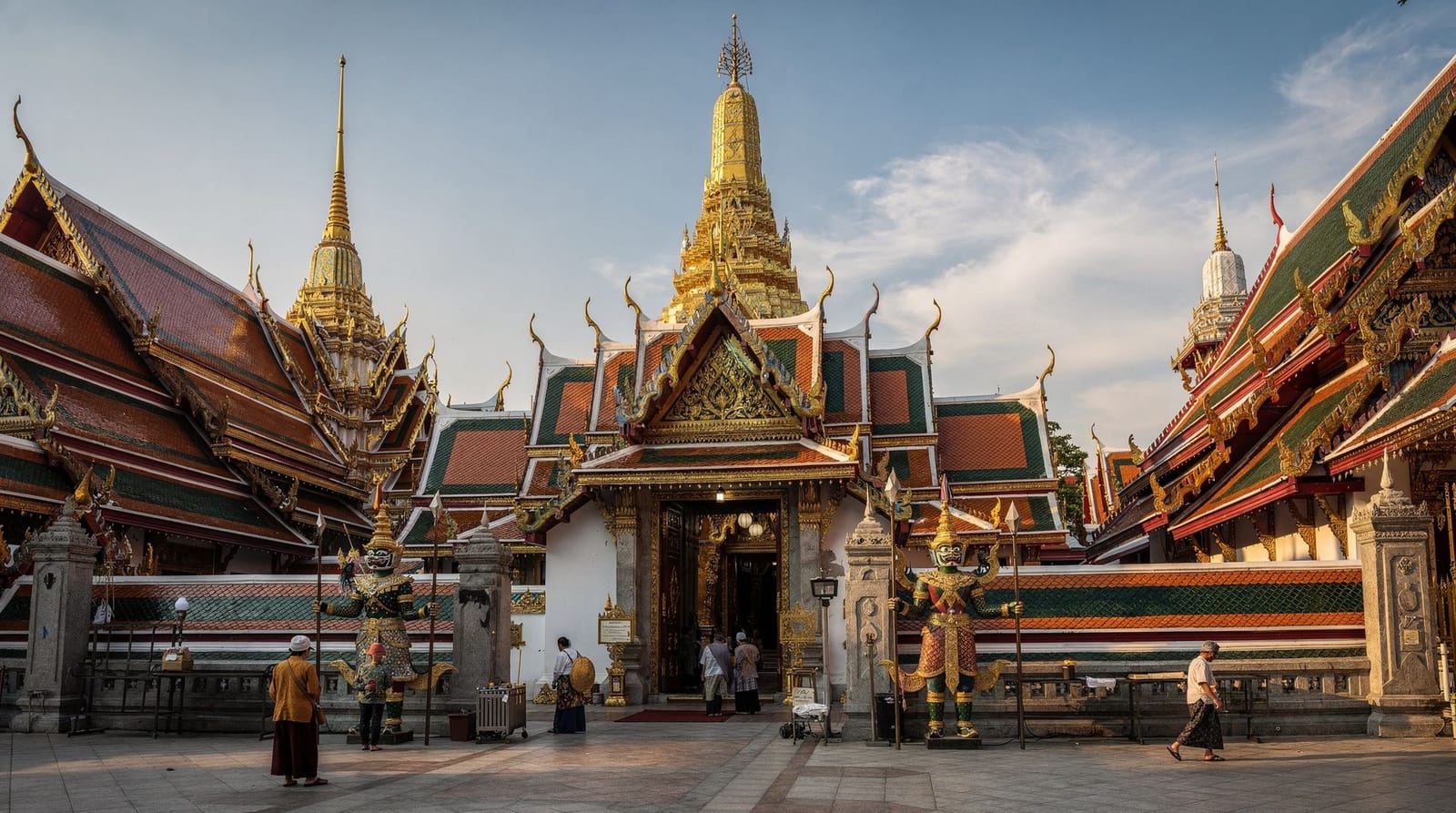
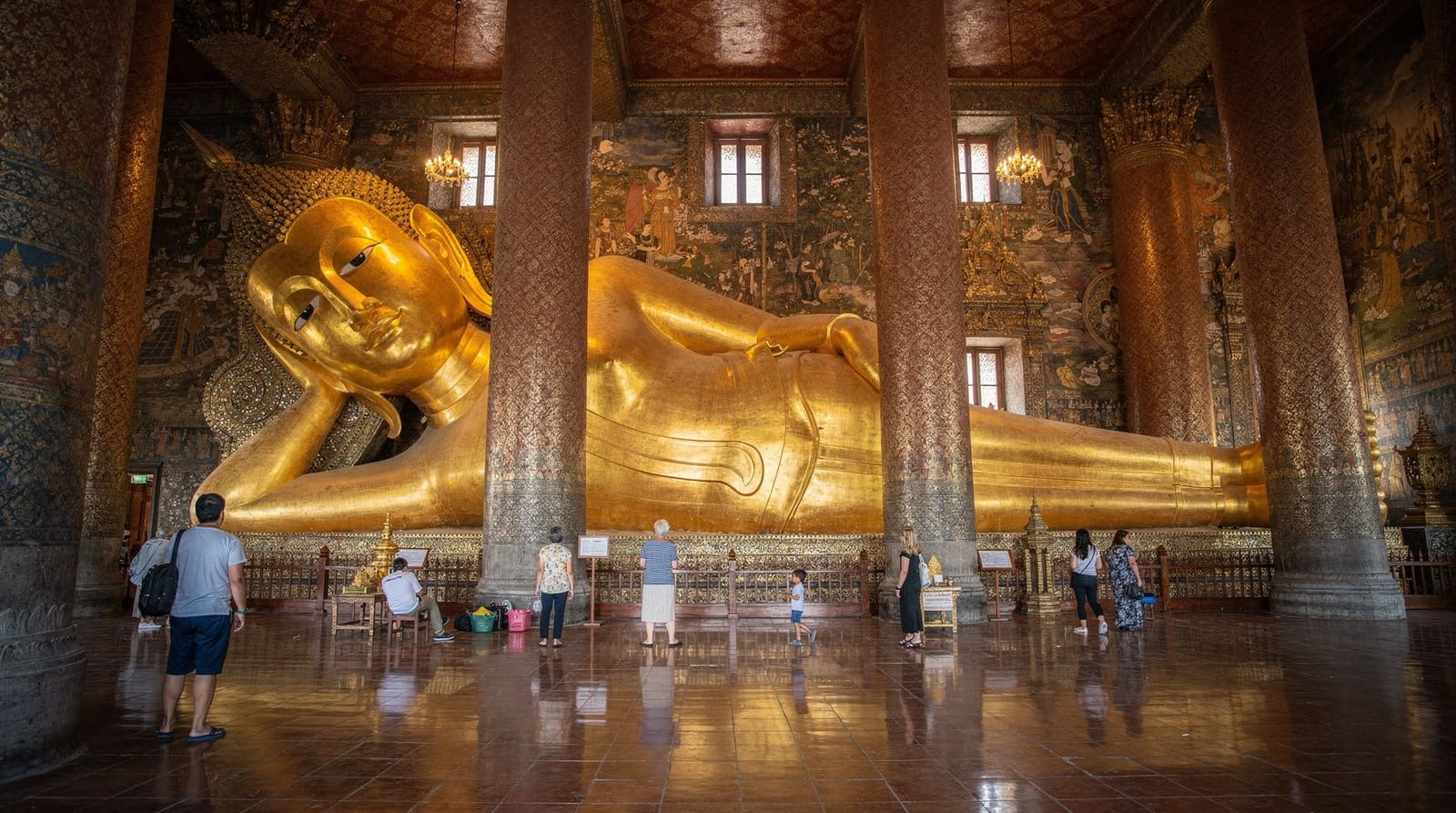
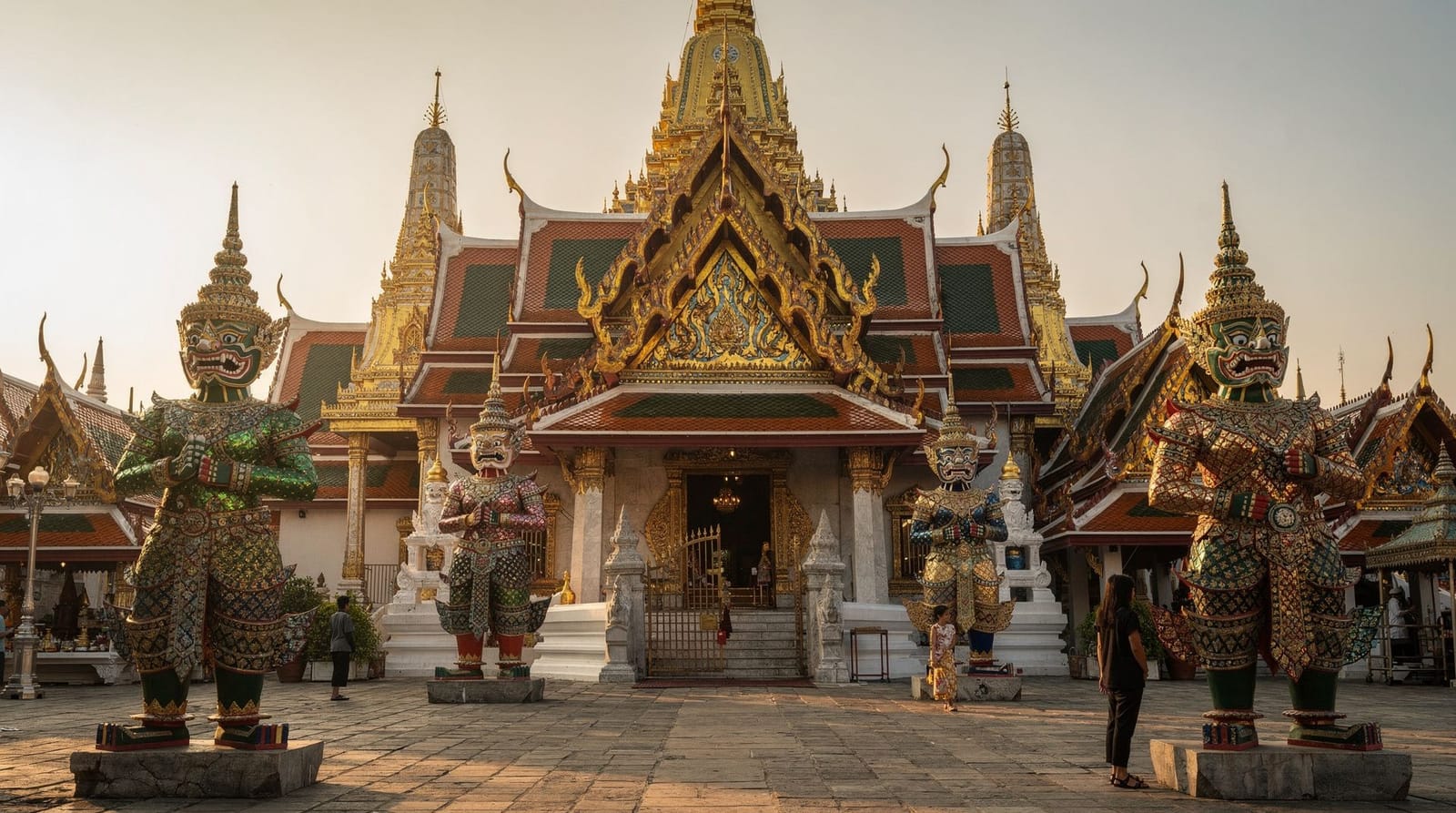
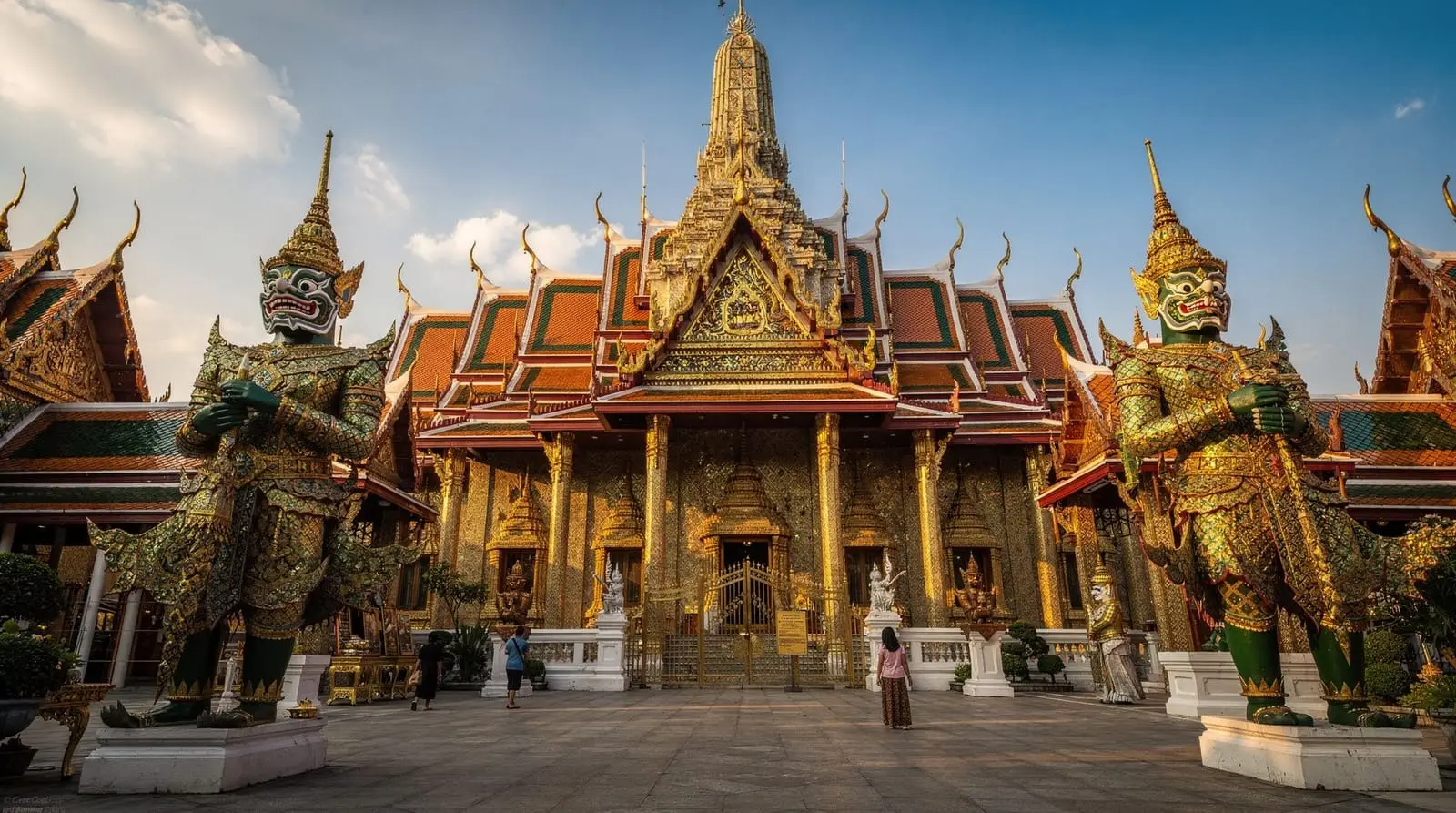
Wat Phra Kaew, inside the Grand Palace, houses the Emerald Buddha — a small jade image that is the most sacred and revered Buddha in the country, whose seasonal robes are changed by the King. Wat Pho holds the enormous gold-leafed Reclining Buddha, depicting the Buddha entering final nirvana, and is also the home of Thailand’s leading school of traditional medicine and massage, covered in the Wat Pho massage school guide. Across the river, Wat Arun, the Temple of Dawn, rises in porcelain-encrusted spires. In Chinatown, Wat Traimit holds a five-and-a-half-tonne solid gold Buddha, hidden under plaster for generations and revealed by accident. And Wat Saket, the Golden Mount, offers a working hilltop temple and a city view. Seeing several in sequence is easy with the temple hopping route and the Bangkok temples itinerary.
For Thai religious history in concentrated form, the open-air Ancient City (Muang Boran) recreates the kingdom’s great Buddhist monuments at near-full scale across a vast park you tour by bicycle.
Ancient City (Muang Boran) entry ticket — Thailand’s monuments in one parkThe Sino-Thai religious blend is best felt on foot through the shrines and temples of Chinatown and the old riverside quarters.
Chinatown and Talat Noi walking tour — temples, shrines and shophousesLearning, meditating and observing holy days
You do not have to be Buddhist to learn or even to meditate in Bangkok. Several temples and centres welcome foreigners for meditation sessions, dharma talks and short introductions to practice, some conducted in English — Wat Mahathat near the Grand Palace has long offered instruction to visitors. You need not convert or commit; sincere curiosity and respect are enough. Dress modestly, follow the centre’s guidance, and approach it as genuine inquiry rather than a tourist activity.
The Buddhist calendar centres on lunar holy days. The three major ones are Makha Bucha (February or March), Visakha Bucha (May, marking the Buddha’s birth, enlightenment and passing on the same full moon), and Asanha Bucha, which leads into the start of the three-month rains retreat (July). On these days Thais flock to temples, make merit, and join candlelit processions (wian tian) circling the temple three times, and alcohol sales are restricted across the country. Witnessing a wian tian procession is quietly moving. These holy days, along with Loy Krathong and Songkran, are mapped in the Bangkok festivals calendar.
Engaging respectfully
The single most important thing a visitor can bring to Bangkok’s Buddhism is respect, because Thai society — and Thai law — treats disrespect toward the Buddha seriously. Cover your shoulders and knees and remove your shoes at temples. Never point your feet at, climb on, sit on, or pose disrespectfully with Buddha images, and never treat a Buddha image as a decoration, a prop or a backdrop for a flippant photo; authorities have detained and deported foreigners over disrespectful Buddha tattoos and images, a sensitivity connected to the monarchy and lèse-majesté rules. Women must not touch monks. Keep your voice low, silence your phone, and lower your camera when people are praying.
Approached this way, Buddhism in Bangkok becomes one of the richest parts of a visit — not a set of rules to fear but a living tradition to witness and, in small respectful ways, to share. For how it all fits into a practical itinerary, see the things to do in Bangkok guide and the must-see first-time guide.
Two more temples that illustrate the faith
Beyond the essential shortlist, two temples reward a deeper look at how Thai Buddhism expresses itself architecturally and devotionally. Wat Benchamabophit, the Marble Temple in Dusit, shows how Thai temple design absorbed European influence in the early twentieth century while keeping its Buddhist function intact, its courtyard ringed with bronze Buddha images from across Buddhist Asia. Wat Paknam, across the river in Thonburi, pairs a genuine working monastery with a strikingly modern devotional space — a glass-domed ceiling depicting the Buddhist cosmos above a giant crystal relic. Seeing one alongside the older Rattanakosin temples shows how the faith keeps finding new architectural expression rather than standing still.
The Sino-Thai religious blend in Chinatown
The blending of traditions is nowhere more visible than in Chinatown (Yaowarat), where Buddhist temples, Chinese shrines and ancestor-worship halls sit within a few minutes’ walk of each other, often serving the same families. Incense coils burn overhead in Chinese-style temples a stone’s throw from purely Theravada wats, and festivals like Chinese New Year and the Vegetarian Festival layer Chinese religious practice onto the Thai Buddhist calendar. The Chinatown Bangkok guide covers the neighbourhood’s temples and shrines in more detail if this blend interests you.
Buddhism beyond the city: Ayutthaya
For a longer historical view, the ruined temples of Ayutthaya, the former Siamese capital a couple of hours north, show what large-scale Buddhist temple building looked like centuries before Bangkok existed — rows of headless Buddha statues and crumbling brick chedis that survived the city’s sacking in 1767. It is a sobering, different register from Bangkok’s gilded, actively used temples, and a natural day-trip extension for anyone whose interest in Thai Buddhism goes beyond a single city.
Frequently asked questions about Buddhism in Bangkok: a visitor's guide to the living faith
What type of Buddhism is practised in Thailand?
Why do monks collect alms in the morning?
What is merit-making and can visitors take part?
Do most Thai men become monks at some point?
What is a spirit house and why are they everywhere?
Can non-Buddhists meditate or learn about Buddhism in Bangkok?
What are the most important Buddhist temples to understand in Bangkok?
What Buddhist holidays are observed in Bangkok?
How should I behave respectfully toward Buddhism as a visitor?
Top experiences
Bookable activities with verified prices and instant confirmation on GetYourGuide.