Best temples in Bangkok: the complete honest guide
Bangkok: Grand Palace, Wat Pho, Wat Arun Sacred & Local Tour
What are the best temples to visit in Bangkok?
For first-time visitors the essential three are Wat Phra Kaew (inside the Grand Palace, home of the Emerald Buddha), Wat Pho (the Reclining Buddha and the birthplace of Thai massage), and Wat Arun (the river-facing Temple of Dawn). Beyond the icons, Wat Saket (the Golden Mount) gives the best free city view, Wat Traimit holds a solid-gold Buddha, Wat Benchamabophit is the marble masterpiece, and Wat Paknam in Thonburi has the now-famous green glass ceiling stupa. This guide ranks them honestly and tells you what to skip.
Bangkok has more than 400 Buddhist temples, and a visitor could spend a fortnight and not run out. But the difference between the essential temples and the rest is real, and so is the difference between an early, well-planned temple morning and a sweaty, crowded, scam-dodging slog. This guide ranks the temples that actually deserve your time, gives the real prices and hours, and tells you honestly which ones are worth a special trip and which you can skip.
| Where | mostly Rattanakosin old city and the river |
| Cost | free (Wat Paknam) to 500 THB (Grand Palace) |
| Time needed | a morning for the essential three; a full day with extras |
| Getting there | MRT Sanam Chai, river ferries, or a temple-hopping tour |
| Best time | 8:00–8:30 opening, before the tour groups and the heat |
Bangkok’s temples (wat in Thai) range from the gilded royal monuments of the old city to working neighbourhood shrines where monks chant at dawn and locals come to make merit. The four below the cut are not bad — they simply ask more of your time than they return for a first visit. The rest are organised by how essential they are.
The three essential temples — do these first
If you only have time for a handful, do these three. They sit close together in the Rattanakosin old city and along the river, and you can see all three in a single morning. A guided combo like the Grand Palace, Wat Pho and Wat Arun sacred temples tour handles the route, the entry logistics and the context if you prefer not to navigate solo.
Wat Pho, Wat Arun and the Grand Palace sit within a kilometre of one another, separated by a river crossing that costs a few baht: a three remarkable temples walking tour is the format that fits the geography, where a coach tour spends its morning parking.
1. Wat Phra Kaew & the Grand Palace — the most important
Entry: 500 THB (about USD 15), includes the Grand Palace grounds · Hours: 8:30-15:30 daily · Nearest: Sanam Chai MRT (Blue Line), or Chao Phraya boat to Tha Chang pier
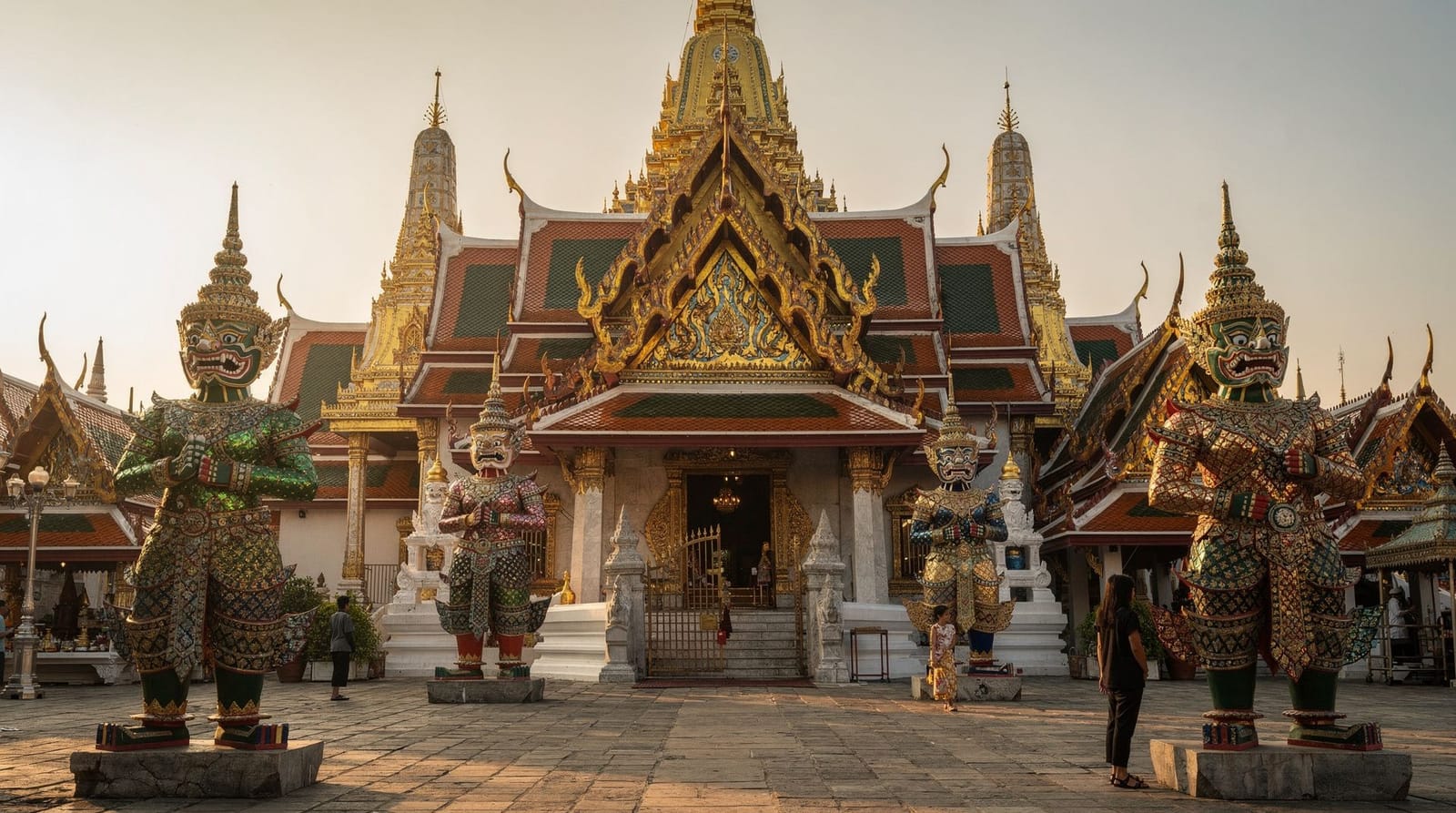
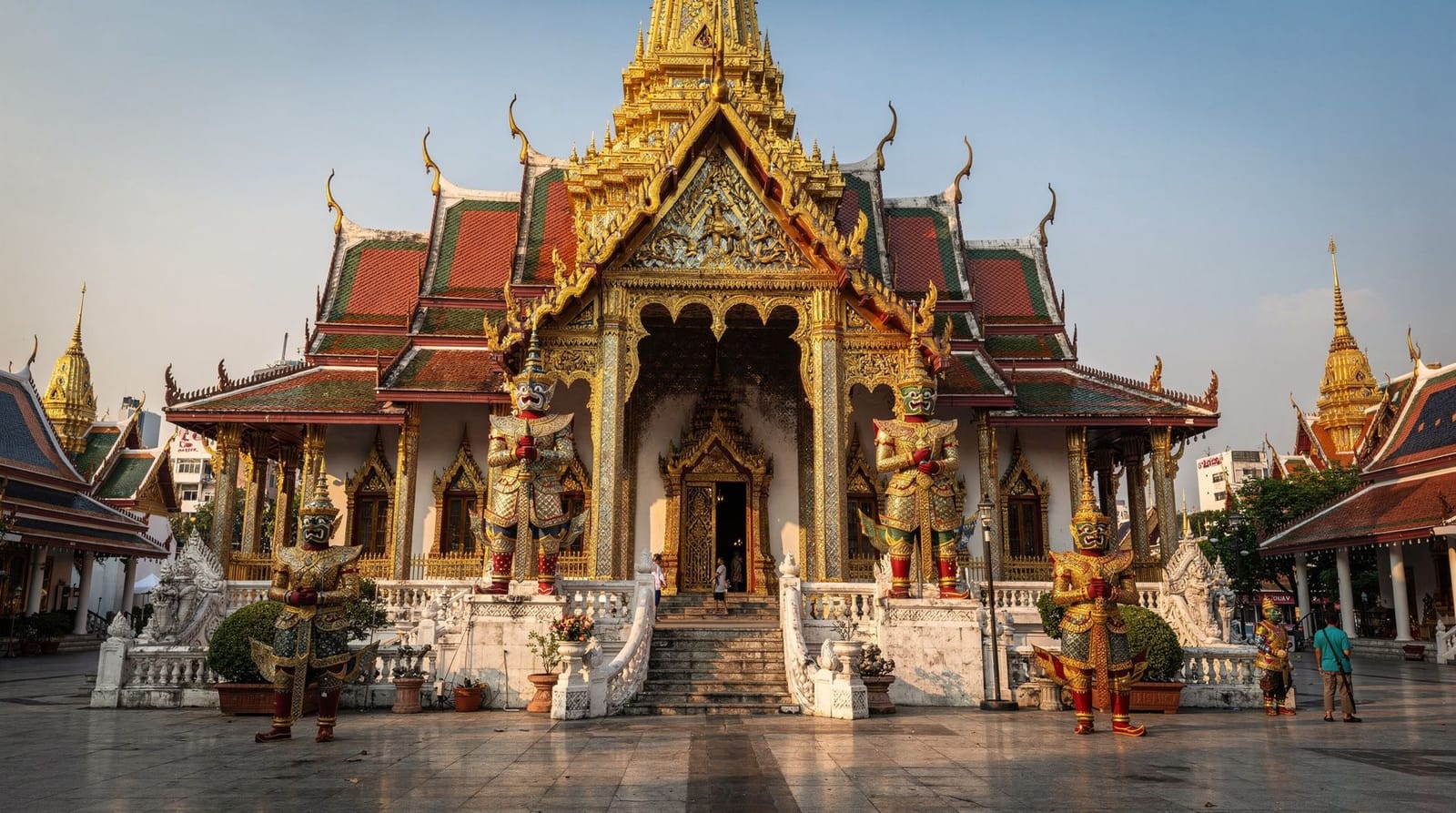
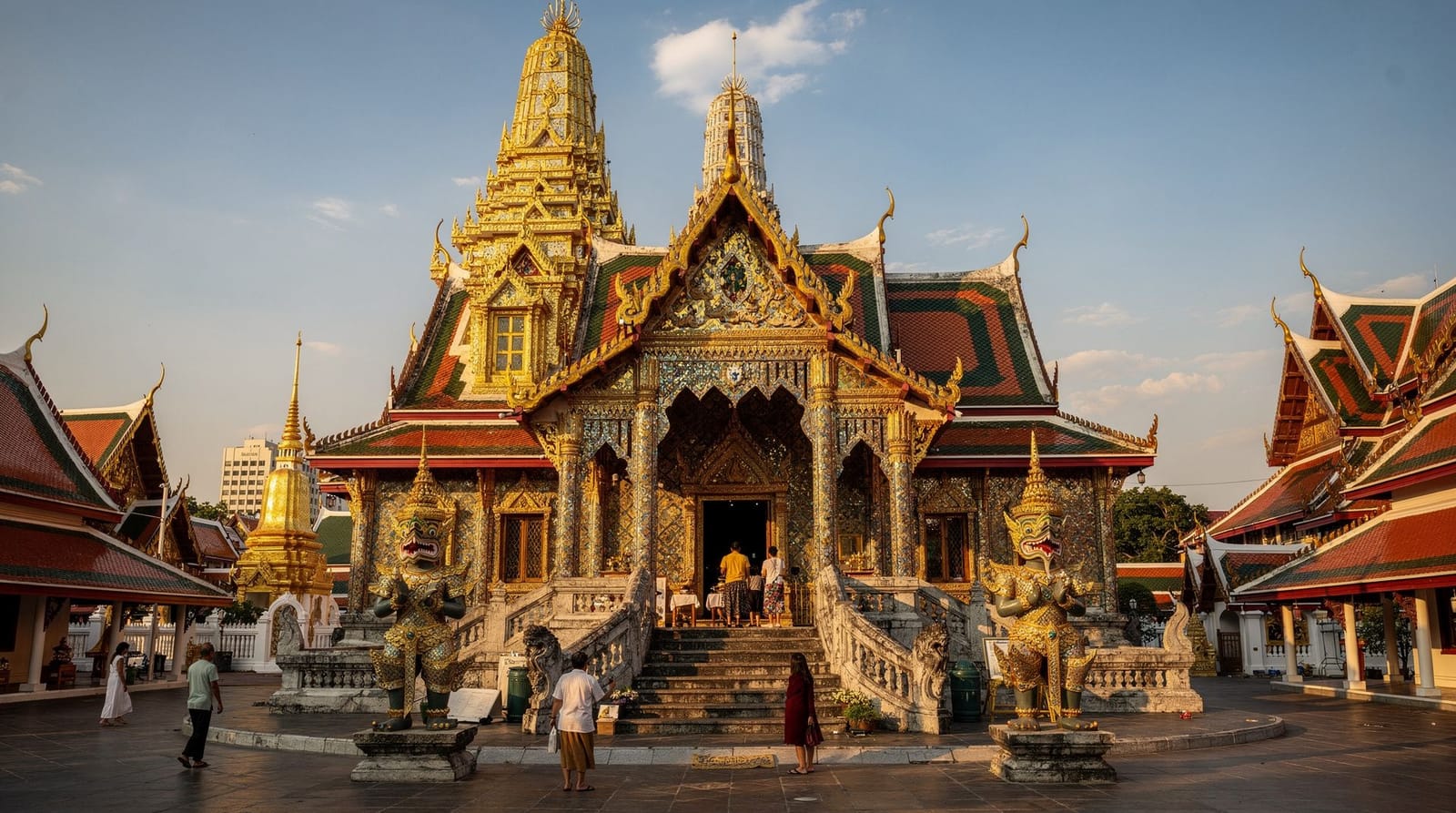
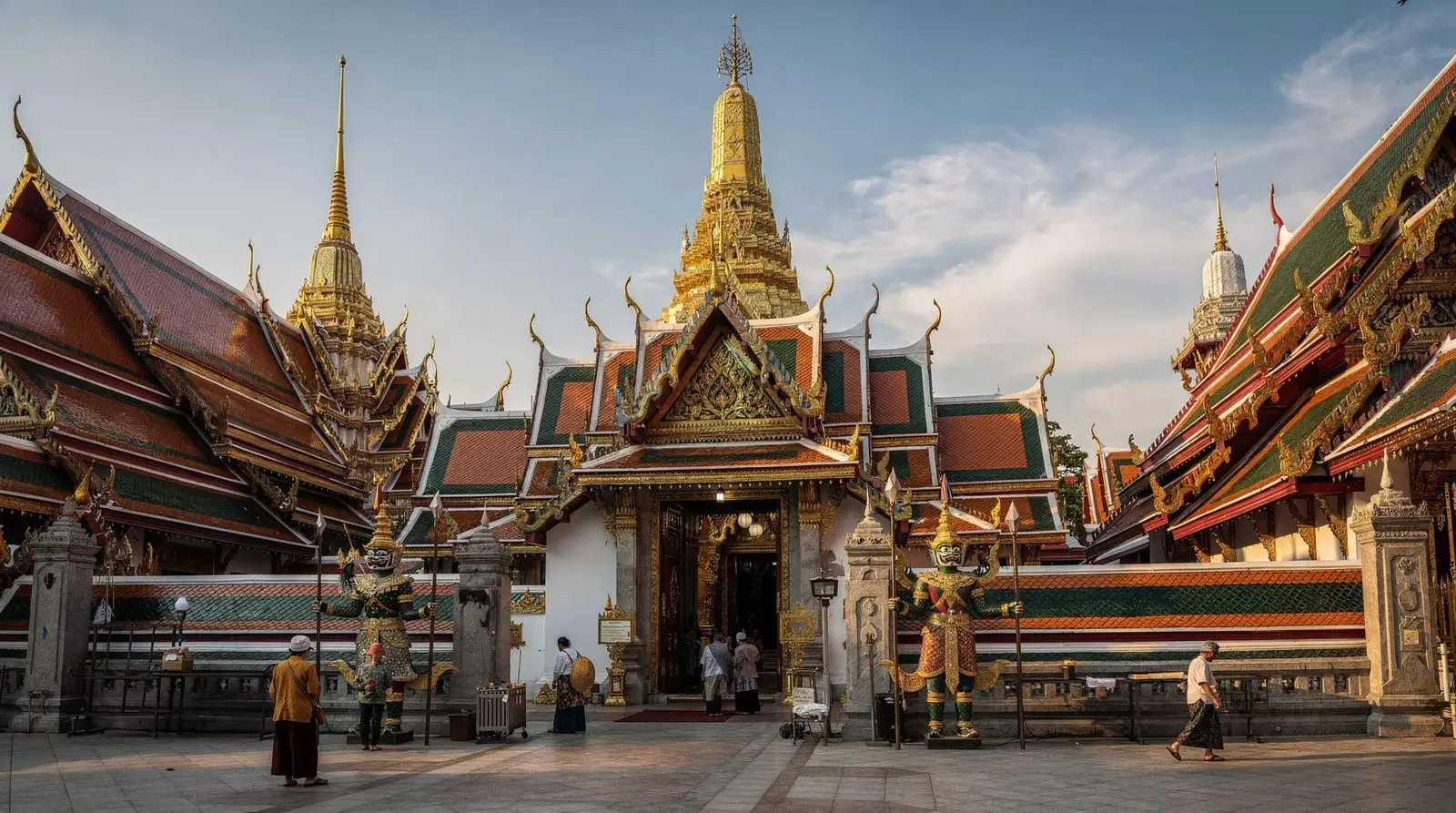
Wat Phra Kaew, the Temple of the Emerald Buddha, sits inside the Grand Palace complex and is the most sacred Buddhist site in Thailand. The Emerald Buddha itself is a 66cm jade figure on a tall gilded throne; the King changes its golden robes three times a year with the seasons. The surrounding compound is a riot of gold chedis, mosaic-covered demons, and the kilometre-long Ramakien murals.
It is also the most crowded, most expensive, and most strictly policed temple in the city. The dress code is enforced to the letter — no shorts, no bare shoulders, no ripped jeans. Arrive at opening; by 10:00 the courtyards are wall-to-wall tour groups. Full detail is in the Wat Phra Kaew and Emerald Buddha guide and the Grand Palace guide.
Honest take: Unmissable on a first visit, but manage expectations — this is a heritage spectacle, not a tranquil temple. Go early, accept the crowds, and combine it with quieter temples afterwards.
2. Wat Pho — the Reclining Buddha and Thai massage
Entry: 300 THB (includes a bottle of water) · Hours: 8:00-18:30 · Nearest: Sanam Chai MRT, 10-minute walk from the Grand Palace
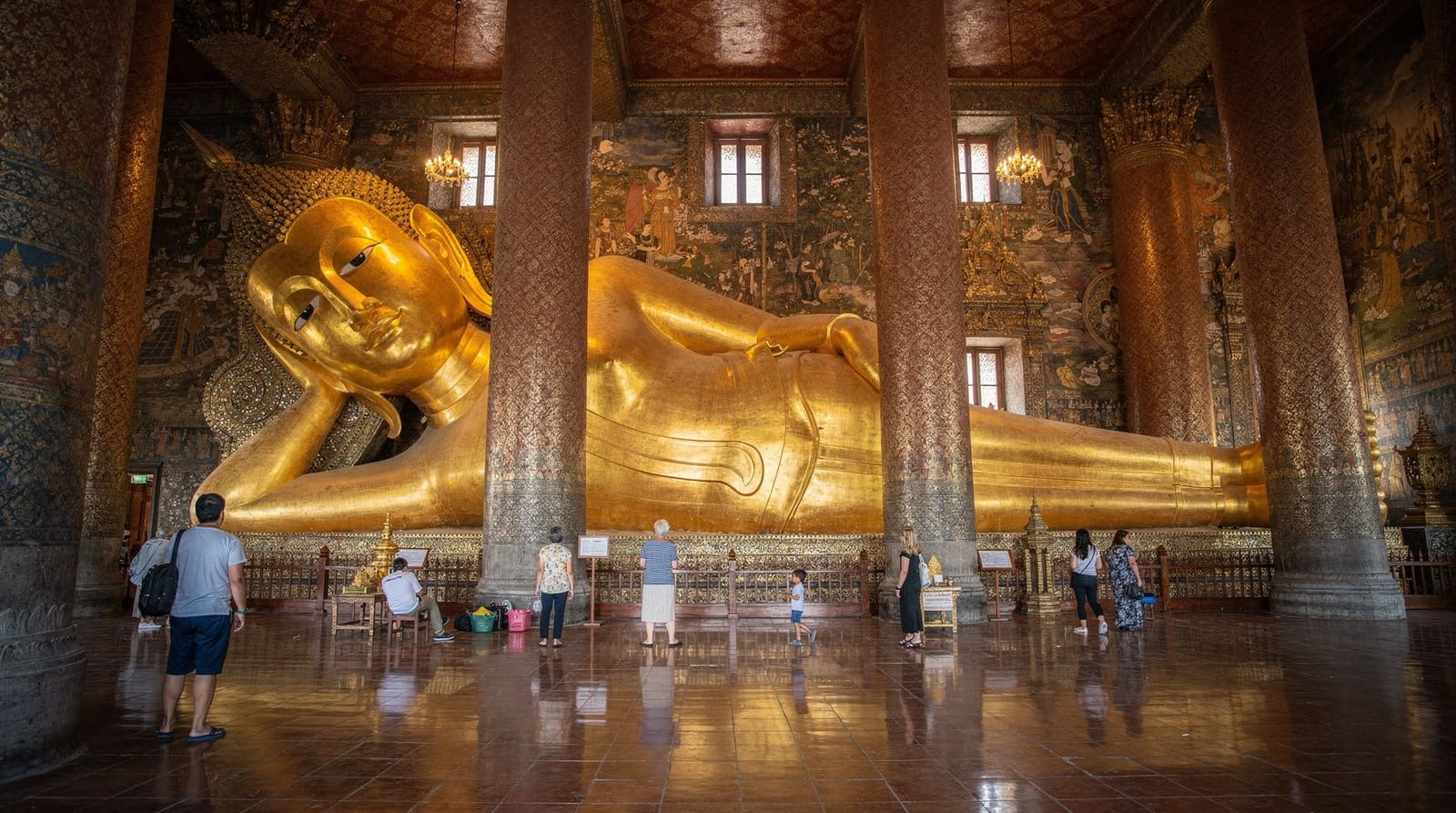
Wat Pho houses the gold-leafed Reclining Buddha, 46 metres long and 15 metres high, with mother-of-pearl soles. It is also the home of traditional Thai medicine and massage — you can get an authentic hour-long massage here from the school’s therapists. The compound is larger and far more peaceful than the Grand Palace, with 91 chedis and shady cloisters lined with Buddha images.
I rate Wat Pho the most rewarding single temple in Bangkok for most visitors: the Reclining Buddha is genuinely breathtaking, the crowds thinner, and the massage is a memorable bonus. The Wat Pho guide covers the massage booking, the foot-rubbing coin ritual, and the best photo angles.
3. Wat Arun — the Temple of Dawn
Entry: 200 THB · Hours: 8:00-18:00 · Nearest: cross-river ferry (4-5 THB) from Tha Tien pier near Wat Pho
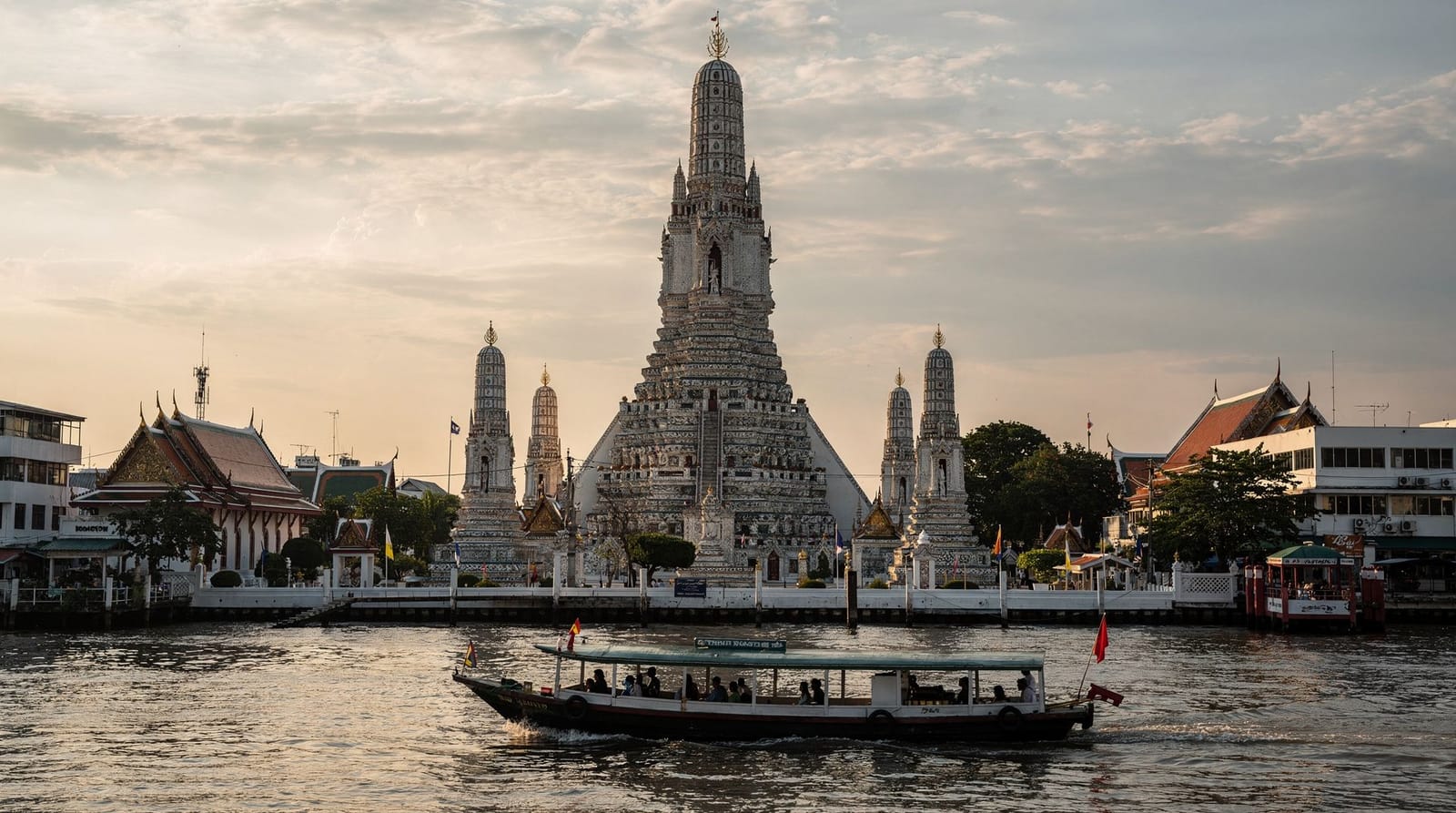
Wat Arun’s 70-metre central prang (Khmer-style spire) is encrusted with broken Chinese porcelain that catches the light. You can climb the steep lower steps for a view across the Chao Phraya. Despite the name, the best light is at sunset, photographed from the Wat Pho side of the river — the temple glows gold against the dusk.
Combine it with Wat Pho via the cross-river ferry: it is one of Bangkok’s great little journeys. See the Wat Arun guide for climbing tips and the Wat Arun photography guide for the best sunset spots.
The best of the rest — worth a special trip
Wat Saket (the Golden Mount) — best free-ish view
Entry: 50 THB for the summit · Hours: 8:00-19:00 · Nearest: Phan Fa Lilat (klong boat) or a walk from the old city
Wat Saket sits atop an artificial hill — the Golden Mount — reached by 344 winding steps past bells, gongs and shaded gardens. The golden chedi at the top holds a relic of the Buddha, and the terrace gives a 360° panorama of the old city. At 50 THB it is the best-value view in Bangkok, far cheaper and more atmospheric than the paid skyscraper decks. The annual temple fair in November (around Loy Krathong) wraps the mount in red cloth. Full detail in the Wat Saket Golden Mount guide.
Wat Traimit — the solid gold Buddha
Entry: 40 THB (temple) / 100 THB (with the heritage museum) · Hours: 8:00-17:00 · Nearest: Hua Lamphong MRT, edge of Chinatown
Wat Traimit holds a 5.5-tonne Buddha made of solid gold — the largest in the world. For decades it was hidden under plaster and only revealed in 1955 when it was dropped during a move and the stucco cracked. The Chinatown location makes it an easy pair with a Yaowarat street-food walk. See the Wat Traimit golden Buddha guide and the Yaowarat Chinatown food guide.
Wat Benchamabophit — the Marble Temple
Entry: 50 THB · Hours: 8:00-17:30 · Nearest: in the Dusit district near the old parliament
Built of Italian Carrara marble in 1899, Wat Benchamabophit is the most photogenic example of modern Thai temple architecture — symmetrical, gleaming white, with a courtyard of 52 bronze Buddha images representing different styles and eras. It appears on the back of the 5-baht coin. It is quieter than the river temples and rewards visitors who want craftsmanship over crowds. See the Wat Benchamabophit marble temple guide.
Wat Paknam — the Instagram glass stupa
Entry: free · Hours: 8:00-18:00 · Nearest: Bang Phai MRT (Blue Line), Thonburi side
Wat Paknam Phasi Charoen exploded on social media for the emerald-green glass dome inside its white 80-metre pagoda — a hypnotic cosmic ceiling painted with a Buddhist universe. The compound also has a giant seated Buddha statue visible across the rooftops. It is free, less touristed than the old-city temples, and a genuine working monastery. Go in late morning for the light. The Wat Paknam guide has the photography timing and how to reach it on the new MRT line.
Shrines worth knowing
Erawan Shrine — the city’s lucky Hindu shrine
Entry: free · Hours: 6:00-23:00 · Nearest: Chit Lom BTS, beside the Grand Hyatt Erawan
Not a Buddhist temple but a Hindu shrine to Brahma, the Erawan Shrine is one of Bangkok’s most-visited religious sites — wreathed in marigolds and incense, with traditional dancers performing for those whose wishes were granted. It sits in the middle of the Ratchaprasong shopping district and is free to visit. See the Erawan Shrine guide.
What to skip (on a first visit)
- Wat Suthat and the Giant Swing — beautiful and historic, but most first-timers run out of temple energy before reaching it. Save for a second trip.
- The endless minor wats along the old-city streets — pretty but interchangeable; one or two is plenty.
- Any temple a tuk-tuk driver insists on taking you to for free — this is the gem-scam route, not sightseeing.
How to plan your temple days
The smartest approach is to cluster temples geographically and go early. The temple-hopping route guide lays out the exact walking-and-ferry sequence, and the Bangkok temples itinerary builds it into a full day with food stops. For a structured visit with transport handled, the three major royal temples walking tour covers the essential trio on foot.
Whatever you do, read the temple etiquette and dress code guide first — getting turned away at the Grand Palace gate for bare knees is the most avoidable mistake in Bangkok.
Temple etiquette essentials
- Dress: shoulders and knees covered; shoes off in prayer halls. Carry a scarf.
- Feet: never point your feet at a Buddha image or a monk; tuck them behind you when sitting.
- Head: the highest part of the body; do not touch anyone’s head.
- Monks: women must not touch a monk or hand things directly to one.
- Photography: fine in most areas, but never pose with your back to a Buddha or climb on statues — this can lead to detention or deportation.
- Quiet: keep your voice down inside prayer halls where people are praying.
For the deeper cultural context, see the Bangkok culture guide and the monarchy respect and lèse-majesté guide.
Avoiding the temple scams
The single most common scam targets temple visitors. A well-dressed, friendly local approaches near the Grand Palace, Wat Pho or Wat Arun and says the temple is closed today — for a Buddhist holiday, a ceremony, or “monk prayers until noon.” They suggest a cheap tuk-tuk tour to lesser-known temples instead, which inevitably ends at a gem or tailor shop where the driver earns commission. The temples are almost never closed during published hours.
Just keep walking to the official ticket office. The Grand Palace scam warning, the gem scam guide and the tuk-tuk scams guide cover the full playbook. For a guided experience that removes the scam risk entirely, the guided Grand Palace, Wat Pho and Wat Arun tour takes you straight in.
Skip-the-line tickets and timing
The Grand Palace ticket queue is the single biggest time sink of a temple morning, especially December through February. A skip-the-line Grand Palace ticket bought in advance removes that queue entirely and is worth the small premium if your morning is tight. Whatever ticket you use, the Grand Palace dress code guide is worth reading the night before — being turned away at the gate for bare shoulders or the wrong trousers costs far more time than any queue, and the on-site cover-up rental is slow and often out of larger sizes.
Temple photography, done respectfully
Bangkok’s temples are among the most photogenic religious sites anywhere, but the best shots also require patience and respect. Golden light at opening flatters the gold chedis and marble courtyards far better than harsh midday sun, and the crowds are thinnest then too. The temple photography tips guide covers composition and timing across the major temples in more depth, and the Wat Arun photography guide linked above zooms in on the single best sunset shot in the city. Whatever the photo, never pose with your back to a Buddha image, climb on statues, or hold up a queue of other visitors for a shot — a temple is a place of worship first.
Free and low-cost temple days
Not every meaningful temple visit needs a 500 THB ticket. Wat Paknam and the Erawan Shrine cost nothing, and Wat Saket’s Golden Mount is 50 THB for what is arguably the best view in the old city. Stringing these together makes for a rewarding, nearly free temple day, and the wider free things to do in Bangkok guide has more no-cost ideas to pair with it if budget is a bigger factor than ticking off the headline sights.
Frequently asked questions about Best temples in Bangkok: the complete honest
How much does it cost to visit Bangkok's temples?
What is the dress code for Bangkok temples?
What is the Grand Palace closed scam?
How many temples can I see in one day?
Do I need a guide for Bangkok's temples?
What time should I visit Bangkok temples?
Can women visit Bangkok temples and approach monks?
Are Bangkok's temples worth the entry fees for foreigners?
Top experiences
Bookable activities with verified prices and instant confirmation on GetYourGuide.