Bangkok street food guide: where to eat, what to order, and how
Bangkok: Street Food Tasting Tour at Night
Where is the best street food in Bangkok?
Yaowarat (Chinatown) is the headline night-eating zone, but Banthat Thong, Bang Rak/Charoenkrung, Victory Monument and Or Tor Kor market all rival it. Most dishes cost 40–80 THB (about 1.20–2.40 USD), cash only, and the best stalls are busiest because locals trust them.
Street food is not a sideshow in Bangkok; it is the main event, and for many residents it is simply dinner. The city’s stalls, carts and shophouse kitchens turn out some of the best-value cooking on earth, usually 40–80 THB a dish (roughly 1.20–2.40 USD at about 33 THB to the dollar). This guide breaks Bangkok down by eating zone, tells you what to order and how, and is honest about the handful of traps that catch first-timers.
| Where | Yaowarat, Banthat Thong, Bang Rak, Or Tor Kor |
| Cost | 40–80 THB a dish; 250–300 THB for a full night |
| Time needed | 2–3 hours for a proper food crawl |
| Getting there | MRT Wat Mangkon for Yaowarat; BTS/MRT per zone |
| Best time | Evenings 6pm–midnight for Yaowarat; avoid Mondays |
Why Bangkok eats on the street
Bangkok, or Krung Thep, runs on a culture of eating out. Small flats with tiny kitchens, brutal heat that makes home cooking unappealing, and a deep specialist tradition mean a single vendor may have cooked one perfect dish for thirty years. That specialisation is the secret: the woman with the boat-noodle cart is not also making pad thai, so the one thing she does is honed. Follow the queues of office workers and you will eat better than at almost any sit-down restaurant. For a dish-by-dish primer on what those stalls are actually serving, pair this guide with what to eat in Bangkok.
The trade-off is that street food rewards a little planning. The legendary stalls are not evenly spread; they cluster in a handful of neighbourhoods, each with its own character and peak hours. Get the geography right and the rest falls into place.
A second thing worth understanding early: Bangkok’s street food runs on the clock as much as the map. A khao man gai cart that sells out by 2 pm is a different proposition from a guay jub shophouse that only fires up at 7 pm. Some of the most beloved vendors work a single four-hour window and then vanish; others are 24-hour institutions. Throughout this guide we flag the best window for each zone, because turning up at the wrong hour is the most common way to “miss” Bangkok street food. The dishes themselves are introduced briefly here and explored in full in what to eat in Bangkok, so use the two together: this page for where and when, that one for the deep dish detail.
The eating zones, ranked by what they do best
Yaowarat and Chinatown — the night-eating heart
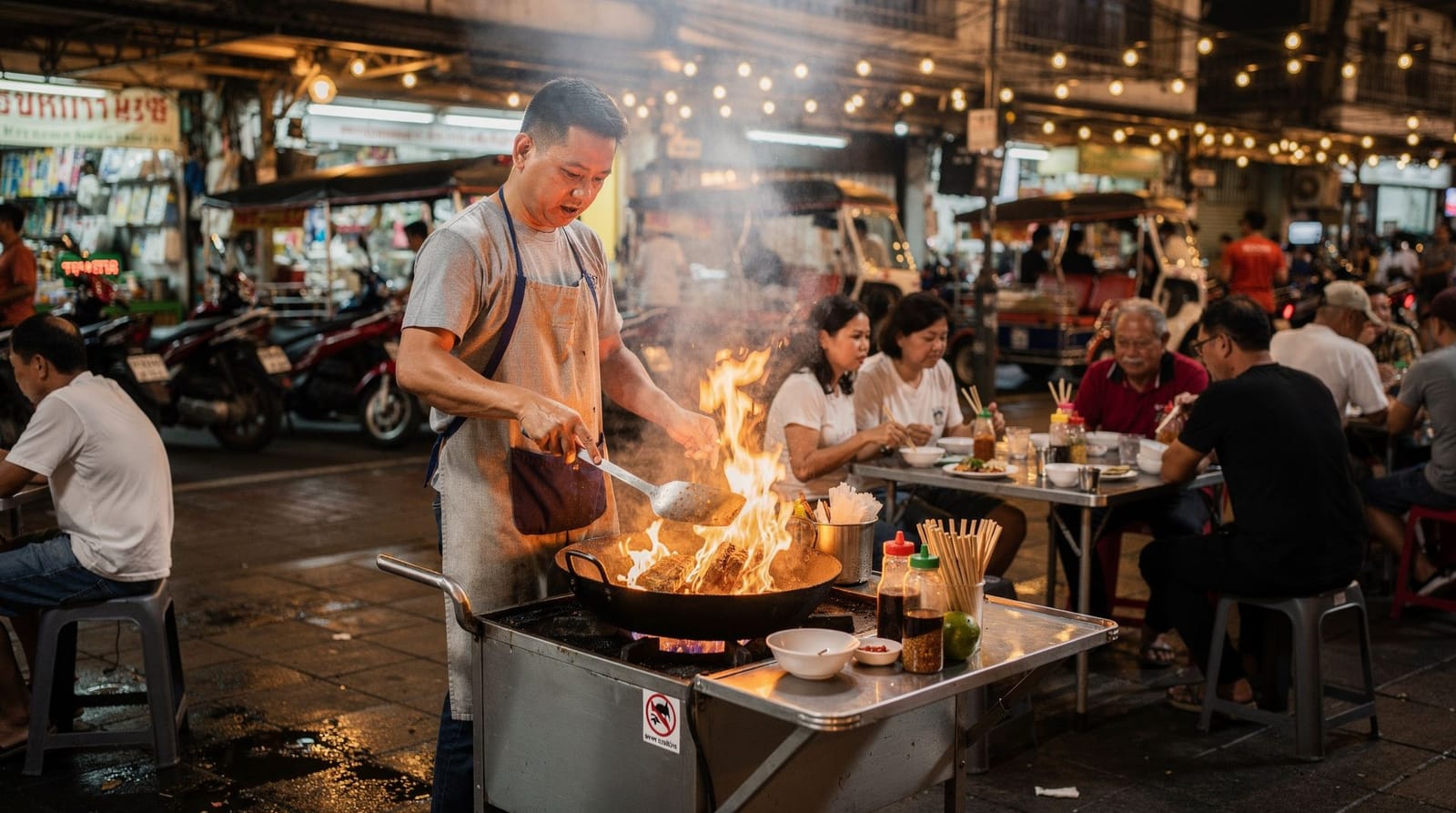
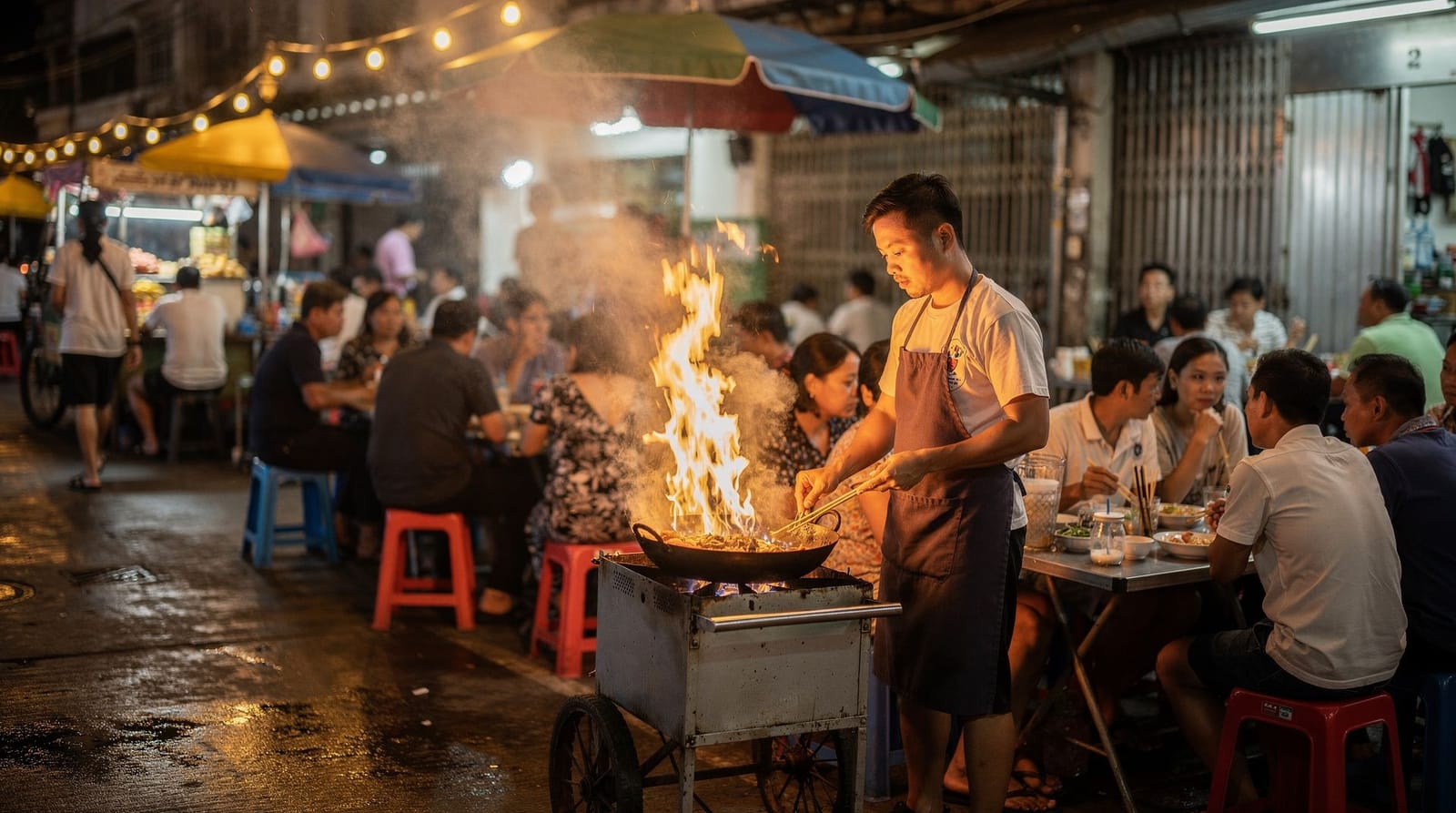
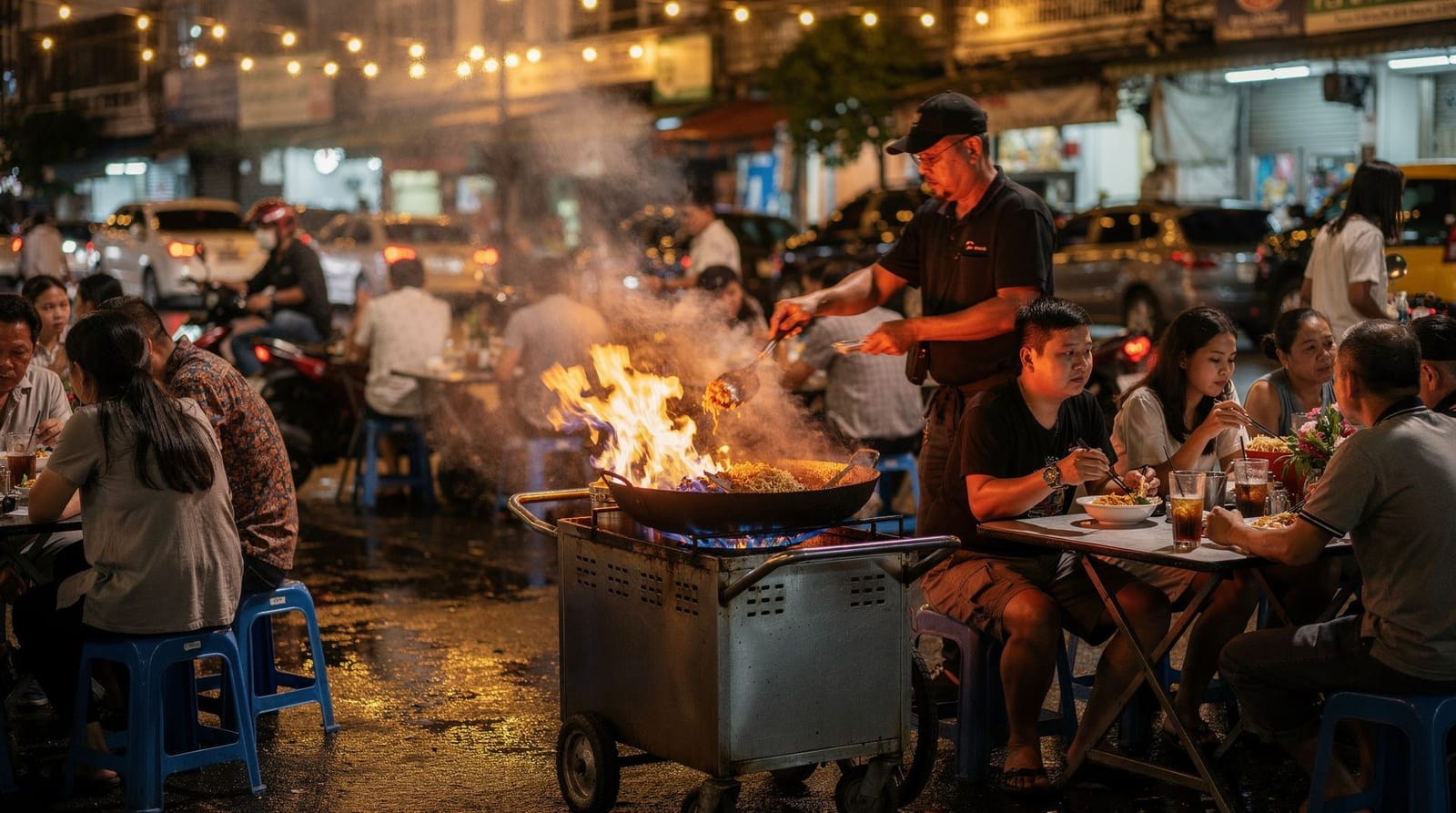
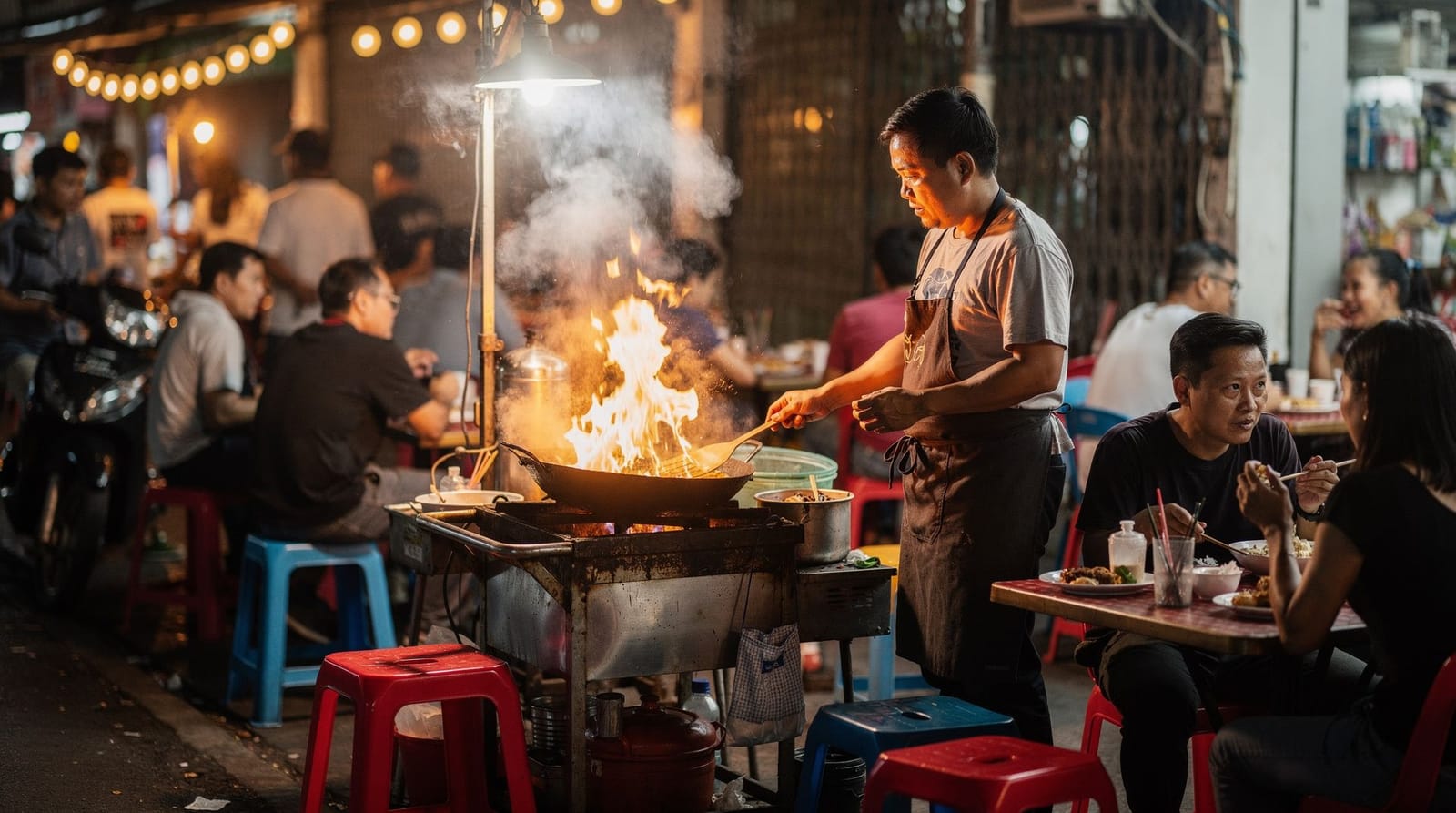
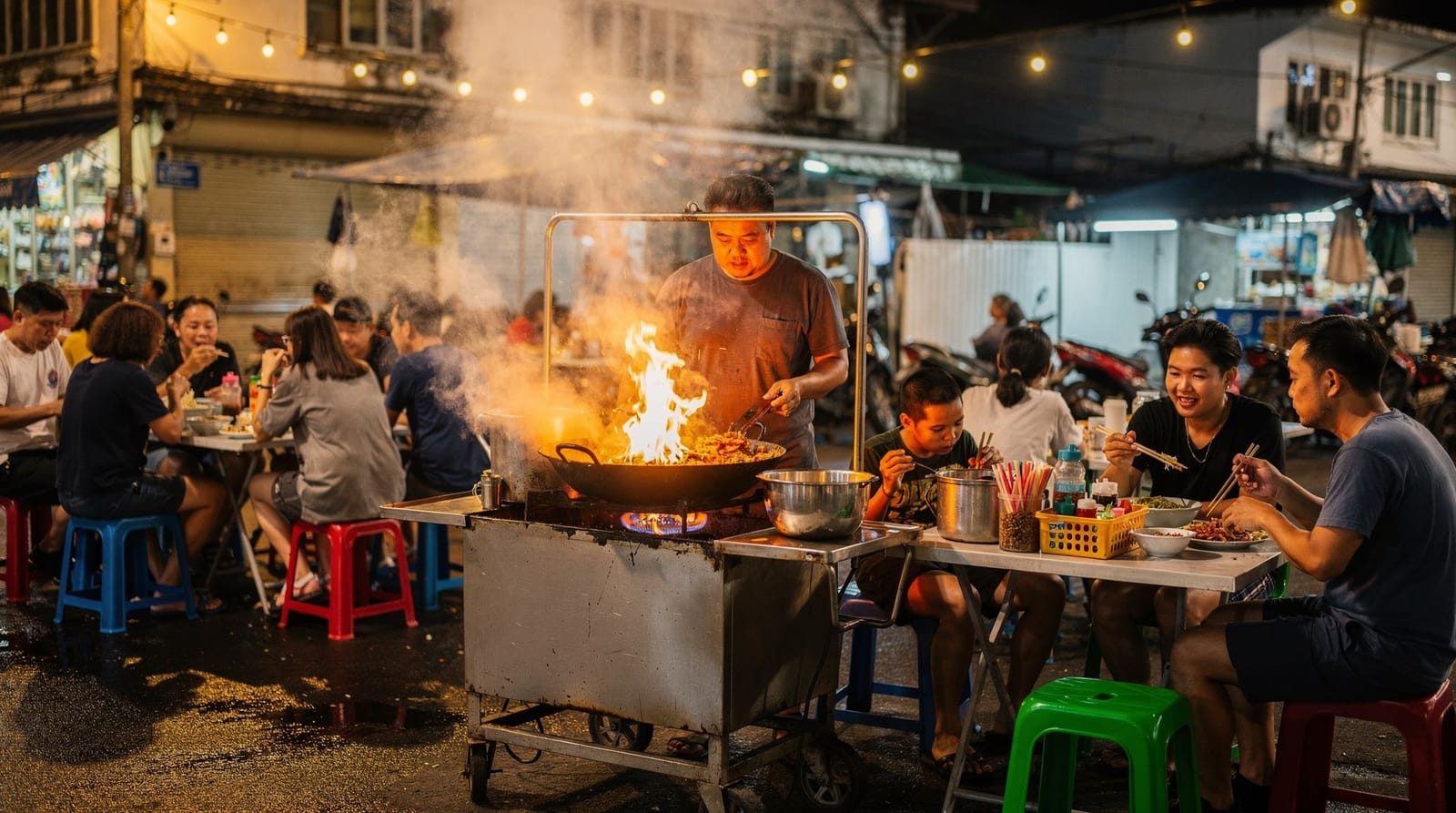
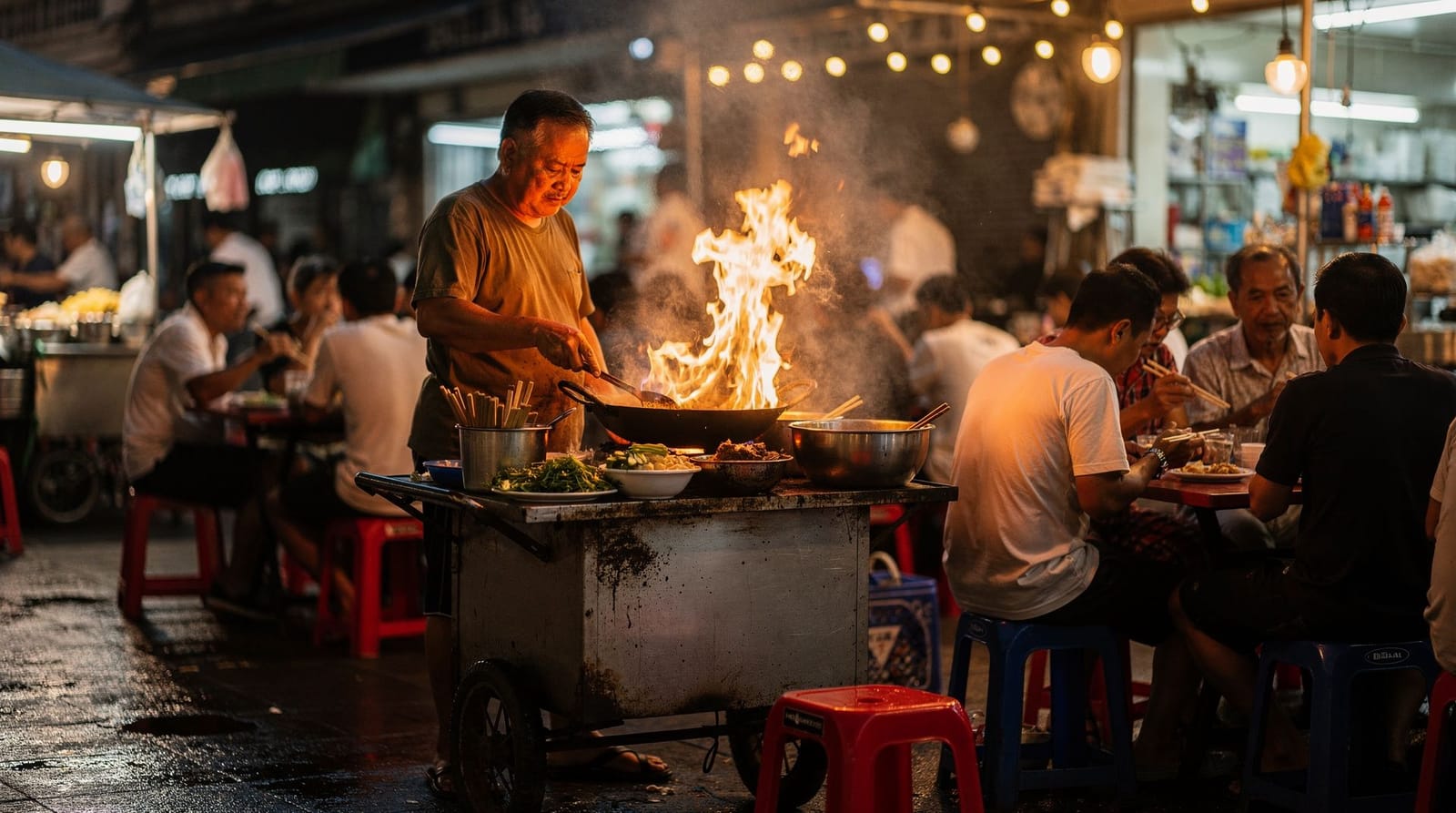
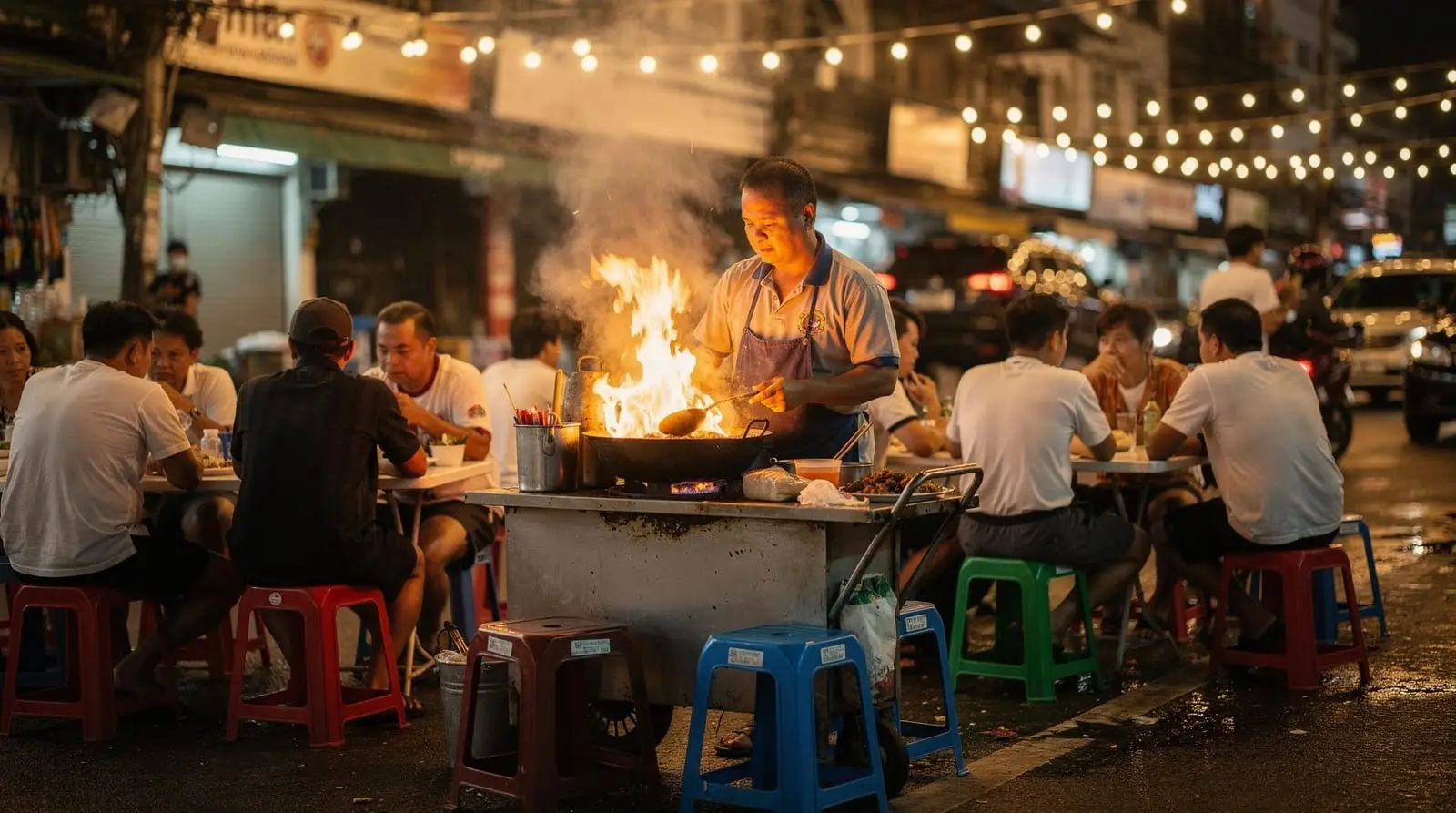
After dark, Yaowarat Road and its tributaries become Bangkok’s densest, most theatrical food scene: woks roaring on the pavement, charcoal grills, mountains of seafood on ice, durian sellers, and dessert carts that run past midnight. This is where you come for guay jub (peppery rolled-noodle soup), kuay teow (noodle soups), oyster omelettes, grilled prawns, dim sum, and the city’s best mango sticky rice. It gets crowded and a few seafood stalls aimed at tourists overcharge, so we cover the specific addresses, queues and traps in the dedicated Yaowarat and Chinatown food guide. Access is easy: MRT Wat Mangkon (Blue Line) drops you in the middle of it. Read the wider neighbourhood context in our Chinatown Bangkok guide and the Chinatown-Yaowarat destination page.
What makes Yaowarat special is density and theatre. Within a few hundred metres you can eat guay jub for a starter, queue at a Bib Gourmand noodle stall, share grilled river prawns at a pavement table, then finish with durian and mango sticky rice from carts that run past midnight. The shophouses behind the main road hide quieter dim sum kitchens, roast-duck specialists and old Chinese dessert shops serving bird’s nest and ginkgo tonics that have been here for generations. It is the one Bangkok food district that genuinely rewards wandering without a plan.
Best window: roughly 6 pm to midnight, Tuesday to Sunday (many stalls close Mondays). It is hot, loud and worth it.
Banthat Thong — the locals’ viral street
A short ride south-west of Siam, Banthat Thong Road has become the street that Bangkok food obsessives talk about. It is less touristed than Yaowarat, packed with student-priced noodle joints, grilled meats, Thai-Chinese desserts and a clutch of Michelin Bib Gourmand stalls. Prices stay honest because the crowd is local. Our Banthat Thong food street guide maps the standouts. If you only have one local-feeling food night and want fewer tourists than Chinatown, this is it. A small-group walk such as the Banthat Thong Michelin and viral eats tour is a fast way to hit the highlights without guessing which queue is worth it.
Best window: evenings, roughly 5 pm to 11 pm.
Bang Rak and Charoenkrung — old Bangkok flavours
Bang Rak, along Charoenkrung Road near the river, is one of the city’s oldest food districts and an underrated daytime-into-evening grazing zone. Expect Thai-Muslim curries and roti, old-school kuay teow, char siu and roast duck shophouses, and excellent coffee. It is calmer than Chinatown and great if you want history with your lunch. See the Bang Rak food guide and the Bang Rak and Charoenkrung destination page. BTS Saphan Taksin is the gateway, and you can pair it with a river day. To dig into the backstreets with a local, the Bang Rak and Charoenkrung 15-tasting walk covers a lot of ground.
Best window: late morning through dinner; some shophouses close mid-afternoon.
Victory Monument — boat noodles and after-work eats
The lanes around Victory Monument (BTS Victory Monument) are famous for boat noodles (kuay teow ruea): tiny, intense, dark-broth bowls served in such small portions that stacking five or ten empty bowls is the whole point. Each bowl is around 15–20 THB, so a feast is cheap. The area is also strong on grilled meats and dessert. Our boat noodles at Victory Monument guide has the specifics. This zone is busy with commuters, which keeps quality high and prices fair.
Best window: late morning to evening.
Ratchawat — quiet, serious, local
Ratchawat market and the streets around it (Dusit area, near Si Yan) are where you go to eat like a Bangkokian with almost no other tourists in sight. Think khao kha moo (stewed pork leg over rice), guay teow, kanom (Thai sweets) and excellent curry-rice stalls. It is morning-and-midday territory and a reminder that you do not need a famous name to eat brilliantly here.
Best window: morning to early afternoon.
Khao San and Banglamphu — convenient, but read the room
If you are staying near Khao San and Banglamphu, you will find food on every corner, plus the pad thai carts and grilled-insect stalls the backpacker strip is famous for. It is convenient and fun after dark, but it is also the zone where prices creep up and the no-price-seafood game is most common, so it pays to be price-aware here. Treat Khao San as a snack-and-atmosphere stop rather than your serious eating, and ride the river or the canal boat to Yaowarat or Banthat Thong for the real meal.
Best window: evening into late night.
Or Tor Kor — the premium market
Or Tor Kor (Ortor Kor), opposite Chatuchak and reached via MRT Kamphaeng Phet, is Bangkok’s upscale fresh market, repeatedly rated among the world’s best. It is not cheap by street standards, but the prepared-food hall is superb: massaman and southern curries, grilled river prawns, fruit at its peak, and some of the finest mango sticky rice in the city. Combine it with the Chatuchak weekend market on a weekend. This is the place to splurge a little on quality. See where it sits among the best food markets.
Best window: daytime, every day; pair with Chatuchak on weekends.
What to order, and how the menu actually works
Most stalls do one or two things. Learn to recognise the categories and you can order anywhere:
- Kuay teow / guay teow (noodle soups): choose your noodle (sen lek thin, sen yai wide, sen mee vermicelli, or bamee egg noodle) and your protein. Around 50–70 THB.
- Khao man gai: poached chicken on oily rice with a punchy dipping sauce, the comfort lunch of choice; see the khao man gai guide. About 50 THB.
- Pad kaprao: minced pork or chicken stir-fried with holy basil and chilli over rice, usually topped with a fried egg (khai dao). The default fast meal, 50–60 THB.
- Pad thai: better on the street than in most restaurants; the best pad thai in Bangkok guide names names. 60–80 THB.
- Som tam and grilled meats: green papaya salad, moo ping (grilled pork skewers, 10–12 THB each), gai yang (grilled chicken) and sticky rice — Isaan food, fiery by default.
- Sweets: mango sticky rice (khao niao mamuang) in season, roti, and Thai-Chinese desserts. The mango sticky rice guide finds the best.
Beyond the headliners, keep an eye out for khao kha moo (five-spice stewed pork leg over rice, around 50–60 THB), hoy tod (crispy oyster or mussel omelette), kuay teow ruea (boat noodles, tiny intense bowls at 15–20 THB), and the point-and-choose khao gaeng curry-rice stalls where you pick two or three dishes over rice for 50–70 THB — the single most efficient way to sample several Thai curries at once. For drinks, fresh-pressed orange juice (nam som khan) is 25–40 THB, Thai iced tea (cha yen) is bright orange and very sweet, and a bag of cut fruit is 20–40 THB.
Ordering vocabulary that goes a long way: aroi (delicious), mai phet (not spicy), phet nit noi (a little spicy), mai sai (without), mai ao (do not want), and always finish with khrap (men) or kha (women) for politeness. Numbers help too: nung (one), song (two), sam (three). Point if you must; vendors are used to it and welcoming, and a smile carries more goodwill than perfect tones.
A practical habit: at noodle and rice stalls, sit first, then order — someone will come to you. At grill and cart vendors, queue and point. The four-pot caddy on every noodle table (fish sauce, chilli flakes, sugar, chilli vinegar) is there for you to season your own bowl, so taste before you tip it all in.
Prices, payment and the honest cost of eating
Real numbers, mid-2026: a noodle soup is 50–70 THB, a rice plate 50–60 THB, moo ping skewers 10–12 THB each, a fruit bag 20–40 THB, a fresh juice 25–40 THB. A genuinely big street dinner across several stalls tops out around 250–300 THB per person, about 7.50–9 USD. If you are spending far more than that on actual street food, something is off. For the wider budget picture, see Bangkok travel costs and Bangkok on a budget, which doubles down on the best cheap eats.
Cash is king. Carry 20s, 50s and 100s; ATMs are everywhere but charge a 220 THB foreign-card fee, so withdraw larger amounts less often. A handful of newer stalls take Thai QR (PromptPay), but assume cash.
One more cost note: where you eat changes the price more than what you eat. The identical pad kaprao that is 55 THB at a street cart becomes 120 THB in an air-conditioned food court and 250 THB in a mall restaurant. None of those is a rip-off; you are paying for the seating and the air-con. But if value is the goal, the street and the wet markets win every time, which is why the famous stalls stay packed.
When to eat: timing the city
Street food in Bangkok has rhythms worth learning. Mornings belong to khao man gai, jok (rice congee), patongo (Thai dough sticks) with pandan custard, and the moo ping carts outside BTS stations feeding commuters. Lunchtime, roughly 11 am to 2 pm, is the office-worker rush — follow the suited crowds to the best rice-and-noodle stalls, and expect some to sell out by early afternoon. Late afternoon is quiet, a good time for markets. Evening into night is when Yaowarat, Banthat Thong and the night markets ignite, running from around 6 pm to midnight and later. Bangkok genuinely is a late-night eating city, so do not rush dinner. Sundays around Chinatown can be heaving; Mondays see many stalls closed. Plan around the dish you want most and the rest of the day arranges itself.
Hygiene, water and eating without getting sick
Bangkok street food is far safer than its reputation, and the rules are simple. Pick stalls with high turnover — a queue means fast stock rotation and fresh oil. Favour food cooked to order in front of you over pre-cooked trays sitting in the heat. Be cautious with raw or barely-cooked seafood and meat, and with cut fruit that has sat out unrefrigerated. Tap water is not potable: drink bottled or filtered only, and brush teeth with it if your stomach is sensitive. The cylindrical ice with a hole through the middle is factory-made and safe; crushed ice is usually fine too at busy spots. Our street food safety guide goes deeper on this. Carry hand gel, since stalls rarely have sinks.
Scams and overpriced traps to sidestep
Most Bangkok food vendors are scrupulously honest. The traps are predictable and easy to dodge:
- No-price seafood stalls in tourist-heavy stretches of Yaowarat and Khao San: always ask the price before ordering grilled prawns or fish, or you may get a 600 THB “market price” surprise. Stalls with clear price tags are safe.
- The tuk-tuk “20-baht tour”: a driver offers a whole-city loop for 20 THB, then steers you to a gem shop or tailor where he earns commission. Decline; it is never about the food.
- Taxi “meter broken”: insist on the meter or walk to the next cab. The BTS and MRT bypass the problem entirely; see the getting around Bangkok guide, the BTS Skytrain guide and the MRT subway guide.
- The “Grand Palace is closed today” gem scam: a friendly stranger near a temple claims it is shut for a holiday and offers a tuk-tuk to a “special” market or shop. It is not closed. Walk on. For the full list, read common Bangkok scams and Bangkok tourist traps.
None of this should scare you off. Eat where Thais eat and the worst that happens is a sweaty, joyful, very cheap dinner.
Michelin on the street: Bib Gourmand and beyond
Bangkok is one of the few cities where the Michelin Guide formally recognises street food. Bib Gourmand stalls — good food at modest prices — are scattered through Chinatown, Banthat Thong and Bang Rak, and most still charge normal street rates, which makes them a genuine bargain. Then there is Raan Jay Fai, the wok-and-goggles legend whose crab omelette (khai jeaw poo) earns a Michelin star and costs around 1,000 THB with long, slow queues; treat it as a once-in-a-trip splurge, not a yardstick for street food. Our Michelin street food guide maps the affordable wins.
If you want to taste a cluster of these in one evening without decoding the map yourself, a small-group Michelin street food tuk-tuk tour stitches several recognised stalls into a single ride. Whether that is worth it depends on your style; we weigh it up honestly in is a Bangkok food tour worth it.
Vegetarian, vegan, halal and dietary needs on the street
Bangkok street food is more accommodating than its meat-and-fish-sauce reputation suggests, but it does take a little vocabulary. Strict vegetarians and vegans should say “jay” (เจ) rather than “mai kin neua” (I don’t eat meat), since “jay” signals no meat, fish sauce, oyster sauce, egg or even garlic and onion in some interpretations — stalls displaying a yellow “เจ” flag, common during the annual Vegetarian Festival and year-round around a few dedicated vendors, cook to that standard. Our vegetarian and vegan Bangkok guide maps the reliable stalls and restaurants beyond that festival window. Halal eating is easiest in and around the Muslim quarters near Charoenkrung and in pockets of Sukhumvit, where halal-certified carts and restaurants serve everything from biryani to grilled satay; the halal food in Bangkok guide lists the trustworthy spots. Families eating with picky younger kids should lean on the milder, familiar dishes covered in the kid-friendly Bangkok food guide — fried rice, satay and plain noodle soups travel well with children who won’t touch chilli. Whatever your restriction, showing a translated card with your requirement (many phone apps generate one) works better than relying on English, which is patchy at the smallest stalls; the Thai customs and etiquette guide has more on communicating politely when language is thin.
Eating solo is completely normal here too — stalls are built around quick single-portion orders and a shared table, so there’s no awkwardness in a table for one. The solo travel in Bangkok guide has more on eating and moving around the city alone with confidence.
Coffee carts and the dessert scene beyond mango sticky rice
Street eating in Bangkok isn’t only savoury. A newer wave of independent coffee carts has spread through Ari, Talat Noi and the sois off Sukhumvit, serving proper espresso alongside the classic sweetened cha yen for a fraction of café prices — the Bangkok coffee scene blog post tracks where that wave is strongest. For dessert beyond mango sticky rice, look for khanom babin (coconut pancakes cooked on a hotplate), tub tim krob (crunchy water chestnut in coconut milk with crushed ice), and the retro-market dessert stalls found at night markets like the Rod Fai train night market, which pairs vintage stalls with food carts in a nostalgic, photogenic setting. None of this needs to be planned in advance — the best approach is simply to leave room after dinner and follow whichever cart has the longest queue of Thai regulars. The atmospheric back lanes of Talat Noi are a particularly good hunting ground for this newer wave, mixing century-old shophouses with a handful of the coffee carts and dessert stalls that have made the neighbourhood a minor food destination in its own right over the past few years.
Putting it together: a sample street-food night
A satisfying first night: start in Chinatown around 6 pm via MRT Wat Mangkon. Graze guay jub and grilled prawns on Yaowarat, queue at a Bib Gourmand noodle stall, then close with mango sticky rice or fresh durian. Total spend with a couple of drinks: rarely over 350 THB. To weave food through a whole trip, follow the Bangkok foodie itinerary, or fold a food night into the broader Bangkok 3 days plan. First-timers should also skim Bangkok for first-timers for the basics that make eating out frictionless.
Frequently asked questions about Bangkok street food guide: where to eat, what to order, and how
How much should a street food meal cost in Bangkok?
Is Bangkok street food safe to eat?
Do I need cash for Bangkok street food?
What does mai phet mean and how do I order less spicy?
When is the best time to eat street food in Bangkok?
Are the Michelin street food stalls worth it?
Should I book a guided street food tour or go solo?
Top experiences
Bookable activities with verified prices and instant confirmation on GetYourGuide.