Bangkok's coffee scene snuck up on me
I did not come to Bangkok for the coffee. For years it never crossed my mind — Bangkok was about street food and temples and 25-baht iced cha yen, the sweet orange Thai tea, gulped from a plastic bag. And then, somewhere over the last several years, I started noticing that the city had quietly grown one of the most interesting specialty coffee scenes in Asia, hidden in shophouses and side sois, pouring single-origin beans from the northern Thai hills with a seriousness that took me completely by surprise. Now a slow cafe morning is one of my favourite Bangkok rituals. Here is how the scene snuck up on me, and where to find it.
| Where | Ari, Bang Rak/Charoenkrung, Talat Noi, Thonglor/Ekkamai |
| Cost | Around 90–180 baht specialty, 20–30 baht traditional street |
| Time needed | A relaxed morning, 2–3 hours for a proper crawl |
| Getting there | BTS Ari or Thonglor/Ekkamai; walk or short Grab for the river districts |
| Best time | Before 9am, ahead of the laptop crowd and the heat |
From oliang to single-origin
To understand the surprise, you have to know where Bangkok coffee started. The traditional version is oliang — dark, sweet, intense iced coffee brewed with a cloth filter, often blended with corn or sesame, sold from carts for 20 to 30 baht — and cha yen, the orange iced tea. Both are wonderful in their way and still everywhere. But layered on top of that, in the last decade, has come a wave of third-wave specialty cafes obsessing over origin, roast and extraction, often showcasing Thai beans grown in the cool highlands around Chiang Mai and Chiang Rai, where coffee was introduced as a crop replacement for opium. The result is a city where you can drink a 30-baht street oliang in the morning and a 180-baht single-origin pour-over of Thai-grown beans in the afternoon, and both feel completely authentic. The hidden gems guide nods to this, but the coffee scene deserves its own pilgrimage.
Ari: the cafe heartland
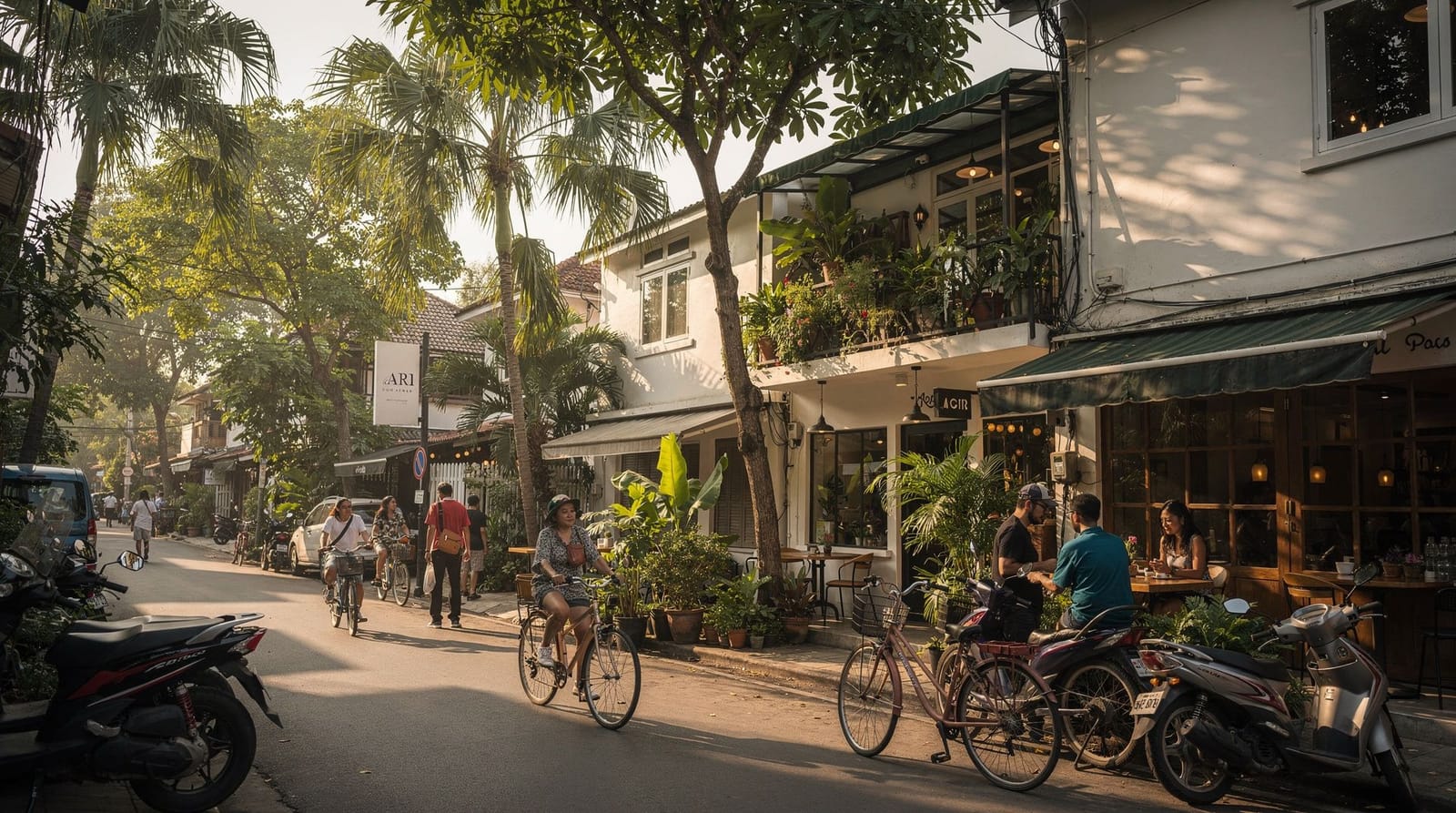
If Bangkok’s coffee scene has a capital, it is Ari, a leafy, low-rise neighbourhood a couple of BTS stops north of the Siam crush. Ari is dense with independent cafes — minimalist shophouse roasteries, plant-filled corner spots, design-conscious places where the barista talks you through the bean’s tasting notes. I can happily spend a whole morning drifting from one to the next, a flat white here, a pour-over there, working or just watching the neighbourhood. The Ari neighbourhood guide names the best of them, and it is the single best area in the city for a deliberate cafe crawl. Prices sit around 90 to 180 baht for a specialty coffee, which on a 35-degree afternoon buys you world-class caffeine and blessed air-conditioning in one.
Bang Rak and Charoenkrung: coffee meets old Bangkok
Down by the river, Bang Rak and Charoenkrung have become an unlikely creative hub, and the coffee here comes wrapped in atmosphere. Cafes occupy beautifully restored old shophouses and converted heritage buildings along Charoenkrung Road, the city’s oldest paved street, often doubling as art spaces or design studios. Drinking a careful pour-over in a century-old shophouse with the ceiling fans turning is a particular Bangkok pleasure, and the neighbourhoods guide explains how this district reinvented itself. It pairs perfectly with a wander through the area’s galleries and old-Bangkok streets.
Talat Noi: coffee among the rust
My favourite coffee atmosphere, though, is in Talat Noi, the old riverside district of car-parts shops and street art near Chinatown. Here, tiny independent cafes hide among the rusting engine workshops and crumbling Sino-Portuguese mansions, some of them riverside, some tucked down lanes you would never find without wandering. There is something perfect about a precise, modern flat white served in a setting of beautiful decay, and the Talat Noi guide maps the lanes where the best of them hide. Combining a coffee crawl here with the area’s street art is one of my favourite low-key Bangkok afternoons.
What to order
A few notes for the specialty cafes. Ask whether they roast Thai beans and try one if they do — the northern Thai single-origins, often washed and floral or honey-processed and fruity, are the whole point of the scene and a genuine local product. A pour-over or filter coffee best shows off a good bean; an espresso-based flat white or latte is the safer, milkier option. Many cafes also do excellent cold brew, which is a blessing in the heat. And do not skip the traditional side entirely — a 25-baht oliang from a street cart, or a cha yen poured over ice, is part of the city’s coffee story too and shockingly good for the price.
One small ordering note that trips up newcomers: if you order plain “coffee” at a traditional cart you will get it sweet and milky by default, because Thai coffee culture assumes sugar and condensed milk unless told otherwise. At specialty cafes the opposite holds — they will let the bean speak and add nothing. And do try a dirty, the cold-milk-and-fresh-espresso drink that has become almost a signature of the Bangkok third-wave scene; a good one, with the espresso pulled straight onto cold milk over ice, is one of the genuinely great hot-weather coffees anywhere, and most cafes here do it well for around 100 to 130 baht.
A practical Ari cafe-crawl plan
Because people always ask me how to actually do it, here is the morning I run in Ari. I take the BTS to Ari station, which puts me right at the mouth of the neighbourhood, and I start early — by 9am, before the heat and before the laptop crowd claims every seat. I do a first proper coffee at a roastery on or just off Soi Ari, a pour-over to wake the palate, then walk the leafy sois doing one drink at a time: a flat white at the second stop, maybe a cold brew at the third when the day warms. I keep it to three or four cafes across two to three hours, because more than that and you are just jittery and you stop tasting anything. Between coffees the neighbourhood itself is the reward — low-rise streets, plant-filled shopfronts, breakfast spots doing jok and khao tom if you need ballast. Budget maybe 400 to 600 baht for a morning of good coffee, and treat the air-conditioning between stops as half the point on a 35-degree day. The Ari neighbourhood guide and the wider Bangkok neighbourhoods guide fill in where to eat around the coffee.
A cafe morning as a travel strategy
Beyond the coffee itself, I have come to use the cafe scene as a way to experience Bangkok’s neighbourhoods. Picking an area — Ari, Bang Rak, Talat Noi — and crawling slowly from cafe to cafe is a low-key, air-conditioned, deeply pleasant way to absorb the texture of a part of the city you might otherwise rush through. It is the antithesis of the temple-march, and it has shown me a more relaxed, creative, local Bangkok than any guidebook circuit. If you want a guided angle on the same neighbourhoods, a Jim Thompson and Baan Krua walk reveals the creative side of the city, but honestly, a flat white and a willingness to wander is all the structure you need.
For those who want to fold coffee into a wider exploration, a Jim Thompson House and Baan Krua community walk takes you through the kind of creative, low-rise neighbourhood where Bangkok’s best cafes thrive.
Why the heat made me a coffee convert
There is a practical, almost embarrassing reason the coffee scene won me over, and it is the weather. Bangkok in the afternoon is a wall of heat, and for years my survival strategy was to duck into whatever mall offered the nearest blast of air-conditioning. Specialty cafes turned out to be a far better refuge: cooler in tone, quieter, often beautiful, and pouring something worth lingering over rather than a food-court compromise. A pour-over became my excuse to sit still for forty minutes in the worst of the heat, somewhere with character, watching a neighbourhood I would otherwise have rushed through. The cafe scene, in other words, solved a real problem the city poses to every visitor — what to do between roughly 1pm and 4pm when being outdoors is genuinely unpleasant — and solved it with grace. That is part of why it stuck for me where it might not in a temperate city: here, a good cafe is not just a treat but a tactic.
The heritage-building angle, deepened
The more I dug into the scene, the more I realised the best of it is wrapped around old Bangkok rather than glass towers. Along Charoenkrung in Bang Rak and through the lanes of Talat Noi, cafes have moved into century-old Sino-Portuguese shophouses, former printing works, and converted warehouses, often sharing the building with a gallery or a design studio. The coffee is the excuse; the architecture is the reward. Drinking a careful cup under a slow ceiling fan, surrounded by patina that no developer could fake, is a particular pleasure that the newer Ari roasteries, lovely as they are, cannot quite match. The Talat Noi guide, the riverside Bangkok guide and the hidden gems list all wind through this part of the city, and pairing a coffee crawl with the street art and old shophouses here is one of my favourite low-key afternoons anywhere in Bangkok.
Thonglor and Ekkamai: the newer, design-forward wave
The scene keeps expanding, and the newest cluster worth chasing is Thonglor and Ekkamai, the upscale neighbourhood a couple of BTS stops from Ari’s laid-back sois. Cafes here lean glossy — polished concrete, imported machines, elaborate signature drinks alongside the straight pour-overs — and prices run a touch higher, closer to 150 to 220 baht. It is a different mood from Ari’s shophouse charm: less neighbourhood ritual, more destination cafe, often shared with the area’s boutiques and design studios. I go when I want a proper sit-down work session with reliably fast wifi rather than a wandering crawl. The Thonglor nightlife guide covers the same strip after dark, if you want to bookend a coffee afternoon with an evening out.
Bringing the beans home
Once the scene had its hooks in me, I started buying bags of Thai-grown beans to take home, and most of the better roasteries in Ari and Talat Noi sell their own beans by the bag, usually 250 to 450 baht for a decent-sized bag, whole or ground to order. Ask for a northern Thai single-origin if you want something distinctive rather than a generic house blend, and check the roast date, since freshness varies a lot between shops. It has become my favourite Bangkok souvenir — cheaper than most, genuinely local, and it keeps the trip going for a few more weeks every morning at home.
The surprise that stuck
Bangkok’s coffee scene snuck up on me, and now I plan around it — a cafe morning in Ari, an afternoon pour-over in a Talat Noi shophouse, a 25-baht oliang from a cart between sights. In a city already famous for feeding you better than almost anywhere on earth, the rise of genuinely excellent coffee feels almost greedy. If you arrive expecting only street food and sweet iced tea, prepare to be ambushed by a flat white good enough to rival any in the world, served in a shophouse you will not want to leave.
The neighbourhoods compared
| Neighbourhood | Vibe | Price range | Best for |
|---|---|---|---|
| Ari | Leafy, laid-back shophouse roasteries | 90–180 baht | A slow morning cafe crawl |
| Bang Rak/Charoenkrung | Heritage buildings, creative hub | 100–200 baht | Coffee wrapped in old-Bangkok atmosphere |
| Talat Noi | Rust, street art, riverside | 80–150 baht | Atmosphere over polish |
| Thonglor/Ekkamai | Upscale, design-forward | 150–220 baht | Work sessions, fast wifi |
Frequently asked questions about Bangkok’s coffee scene
Where is the best coffee in Bangkok?
Ari is the cafe heartland, dense with specialty roasteries; Bang Rak and Charoenkrung pair coffee with restored heritage buildings; and Talat Noi hides excellent cafes among rusting workshops and street art near Chinatown.
How much does specialty coffee cost in Bangkok?
A specialty coffee in a third-wave cafe runs around 90 to 180 baht. Traditional street oliang and cha yen, by contrast, cost just 20 to 30 baht and are excellent value in their own right.
Is Thai coffee any good?
Yes. Beans grown in the cool northern highlands around Chiang Mai and Chiang Rai are increasingly excellent, often floral or fruity single-origins, and many Bangkok specialty cafes proudly roast and serve them.
What is the best Bangkok neighbourhood for a cafe crawl?
Ari, a couple of BTS stops north of Siam, is the densest and easiest, with independent roasteries clustered along leafy sois. For coffee wrapped in heritage atmosphere, Bang Rak and Charoenkrung and the lanes of Talat Noi are the most characterful.
What should I order at a Bangkok specialty cafe?
Ask if they roast Thai beans and try a pour-over to taste the single-origin properly. In the heat, a dirty or a cold brew is hard to beat. And do not overlook the traditional 25-baht street oliang, which is excellent in its own right.
Are Bangkok cafes a good place to work or escape the heat?
Yes, they are one of the best afternoon refuges in the city — cooler, quieter and more characterful than the malls, with strong air-conditioning and, in many, fast wifi. A pour-over is the perfect excuse to sit out the brutal 1pm to 4pm stretch in comfort.
Can I build a whole day around Bangkok’s coffee scene?
Yes, and it slots naturally into a wider eating day — a cafe crawl in the morning, street food for lunch and dinner. The foodie itinerary folds a coffee stop into a broader day of eating well.
Is Thai coffee a good souvenir to bring home?
Yes. Most good roasteries in Ari and Talat Noi sell their own beans by the bag, whole or ground, for 250 to 450 baht. It sits well alongside the usual picks on the best souvenirs list, and it is one of the few souvenirs you will actually use daily once home.
For more on the neighbourhoods where the scene thrives, the Ari neighbourhood guide, the Talat Noi guide, the silom and sathorn guide and the where to stay in Bangkok guide are all useful, alongside the getting around Bangkok and BTS skytrain guide for hopping between cafe districts.