Banthat Thong food street: Bangkok's viral student eating strip
Bangkok: Michelin Tastes & Viral Eats – BanthatThong Food Tour
What is Banthat Thong food street and is it worth it?
Banthat Thong is a late-night food strip near Chulalongkorn University that went viral for Jeh O Chula's Mama tom yum noodles (Michelin Bib Gourmand) and Pe Aor's tom yum goong noodles. It is open late, genuinely good and well priced (most dishes 60–200 THB), but the queues are real. Take MRT Sam Yan.
Banthat Thong Road is the food street that Bangkok’s internet decided to love. A few years ago it was a quiet strip of student-priced noodle joints next to Chulalongkorn University; now it is a nightly viral pilgrimage, anchored by Jeh O Chula’s Michelin Bib Gourmand Mama tom yum and a clutch of late-night stalls that draw queues down the pavement. The good news: the food is genuinely excellent and still fairly priced, with most dishes 60–200 THB (about 2–6 USD at 33 THB to the dollar). The catch is the waiting. Take MRT Sam Yan and come hungry, late, and patient.
| Where | Banthat Thong Road, next to Chulalongkorn University |
| Getting there | MRT Sam Yan (Exit 2) for the south end; BTS National Stadium for the north end |
| Cost | Around 60–200 THB a dish; 250–450 THB for a full grazing night |
| Best time | Evening into late night, ideally a weeknight |
| Booking | No booking possible — only patience for the Jeh O queue |
What Banthat Thong actually is
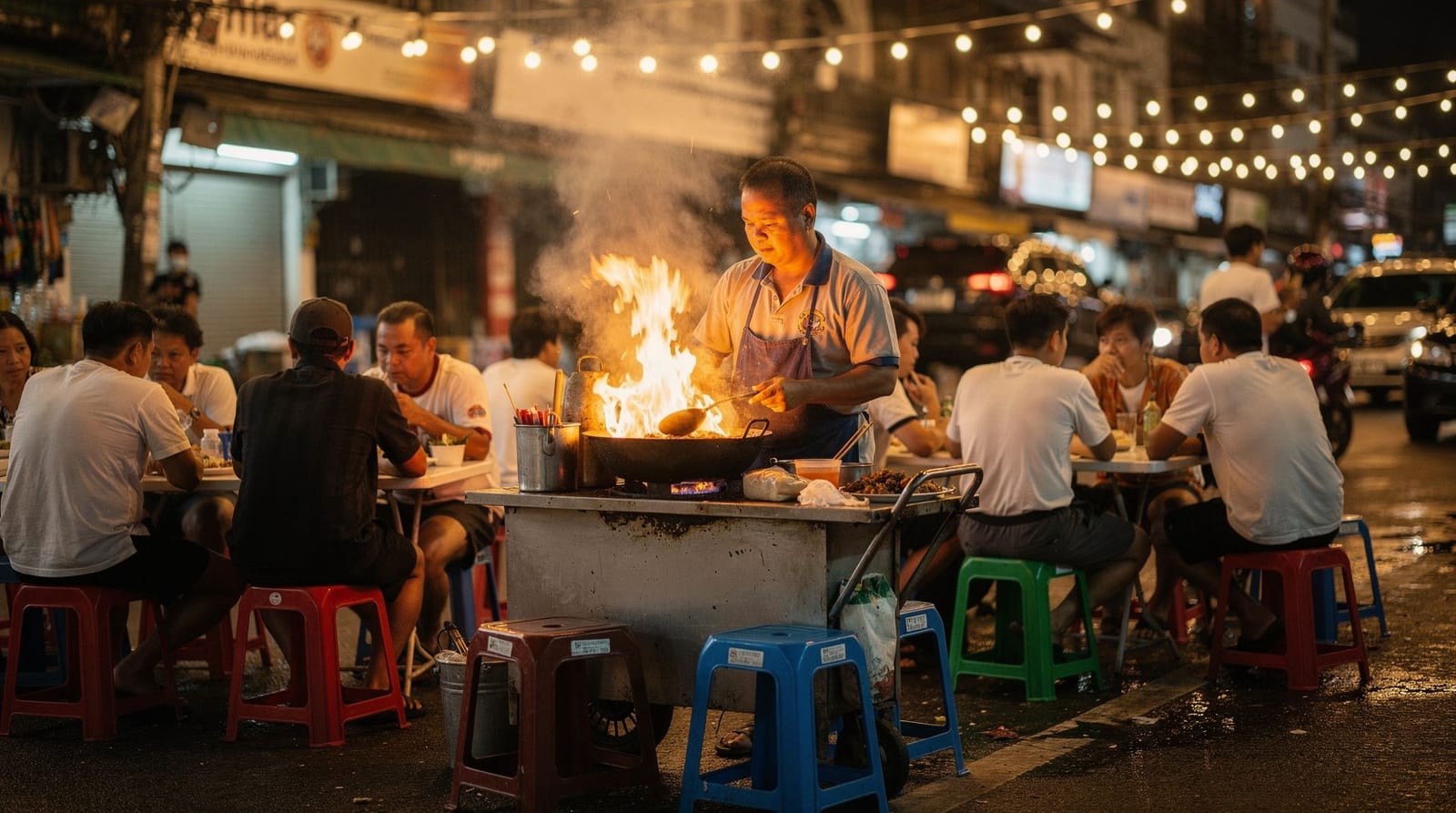
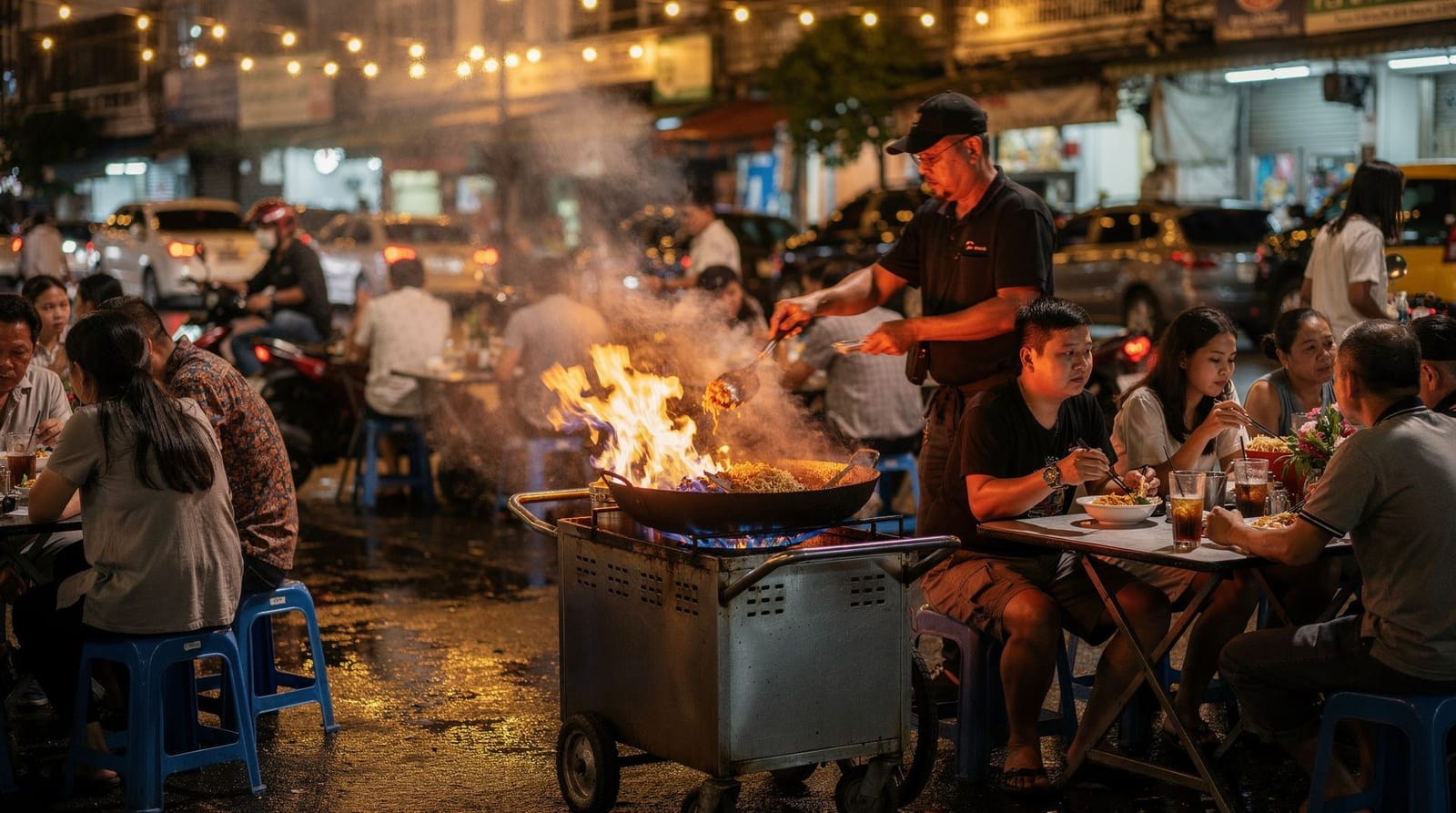
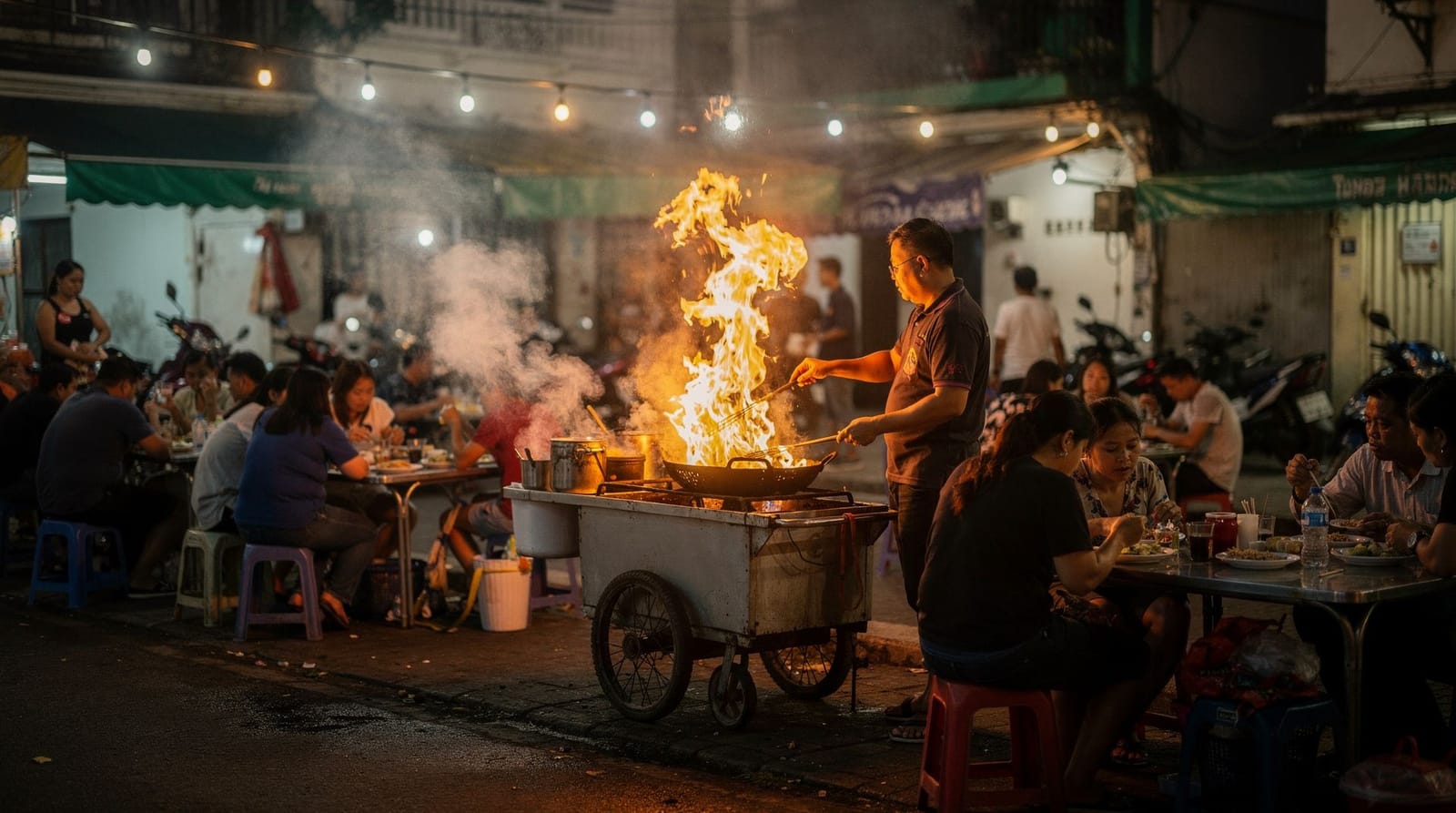
Banthat Thong Road runs near Chulalongkorn University, which is the key to understanding it. This is a student street first and a tourist phenomenon second, so prices stayed honest even as the cameras arrived. By day it is unremarkable; after dark it transforms into one of the city’s most concentrated open-late food strips, packed with tom yum noodle specialists, mookata (Thai barbecue-hotpot), grilled meats, hotpot, bingsu and dessert shops, all serving a young, local crowd.
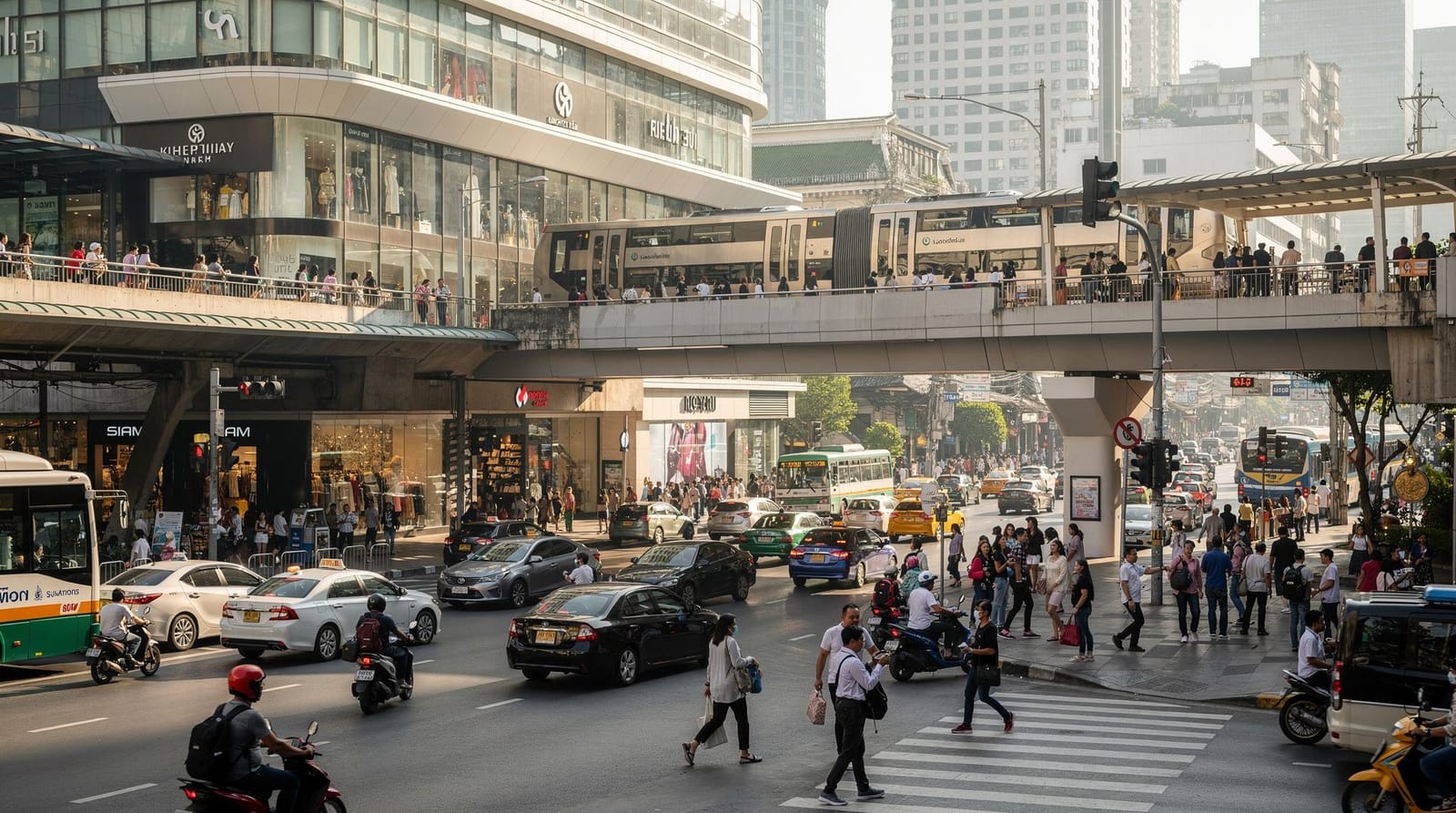
It sits a short ride south-west of Siam, in the orbit of the Siam and Ratchaprasong destination shopping district but a world away in feel. For the wider picture of how it fits Bangkok’s eating map, our Bangkok street food guide ranks it against Yaowarat and Bang Rak, and the Michelin street food guide explains why several stalls here carry the Bib Gourmand badge. This page is the on-the-ground detail: what to eat, how the queues work, and whether the hype holds.
Jeh O Chula and the Mama tom yum
The dish that made the street famous is the Mama tom yum at Jeh O Chula. It is exactly what it sounds like and far better than it sounds: a bubbling tom yum hotpot built on humble instant Mama noodles, loaded with prawns, minced pork, egg, crispy pork and herbs, sour and spicy and rich, meant to be shared. Expect to pay roughly 300–500 THB for a sharing portion depending on size and toppings, which is excellent value for two or three people.
Jeh O is a proper restaurant rather than a cart, and the rest of the menu, the a la carte Thai dishes, is genuinely good, so it is not a one-trick stop. It earned a Michelin Bib Gourmand on merit. The problem is everyone knows. A small-group Banthat Thong Michelin and viral eats tour is one way to taste the street’s highlights without spending your whole night in a single queue, since a guide can route you around the worst waits.
How the queue system works
Here is the part people get wrong. Jeh O Chula runs a QR-code queue that typically opens in the early evening, around 4 pm. You scan the code to take a number, then you are free to wander while you wait, but you must be present when your number is called or you forfeit it. At peak times, especially weekends, the wait can run 1–3 hours. There is no way around it: the only reliable tactic is to arrive at or just before the queue opens and take an early number.
If a multi-hour wait sounds like a bad holiday decision, you are not wrong, and the smart move is to eat the rest of the street while you wait, or skip Jeh O entirely. The food density on Banthat Thong is high enough that you will eat brilliantly either way. The wider Bangkok at night guide covers how to structure a late-night eating crawl so the queue becomes a feature, not a dead loss.
A few tactical notes that make the difference between a great night and a frustrating one. Go on a weeknight if you possibly can; weekend waits balloon as Bangkok’s own young crowd descends. Have one person take the QR number while the rest of your group secures a hotpot or a Pe Aor bowl nearby, then converge when Jeh O calls you. Keep your phone charged, because the queue notification is digital and you will be wandering. And set a personal ceiling: if the quoted wait is two hours or more and you only have one night, it is genuinely fine to walk away. The dish is good, but it is a loaded instant-noodle hotpot, not a religious experience, and the street’s other kitchens will not disappoint you. Treating Jeh O as optional is the single biggest mental unlock for enjoying Banthat Thong.
Pe Aor: the other tom yum legend
A short walk away, Pe Aor is the street’s other heavyweight, and many locals quietly prefer it. The signature is tom yum goong noodles, a deeply creamy, intensely prawn-flavoured broth crowned with a whole grilled river prawn. Depending on the size of the prawn, a bowl runs roughly 100–300 THB, and it is a Bib Gourmand-calibre experience for a fraction of Jeh O’s wait.
If your tom yum craving is the real goal, Pe Aor is the pragmatic answer: similar quality, far shorter queue. Between the two you have the best tom yum noodles in central Bangkok within a few hundred metres. For more on where these dishes sit in the canon, the best cheap eats in Bangkok guide places them among the city’s great-value meals, and the Michelin street food guide explains the Bib Gourmand badge both stalls carry.
Jeh O vs Pe Aor vs mookata: a quick comparison
If the wait at Jeh O has you hesitating, this comparison makes the trade-off concrete.
| Jeh O Chula | Pe Aor | Mookata & hotpot stalls | |
|---|---|---|---|
| Signature dish | Mama tom yum hotpot | Tom yum goong noodles | Thai barbecue-hotpot |
| Typical wait | 1–3 hours (QR queue) | Usually short, rarely more than 15–20 minutes | Rarely a wait |
| Price | Roughly 300–500 THB, shared | Roughly 100–300 THB | Roughly 100–250 THB a head |
| Best for | The viral bucket-list dish | Same tom yum-calibre cooking without the wait | Filling the wait, group meals |
Vegetarian and dietary options
Banthat Thong leans heavily on meat, seafood and pork-based broths, so vegetarians need to be selective rather than expect a dedicated scene. Mookata and hotpot stalls are the easiest fit: you choose your own ingredients, so loading up on vegetables and tofu and skipping the meat trays works well, and asking for “jay” (vegetarian) is understood at most sit-down spots. The tom yum-based dishes are trickier, since the broths are typically built on shrimp or pork stock, so a straight vegetarian version of Jeh O’s Mama tom yum or Pe Aor’s tom yum goong is not realistic here. Desserts — bingsu, toast, brown-sugar drinks and Thai-Chinese sweets — are naturally vegetarian-friendly and a safe fallback. For a street with a genuinely strong vegetarian and vegan scene, the vegetarian and vegan Bangkok guide points you elsewhere; Banthat Thong is better treated as a meat-and-seafood-forward night out.
Weather, seating and comfort
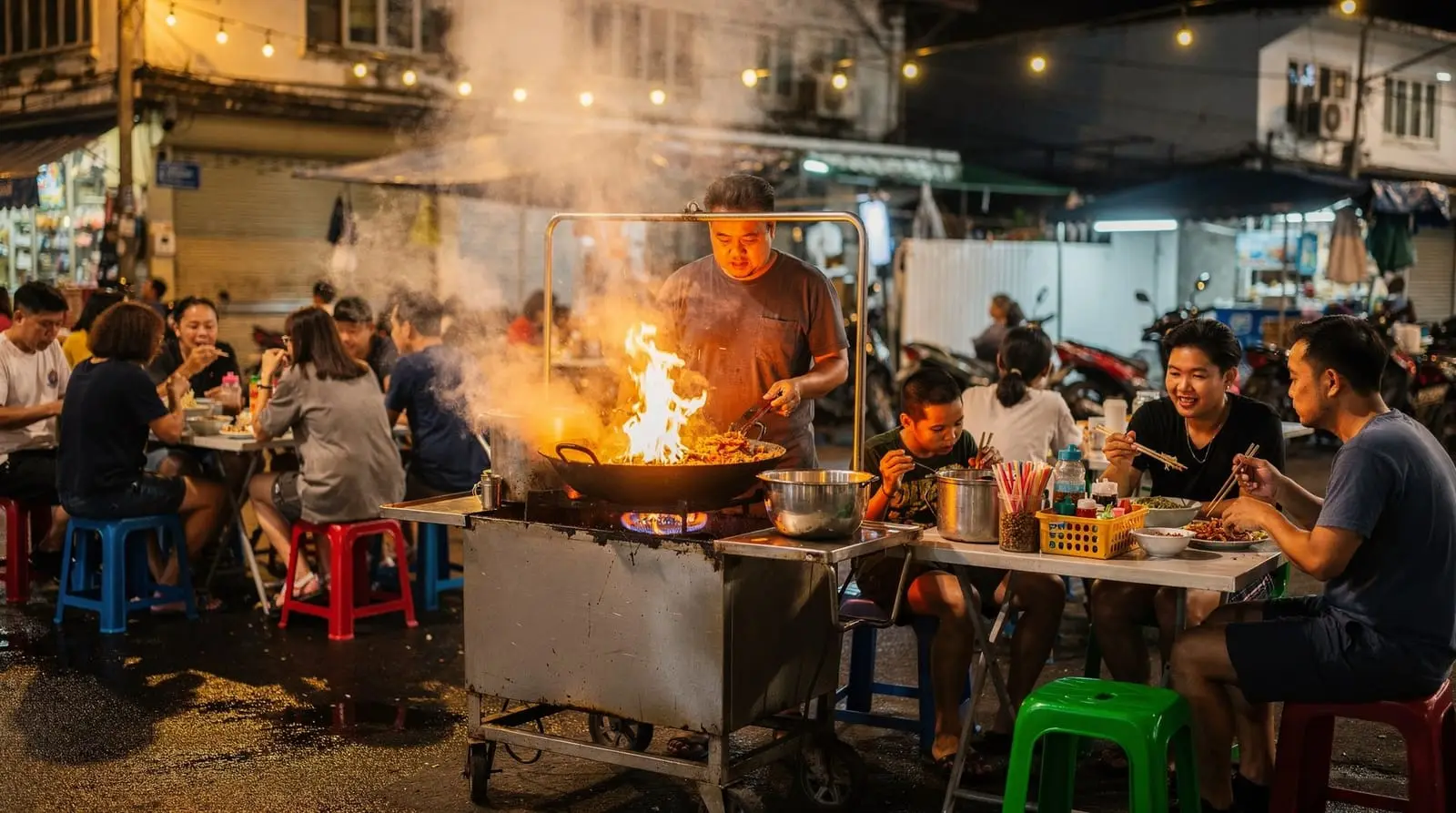
Banthat Thong is an outdoor and semi-outdoor street, so plan around Bangkok’s climate rather than against it. In the hot season (roughly March to May) the evening heat still lingers even after dark, so light clothing and a bottle of water help; in the rainy season (roughly June to October) short, heavy downpours can hit without much warning, and a handful of stalls have limited cover, so a compact umbrella is worth carrying. Seating is mostly plastic stools and folding tables set up on the pavement rather than proper restaurant chairs, and larger groups may need to split across two tables at the busiest stalls. Mosquito repellent is a sensible addition once the sun goes down, particularly if you plan to stand in the Jeh O queue for a while. None of this should put you off — it is simply the reality of eating well on a working street rather than in a dining room.
Mookata, hotpot and grilled meats
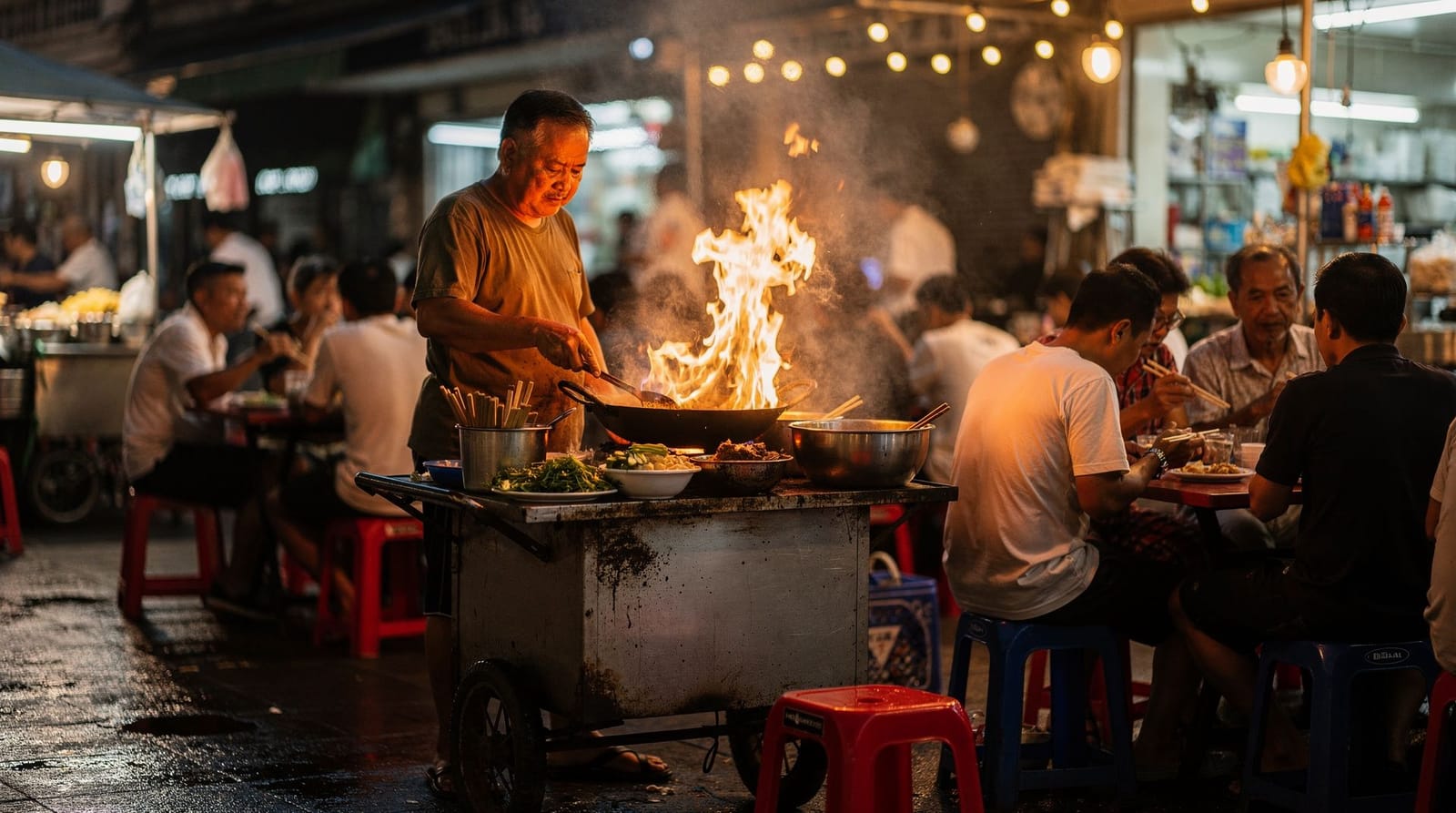
Beyond the two famous bowls, Banthat Thong is a grilling and hotpot street. Mookata, the Thai take on Korean-Japanese barbecue where you grill meat on a domed plate while broth simmers in the moat around it, is a classic group meal here, usually a fixed price per person or buffet style. There are sukiyaki and hotpot spots, grilled-pork and seafood stalls, and the smoke-and-steam atmosphere that makes the street fun to walk even before you sit down.
These are the stalls to fill the Jeh O wait with. Pick the busiest one, expect 100–250 THB a head, and treat it as the warm-up. This is the everyday Bangkok eating that the what to eat in Bangkok guide describes, served at student prices.
It is worth understanding why Banthat Thong feels different from the other viral food spots you may have seen online. Because the street’s core customer base is Chulalongkorn students and young Bangkokians, the vendors compete on value and novelty rather than on tourist markup. That is why you see so much experimentation here, the brown-sugar drinks, the elaborate bingsu, the photogenic toast towers, alongside old-school noodle and grill stalls that have been on the road for years. The viral attention layered on top of an already-good local street rather than replacing it. The risk is that as more visitors arrive, a handful of stalls start padding prices, so the usual rule applies: eat where the local students queue, not where the English-language signs are biggest.
Dessert: bingsu, toast and Thai-Chinese sweets
Banthat Thong takes dessert seriously, which is part of why it stays busy past midnight. Korean-style bingsu (shaved-ice mountains), thick sweet toast, brown-sugar drinks and old-school Thai-Chinese sweets all have dedicated shops along the strip. A bingsu to share runs roughly 150–250 THB; smaller sweets are 40–100 THB. It is the natural last stop, especially while you wait out a queue or wind down a hotpot.
If sweet endings are your thing, pair this with the mango sticky rice guide, since Banthat Thong is a good place to compare the modern dessert scene with the classic version found across the city.
Timing, access and an honest verdict
Take MRT Sam Yan (Exit 2) for the southern end, about a 5–10 minute walk; BTS National Stadium reaches the northern end. Go in the evening, ideally a weeknight, and arrive near the Jeh O queue opening if that bowl is a must. Carry cash; nearly everything is cash or QR only. Budget 250–450 THB per person for a full grazing night.
The honest verdict: Banthat Thong deserves most of its hype. The food is genuinely good, the prices are fair, and the late-night energy is one of the more fun things you can do in the city after dark. The only real downside is the queue at Jeh O, and that is entirely optional, because Pe Aor and a dozen other stalls deliver without the wait. Treat the viral bowl as a bonus, not the mission, and you will have a great night. Slot it into a Bangkok foodie itinerary, and if you want a guide to handle the navigation, a late midnight food tour by tuk-tuk can fold this strip into a wider after-dark crawl. Whether a tour is worth it at all is weighed up in our food tour worth it guide.
How Banthat Thong compares to the city’s other food strips
It helps to know what Banthat Thong is and is not before you go. Unlike Yaowarat in Chinatown, this is not a heritage street-food district with decades-old Teochew stalls; it is a younger, student-driven strip that exploded on Thai social media from around 2021 and skews toward viral noodle bowls, mookata, bubble tea and dessert cafes. The crowd is local and Thai-Chinese, mostly Chulalongkorn students and young Bangkokians rather than tour groups, which keeps prices honest and portions generous. Where Chinatown is best earlier in the night and gets shoulder-to-shoulder, Banthat Thong runs genuinely late — many stalls are busiest from 21h00 well past midnight, so it is the natural second or third stop of a food crawl rather than the opener.
On value it is hard to beat: a full grazing night of three or four stops lands around 250–450 THB (8–14 USD) per person, cheaper than most mall food courts for far better cooking. If you are comparing it against a sit-down meal, the best Thai restaurants guide covers the upgrade path, while the what to eat in Bangkok guide explains the individual dishes you will meet on the strip. The one honest caveat is hygiene-by-crowd: the busiest stalls turn over fast and cook to order, but a handful of dessert and drinks stands sit prepped for hours — pick the ones with queues and visible cooking, the same rule covered in the street food safety guide.
Frequently asked questions about Banthat Thong food street: Bangkok's viral student eating strip
How do I get to Banthat Thong food street?
How does the Jeh O Chula queue system work?
What should I order at Jeh O Chula?
Is Pe Aor tom yum better than Jeh O?
When is the best time to eat on Banthat Thong?
How much does a meal on Banthat Thong cost?
Is the hype around Banthat Thong justified?
Do the stalls take cards or just cash?
Top experiences
Bookable activities with verified prices and instant confirmation on GetYourGuide.