Michelin street food in Bangkok: stalls, stars and Bib Gourmand
Bangkok: Michelin Guide Street Food Tour by Tuk Tuk
Is Bangkok's Michelin street food worth it?
Some of it. Jay Fai holds a Michelin star and her crab omelette costs around 1,000-1,500 THB with long queues. The Bib Gourmand stalls like Thipsamai, Go-Ang chicken rice and Nai Mong Hoi Tod are cheap, fast and genuinely excellent, and usually the better value.
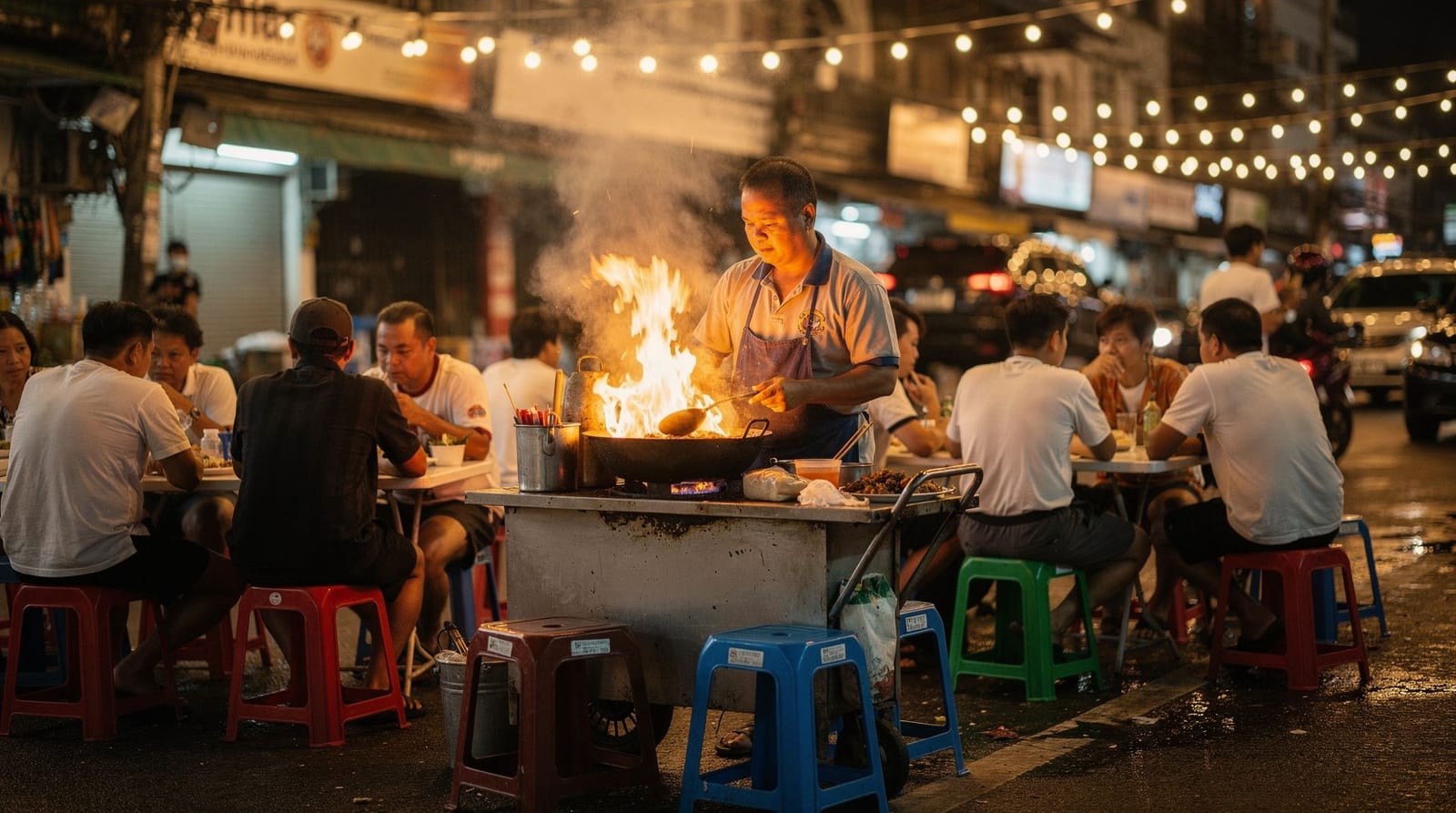
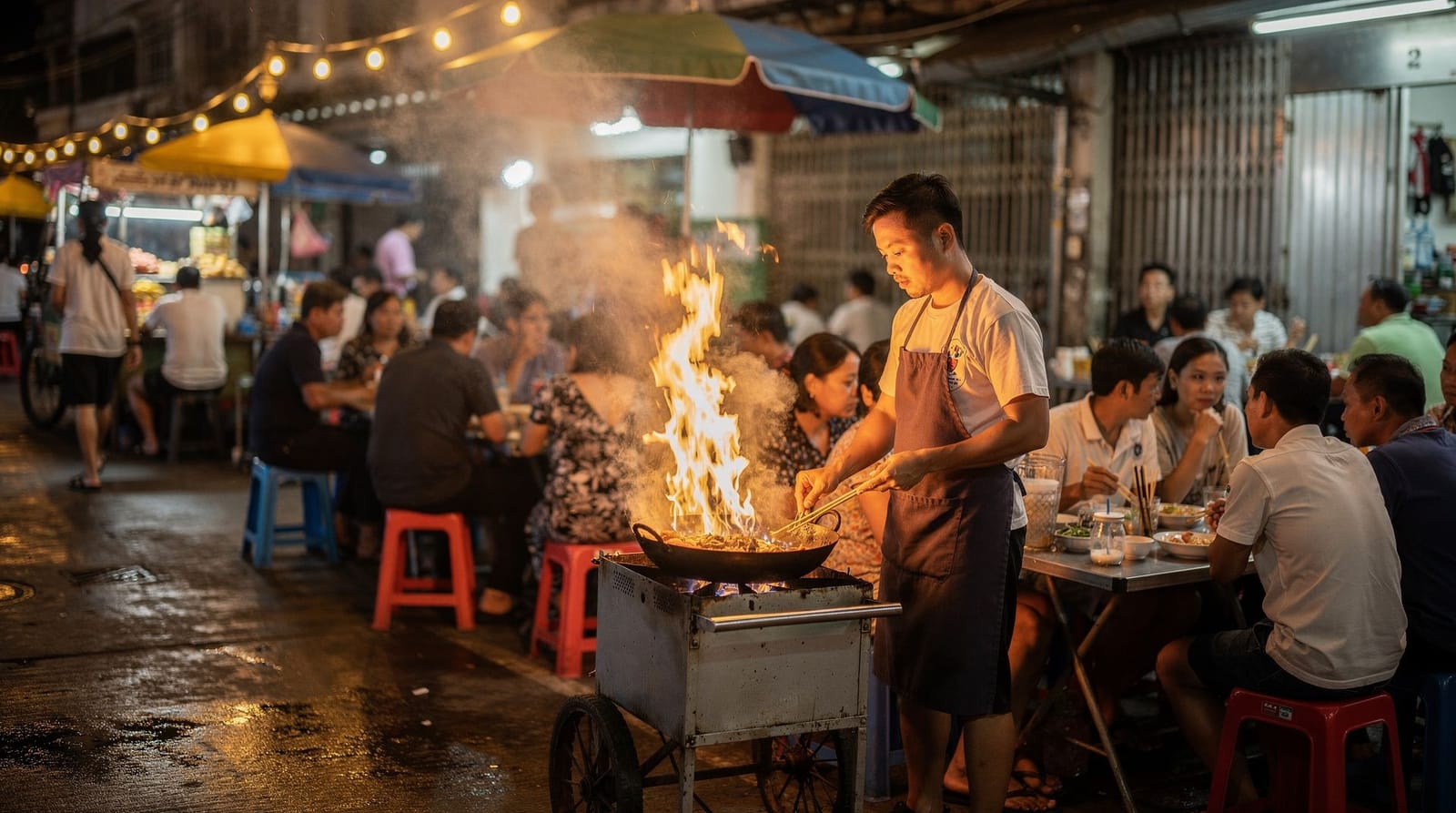
Bangkok is the only city where you can eat Michelin-recognised food from a plastic stool on the pavement for the price of a coffee, or pay 1,500 THB for a single omelette cooked over a charcoal wok by a woman in ski goggles. The Michelin Guide has covered the city since 2018, and its street-food listings have turned several humble stalls into bucket-list queues. This guide explains what the recognition actually means, names the stalls worth your time, and tells you honestly which ones earn the wait and which do not.
| Where | Chinatown (Yaowarat), the Old City, Banthat Thong |
| Cost | 50–250 THB per Bib Gourmand dish; 1,000–1,500 THB for Jay Fai |
| Time needed | 2–3 hours for a walkable cluster; a full evening for Chinatown |
| Getting there | MRT Wat Mangkon (Chinatown); no rail link in the Old City |
| Best time | Evenings, especially after 6pm for Chinatown’s crawl |
What Michelin actually means in Bangkok
Michelin awards two things relevant to street food. Stars (one, two or three) mark exceptional cooking judged purely on the plate, regardless of tablecloths or service. Bib Gourmand marks great food at modest prices, in Bangkok generally a meal under roughly 1,000 THB. There is also a plain “Michelin Selected” listing for recommended places that earn neither.
The crucial point: a star says nothing about comfort, queue length or value. It says the food is among the best in the city. In Bangkok’s street-food world, only Jay Fai has held a star. Almost everything else celebrated as “Michelin street food” is Bib Gourmand or Selected, and that is where the real value sits. A 60 THB plate of Bib Gourmand chicken rice and a 1,200 THB starred omelette are both “Michelin”, but they are utterly different experiences.
Jay Fai: the starred crab omelette
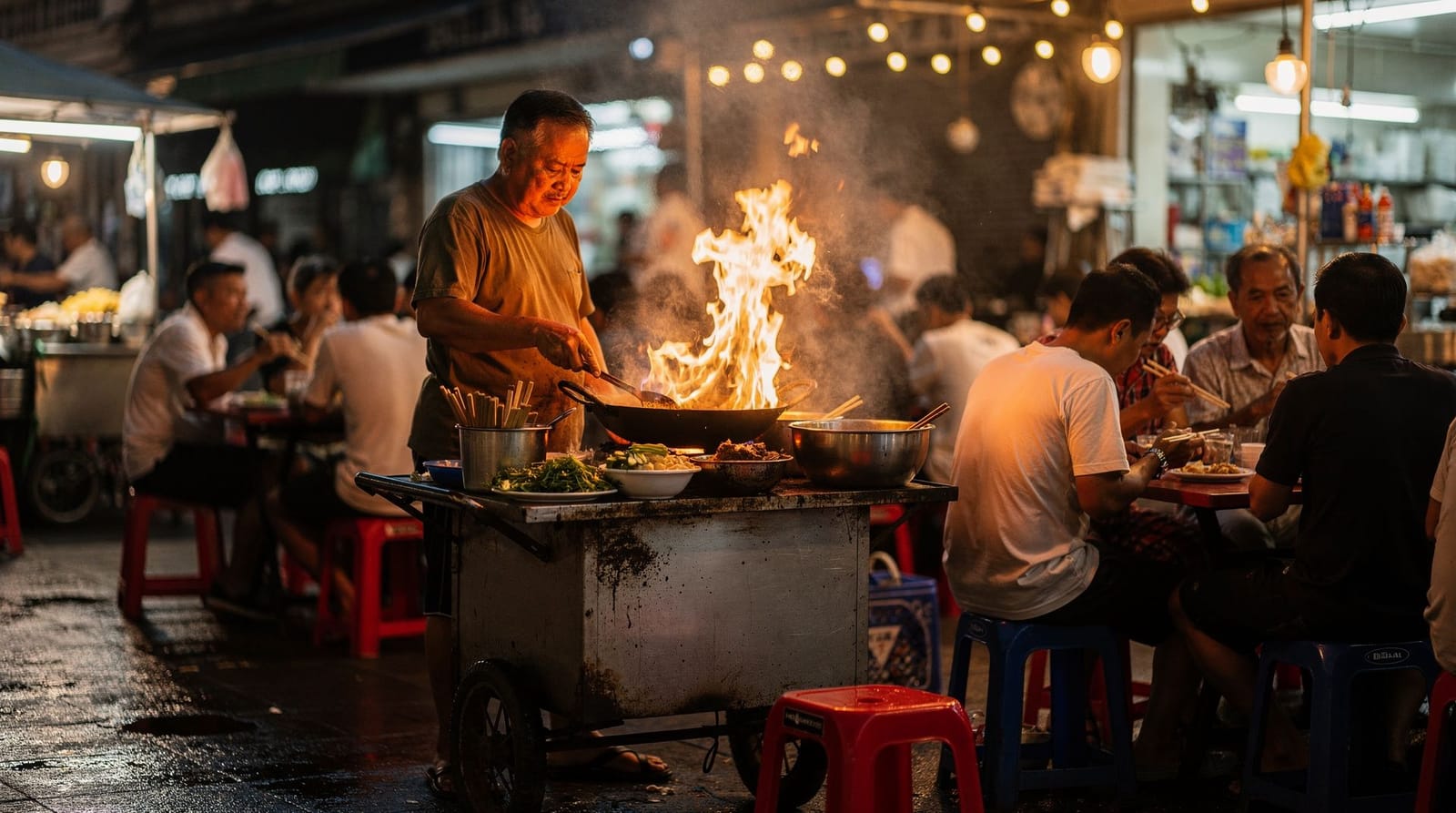
The headline name is Jay Fai, the goggles-wearing chef who cooks every dish herself over twin charcoal woks on Maha Chai Road, near the Golden Mount (Wat Saket) in the Old City. She holds a Michelin star and is the most famous street cook in Thailand.
The dish people come for is her crab omelette (khai jeaw poo), a dense golden roll stuffed with large chunks of fresh crab meat, priced around 1,000-1,500 THB (30-45 USD). The price reflects the sheer volume of crab inside, not theatre. Her drunken noodles (pad kee mao) with seafood and the crab-meat congee are cheaper and also superb.
The honest reality of getting in is the hard part:
- Walk-in queues can run two to four hours or longer, because she cooks every order personally and is not fast.
- A booking system exists but slots are very limited and fill almost instantly when released.
- Some days she sells out of crab or simply does not open; opening hours are famously unpredictable, roughly afternoon into late evening, closed some weekdays.
- Cash only, and the bill is large, so come prepared.
Is it worth it? The food is genuinely excellent and unlike anything else. But you are paying restaurant prices and queuing for hours for a stall experience. If you have the time and the budget and you treat it as a once-in-a-trip event, go. If your trip is short, your money buys more joy across five Bib Gourmand stalls. The nearby Golden Mount and Old City make the wait less wasted; pair it with the Rattanakosin Old City guide.
How to actually queue or book Jay Fai
The mechanics deserve their own breakdown because most people get this wrong. The stall sits at 327 Maha Chai Road, a roughly 12-15 minute walk from the nearest stations; the Old City has no direct BTS or MRT, so most arrive by taxi, ride-hailing app, or by walking from MRT Sam Yot (about 18-20 minutes). She typically opens mid-afternoon, around 2pm to 3pm, and cooks until late, but closes Sunday and Monday and on public holidays, and the exact day-to-day schedule is genuinely unreliable.
If you intend to walk in, arrive before opening and put your name down; staff take names and numbers at the door, and a slot can be a two-to-four-hour wait on a busy evening. The smarter play for many is the advance booking, which opens a fixed number of days ahead through her booking line; slots vanish within minutes of release, so set a reminder and try the moment they open. Whichever route you take, bring enough cash for a 1,500-2,000 THB bill (45-60 USD) once you add drunken noodles or congee to the omelette, and accept that crab can sell out before you reach the wok. Treat the whole thing as a planned event, not a drop-in, and you will not be disappointed.
Thipsamai: the egg-wrapped pad thai
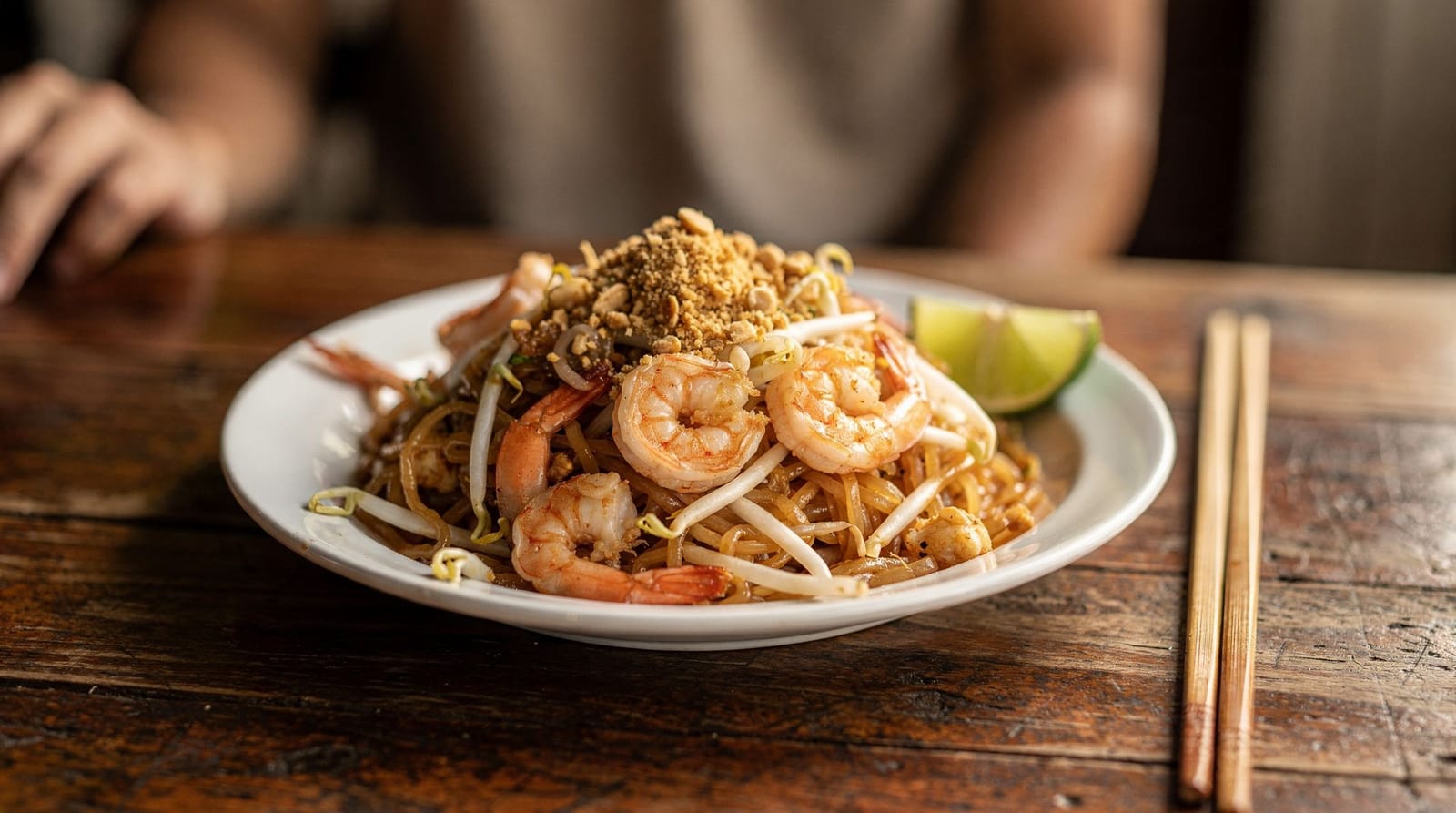
A short walk from Jay Fai on the same Maha Chai Road sits Thipsamai, a Bib Gourmand institution famous for pad thai wrapped in a thin egg crepe. It has been frying noodles since the 1960s and draws long but fast-moving queues most evenings. A plate runs roughly 80-250 THB depending on whether you add prawns or the premium shrimp-oil version.
Locals argue endlessly about whether Thipsamai is the city’s best pad thai, and plenty prefer humbler stalls. But it is reliable, affordable and a genuine piece of Bangkok food history. For the wider debate and alternatives, see the best pad thai in Bangkok guide. Note that “Raan Jay Fai” and Thipsamai are different places; do not confuse the two. Thipsamai opens in the evening, roughly 5pm to midnight, and the queue is worst between 7pm and 9pm; arrive at opening or after 10pm to walk straight in. Skip the famous orange juice sold from the front counter unless you are curious, as it is heavily marked up at around 60-80 THB for the experience rather than the value.
A short walk further, Pa Tong Go Savoey is the celebrated Old City spot for pa tong go, the Thai-Chinese fried dough crullers, served with pandan or sweetened-condensed-milk dips for roughly 30-60 THB a plate. It is a cheap, joyful counterpoint to the queues and a good breakfast or late-night stop. Another worthwhile Old City name is Krua Apsorn, a Bib Gourmand and Selected restaurant (not a pavement stall) on Dinso Road famous for its stir-fried crab with yellow chilli and fluffy crab omelette at around 200-400 THB a dish. It is the sit-down, air-conditioned way to eat crab brilliantly without the Jay Fai queue or bill, and it takes the heat out of an Old City afternoon.
Chinatown’s cluster: where the value is
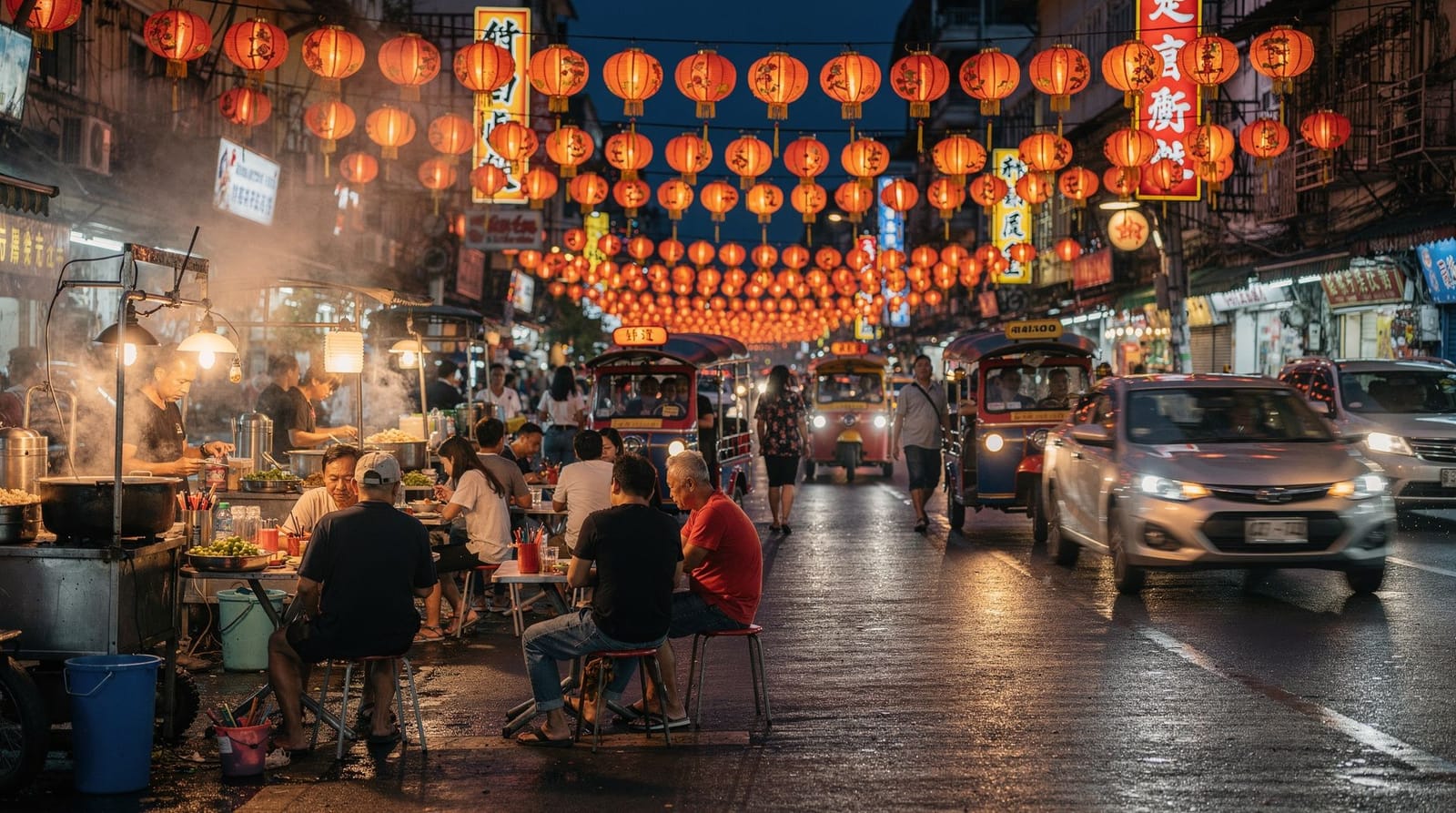
Yaowarat (Chinatown) holds the densest concentration of Michelin-listed street stalls, and unlike Jay Fai most are cheap, fast and walkable from one another after dark. This is the single best area for a Michelin street-food crawl, covered in depth in the Yaowarat Chinatown food guide and the Chinatown Yaowarat neighbourhood guide.
Stalls worth knowing:
- Go-Ang Pratunam Chicken Rice (the pink-uniform khao man kai chain) holds Bib Gourmand recognition. Tender poached chicken over fragrant rice for roughly 50-70 THB. Fast, cheap, excellent.
- Nai Mong Hoi Tod, a Bib Gourmand stall on Phlap Phla Chai Road in Chinatown, famous for crispy fried oyster and mussel pancakes (hoi tod / or suan) at around 100-200 THB.
- Guay Jub Ouan Pochana, a beloved late-night Yaowarat stall serving peppery rolled rice-noodle soup with crispy pork, roughly 60-100 THB.
- Elvis Suki, a quirky long-running stall serving Thai-style suki (a stir-fried noodle dish, not hotpot) for around 60-120 THB.
- Lim Lao Ngow, a Bib Gourmand fishball noodle shop with branches near Yaowarat, famous for springy hand-made fish balls and clear soup at roughly 60-100 THB a bowl. The original is a daytime-into-evening stop and a reliable lighter meal between heavier crawls.
- Rung Reung noodles, a Bib Gourmand pork-and-fishball noodle institution (the well-known branch sits off Sukhumvit Soi 26, BTS Phrom Phong, not Chinatown) serving punchy tom yum-style dry or soup noodles for around 60-90 THB. There are two adjacent shops from a family split, so simply join whichever queue is shorter.
- Charoen Saeng Silom, a Bib Gourmand legend near BTS Surasak / Chong Nonsi serving slow-braised stewed pork leg over rice (khao kha moo) for roughly 80-150 THB. It opens in the morning and sells out by early afternoon, often by 1pm-2pm, so come early or miss it entirely.
- Soei, a Bib Gourmand restaurant in the northern Wong Sawang area known for fiery stir-fries and a standout fish-organ curry, mains around 120-250 THB. A detour rather than a Chinatown walk-in, but a favourite of serious eaters.
These are the stalls that justify Bangkok’s Michelin reputation: world-class flavour at street prices, no booking, cash in hand. The catch is the night queues and the heat. A guided Chinatown Michelin street-stall food tour times the visits and skips the guesswork of which stall is open when.
Neighbourhood clusters: where to point yourself
The listed stalls fall into three walkable clusters, and choosing one per outing beats criss-crossing the city. Yaowarat (Chinatown) is the densest and best after dark: Nai Mong Hoi Tod, Guay Jub Ouan Pochana, Elvis Suki, Lim Lao Ngow and dozens of dessert and seafood stalls sit within a few hundred metres of each other. Reach it via MRT Wat Mangkon, exit 1; the strip is busiest from about 6pm. The Old City (Rattanakosin) around Maha Chai and Dinso roads holds Jay Fai, Thipsamai, Pa Tong Go Savoey and Krua Apsorn, with no rail link, so plan to walk or taxi. Banthat Thong, near MRT Sam Yan and BTS National Stadium, is the newest, most youthful cluster, best treated as a separate evening. Pick one cluster per night rather than chasing all three.
| Cluster | Getting there | Vibe | Approx. cost for 3 dishes | Best for |
|---|---|---|---|---|
| Yaowarat (Chinatown) | MRT Wat Mangkon | Dense, chaotic, best after 6pm | 200–400 THB | The classic Michelin street-food crawl |
| Old City (Rattanakosin) | No rail link — walk or taxi | Historic, slower-paced, daytime and evening | 300–2,000 THB (Jay Fai skews it) | Jay Fai, Thipsamai and a temple day combined |
| Banthat Thong | MRT Sam Yan / BTS National Stadium | Youthful, viral, noodle- and skewer-focused | 200–350 THB | A shorter, trendier evening detour |
These are per-person estimates for tasting rather than a full sit-down meal — street food is built for grazing across several stalls, not ordering one large plate.
Vegetarian, vegan and halal options
Michelin’s street-food list skews heavily toward pork, seafood and egg dishes, so vegetarians, vegans and halal-observant travellers will need to look slightly beyond the headline names. None of the stalls above are dedicated vegetarian or halal kitchens, though a few dishes (some noodle soups without meat stock, certain dessert stalls) can be adapted on request in Thai. Rather than force a substitution at a stall built around pork or crab, it is more reliable to pair a Michelin crawl with dedicated options nearby: the vegetarian and vegan Bangkok guide and the halal food Bangkok guide both list proper kitchens, including some in or near Chinatown, that do not require any substitution guesswork.
Chinese New Year and other timing quirks
Yaowarat is Bangkok’s Chinatown, and Chinese New Year (a lunar-calendar date, typically late January to mid-February) transforms the street for several days into one of the city’s biggest street parties, with lion dances, lantern displays and enormous crowds. Some regular stalls get swallowed by the festival stage and street closures, while temporary vendors multiply; it is a spectacular time to visit but a chaotic one for a focused Michelin crawl, so if quiet, efficient stall-hopping matters more to you than festival atmosphere, avoid the exact festival days and go the week before or after instead.
Honest worth-it verdicts
Banthat Thong: the newer hotspot
Beyond the classic clusters, Banthat Thong Road near the Sam Yan and National Stadium areas has become a viral food street, with several Michelin-recognised and influencer-driven stalls for noodles, grilled skewers and desserts. It is busiest at night and skews younger and more local-trendy than Chinatown. The full rundown is in the Banthat Thong food street guide. To eat the best of it without queuing blind, a Banthat Thong Michelin and viral eats tour is the efficient option.
Honest worth-it verdicts
To cut through the hype, here is the blunt scorecard:
- Jay Fai: extraordinary food, extraordinary hassle and price. Worth it once if you have time and budget; skippable on a short trip.
- Thipsamai: solid, historic, affordable, fast queue. Worth it, with low risk.
- Go-Ang chicken rice: cheap, brilliant, no queue drama. Easy yes.
- Nai Mong Hoi Tod: a genuine highlight if you like the oyster pancake. Worth it.
- Guay Jub Ouan Pochana: superb late-night bowl for under 100 THB. Worth it.
- Charoen Saeng Silom: outstanding pork leg, but only if you arrive before it sells out. Worth the early alarm.
- Lim Lao Ngow / Rung Reung: excellent everyday noodle bowls, no drama. Easy yes when you want something lighter.
- Krua Apsorn: the best way to eat crab without the Jay Fai queue. Strong yes for a sit-down meal.
- Banthat Thong stalls: hit and miss, very trendy. Worth it if you go selectively.
The pattern is clear. The Bib Gourmand stalls deliver the best ratio of joy to baht, and the starred stall is a splurge experience rather than a value one. The honest skip list is short: do not queue hours for a stall purely because it carries a Michelin sticker if a near-identical bowl is available two doors down with no wait, and treat the marked-up tourist add-ons (premium juices, “famous” branded drinks) as optional theatre rather than the main event.
How to actually get a table (or a stool)
A few rules make the difference between a great night and a frustrating one. Carry cash in small notes; almost no street stall takes cards, and Jay Fai’s bill is large. Go early or late to dodge the worst queues; many stalls peak from 7pm to 9pm. For Jay Fai specifically, decide in advance whether you will queue from opening or chase a booking slot, and have a backup plan for the likely chance she is sold out or closed.
The most reliable way to eat across several Michelin and Bib Gourmand stalls in one evening is a guided crawl. A Bangkok Michelin street-food tour by tuk-tuk covers multiple listed stalls across neighbourhoods with the queuing and ordering handled for you, and a night Michelin foodie tour of Chinatown focuses the evening on Yaowarat’s densest cluster. Whether that is worth the price over going solo is weighed honestly in the food tour worth it guide. If you want street food quickly and cheaply beyond just the Michelin list, the best cheap eats in Bangkok guide broadens the net, and the street food safety guide covers general hygiene sense at any stall, starred or not. For a nightcap after the food, Chinatown also hides a growing scene of low-key bars covered in the Chinatown speakeasies guide.
For broader context, pair this with the Bangkok street food guide, the what to eat in Bangkok guide and the Bangkok food tour overview. If you want to plan an entire eating-led day, the Bangkok foodie itinerary sequences it for you.
Frequently asked questions about Michelin street food in Bangkok: stalls, stars and Bib Gourmand
What does a Michelin star mean for a Bangkok street stall?
What is the difference between a star and Bib Gourmand?
How much is Jay Fai's crab omelette?
How do I get a table at Jay Fai?
Is Thipsamai pad thai worth it?
Do Bangkok Michelin street stalls take cards?
Where are most Michelin street stalls concentrated?
Can I visit several Michelin stalls in one night?
Top experiences
Bookable activities with verified prices and instant confirmation on GetYourGuide.