Old City Rattanakosin: Bangkok's royal island, an honest guide
Old Bangkok Temples, Markets & Hidden Gems by Tuk Tuk
What is Rattanakosin and why is it Bangkok's most important district?
Rattanakosin is Bangkok's original royal island, founded in 1782 and bounded by the Chao Phraya River and a ring of canals. It holds the heaviest concentration of must-see sights in Thailand — the Grand Palace and Wat Phra Kaew, Wat Pho with its reclining Buddha, Wat Arun across the river, the City Pillar Shrine, the National Museum and the Sanam Luang royal field. It is a daytime district with no BTS or MRT inside it (nearest is MRT Sanam Chai), reached mainly by river boat or taxi. It is also the heartland of Bangkok's most persistent scam, the Grand Palace 'closed' routine.
Rattanakosin is the royal heart of Bangkok and, by a wide margin, the most important district in the country for any first-time visitor. Founded in 1782 as the seat of the new capital and bounded by the Chao Phraya River and a defensive ring of canals, this small island holds the heaviest concentration of must-see sights in Thailand: the Grand Palace, Wat Pho, Wat Arun across the water, the City Pillar Shrine, the National Museum and the great ceremonial field of Sanam Luang. It is also the daytime district where Bangkok’s most persistent scam — the Grand Palace “closed” routine — is waiting for the unprepared. This guide covers what to see, how to reach it without a Skytrain, and how to do it all without getting fleeced.
| Where | The historic island bounded by the river and canals |
| Cost | ~500 THB Grand Palace + ~300 THB Wat Pho + ~200 THB Wat Arun |
| Time needed | One full day for the trio; two for the quieter sights too |
| Getting there | MRT Sanam Chai, river boat, or Grab — no BTS inside |
| Best time | Early morning start, soon after the 08h30 opening |
The royal island: what Rattanakosin is
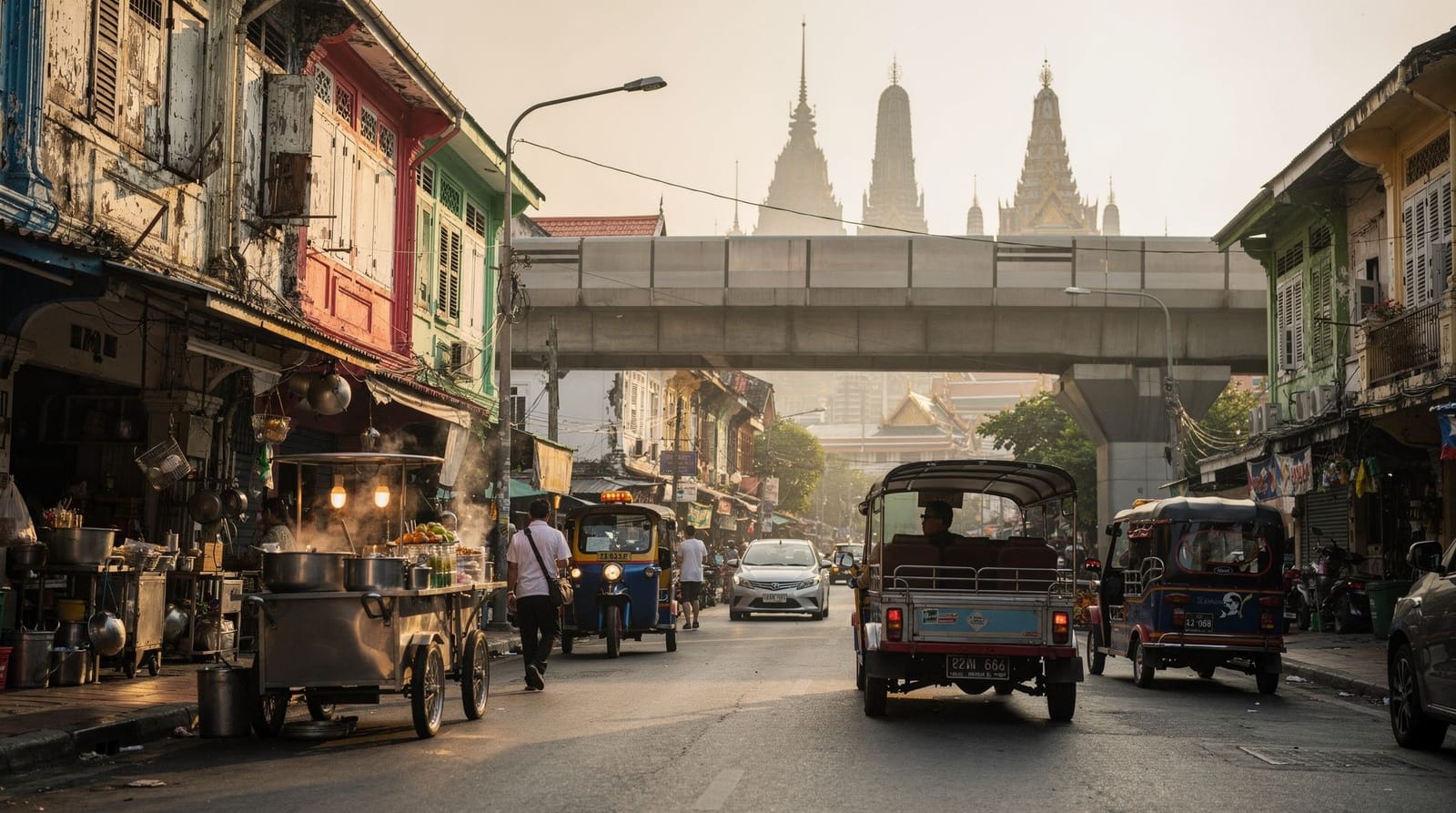
When King Rama I moved the capital across the river from Thonburi in 1782, he built his new city on an island carved out of the east bank by a ring of canals — Rattanakosin, the “jewel city.” That deliberate geography survives today: the district is compact, walkable and ringed by water, with the palaces and great temples clustered within a short distance of one another. It is the Bangkok of guidebook covers, gilded spires against the sky, and the symbolic and ceremonial centre of the Thai monarchy.
It is, crucially, a daytime district. The major sights close by mid-to-late afternoon and the area quietens dramatically after dark — there are no rooftop bars or nightlife here, just temples, museums and old-Bangkok streets. Plan it as a morning-and-afternoon experience, and base your evenings elsewhere. The Rattanakosin destination page maps the island, and the Bangkok neighbourhoods guide places it against the modern east of the city.
Getting there: the no-BTS problem
The single most important practical fact about Rattanakosin is that there is no BTS or MRT station inside it. The historic core was never wired into the Skytrain network, which is why so many visitors stay in the rail-connected east and day-trip in. You have three realistic ways to arrive.
The newest and often easiest is MRT Sanam Chai on the Blue line, which opened on the southern edge of the island near Wat Pho — a genuine game-changer for reaching the Old City by rail, with a striking station designed to evoke a palace interior. From there it is a short walk to Wat Pho and on to the Grand Palace.
The most scenic option is the Chao Phraya river boat, which sidesteps Bangkok’s notorious traffic entirely. Take it to Tha Tien pier (for Wat Pho and the cross-river ferry to Wat Arun) or Tha Chang pier (for the Grand Palace). The third option is a Grab or metered taxi, fine outside rush hour but vulnerable to gridlock. The getting around Bangkok guide, the MRT subway guide and the Chao Phraya boats guide explain the options; for most visitors the river boat is the most pleasant and reliable.
The Grand Palace “closed” scam — read this first
Before you set foot in Rattanakosin, internalise this, because it catches thousands of visitors a year. Near the Grand Palace, a well-dressed, friendly stranger or a tuk-tuk driver will approach you and explain — convincingly, with apparent kindness — that the Palace (or a particular temple) is closed today: for a Buddhist holiday, a special ceremony, monks at prayer, a royal event. They will then offer a cheap tuk-tuk tour of other sights instead, often for a token 20 or 40 THB.
It is a lie. The Grand Palace is open almost every single day, from 08h30 to 15h30. The “tour” loops you through gem shops, tailors and souvenir outlets that pay the driver commission, with heavy pressure to buy overpriced or worthless goods (the related gem scam has separated tourists from serious money). The defence is simple: ignore anyone who approaches you with this claim, do not get into an unsolicited tuk-tuk, and walk to the official Grand Palace entrance to check for yourself. The dedicated Grand Palace scam warning, the gem scam guide, the tuk-tuk scams guide and the common Bangkok scams guide cover the full playbook.
The Grand Palace and Wat Phra Kaew
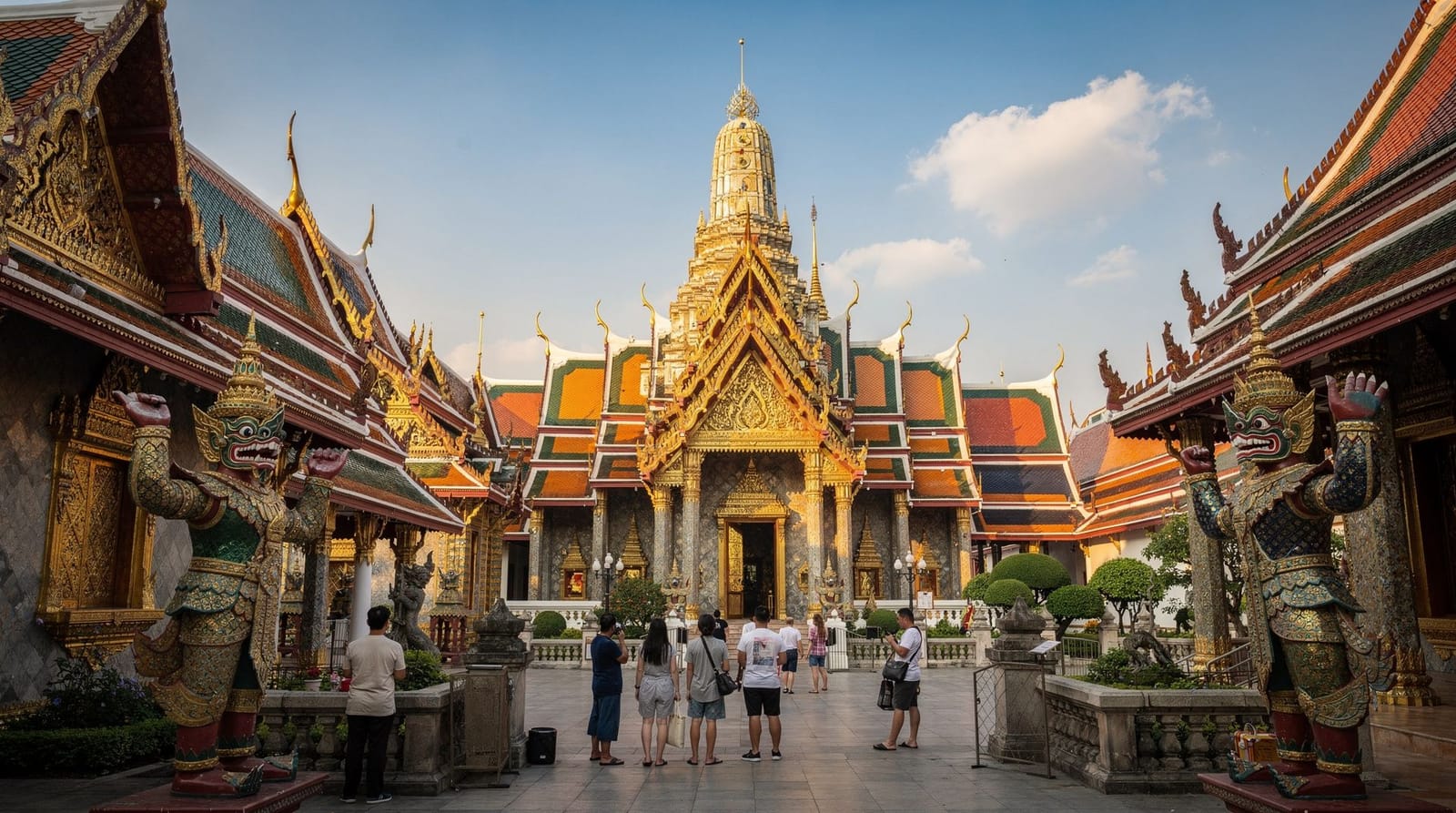
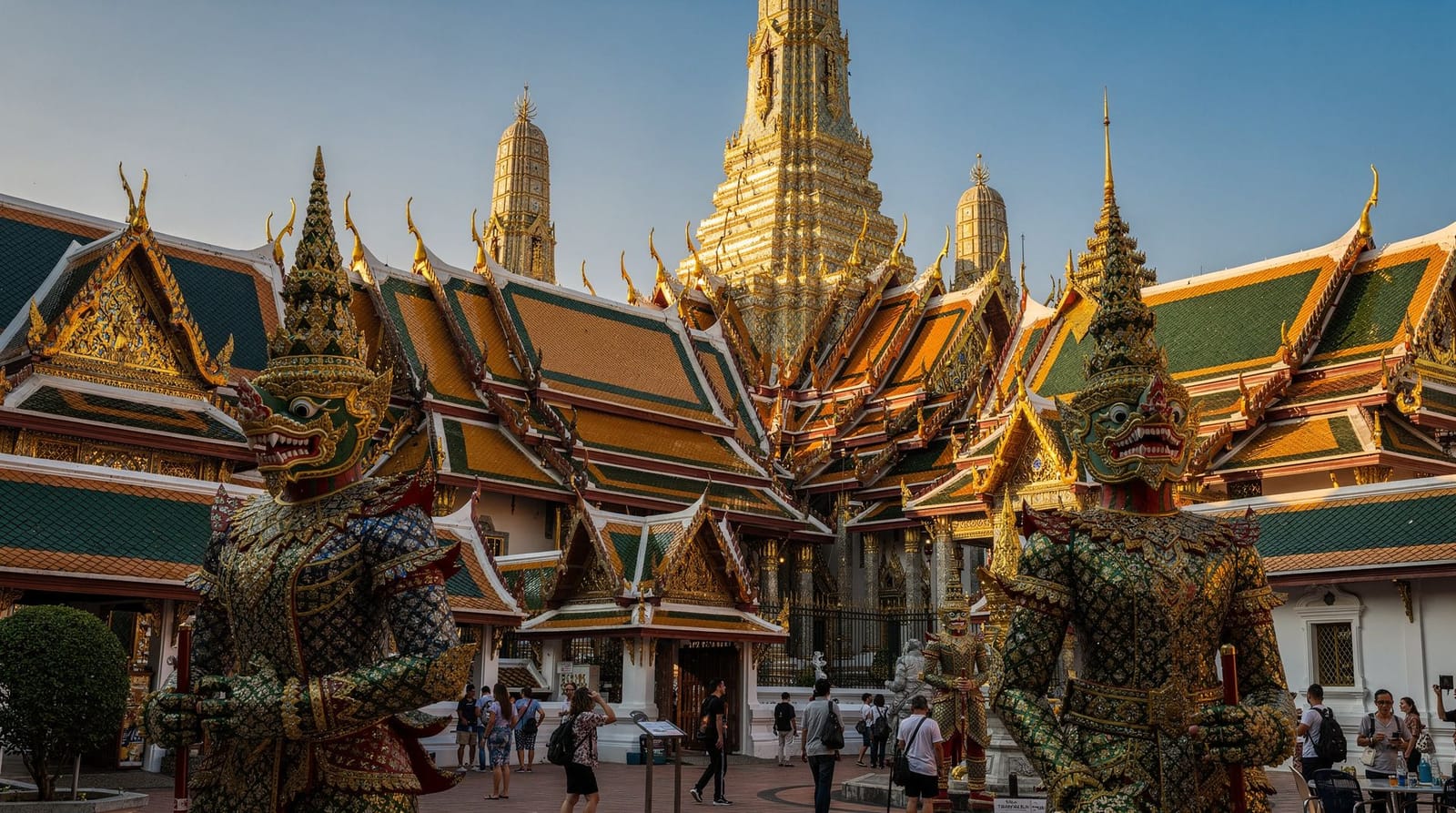
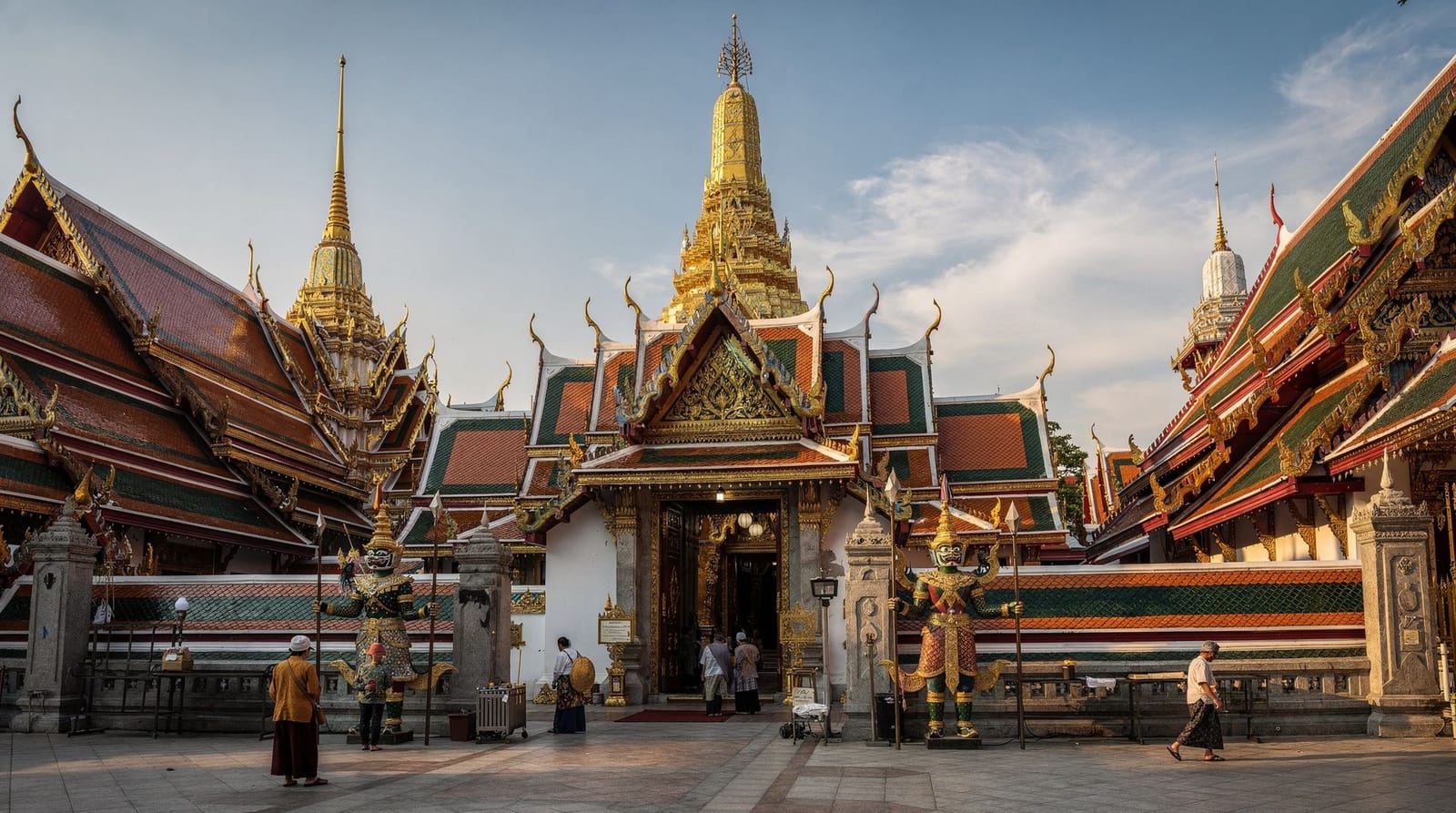
The Grand Palace is the headline sight of Thailand — a dazzling 218,000-square-metre walled complex of throne halls, pavilions and gilded spires that served as the royal residence from 1782 well into the 20th century. Within its walls stands Wat Phra Kaew, the Temple of the Emerald Buddha, the most sacred Buddhist site in the country, housing a small jade Buddha image whose seasonal robes are changed by the King himself.
It is spectacular and unmissable, but it is also hot, crowded and strict. Entry costs 500 THB (about 15 USD), the dress code is rigidly enforced (shoulders and knees covered, for everyone), and the open grounds offer little shade — go early, soon after the 08h30 opening, to beat both the worst heat and the tour-group crush. The Grand Palace guide, the Grand Palace dress code guide, the tickets and skip-the-line guide and the Wat Phra Kaew Emerald Buddha guide cover every detail.
Wat Pho and the reclining Buddha
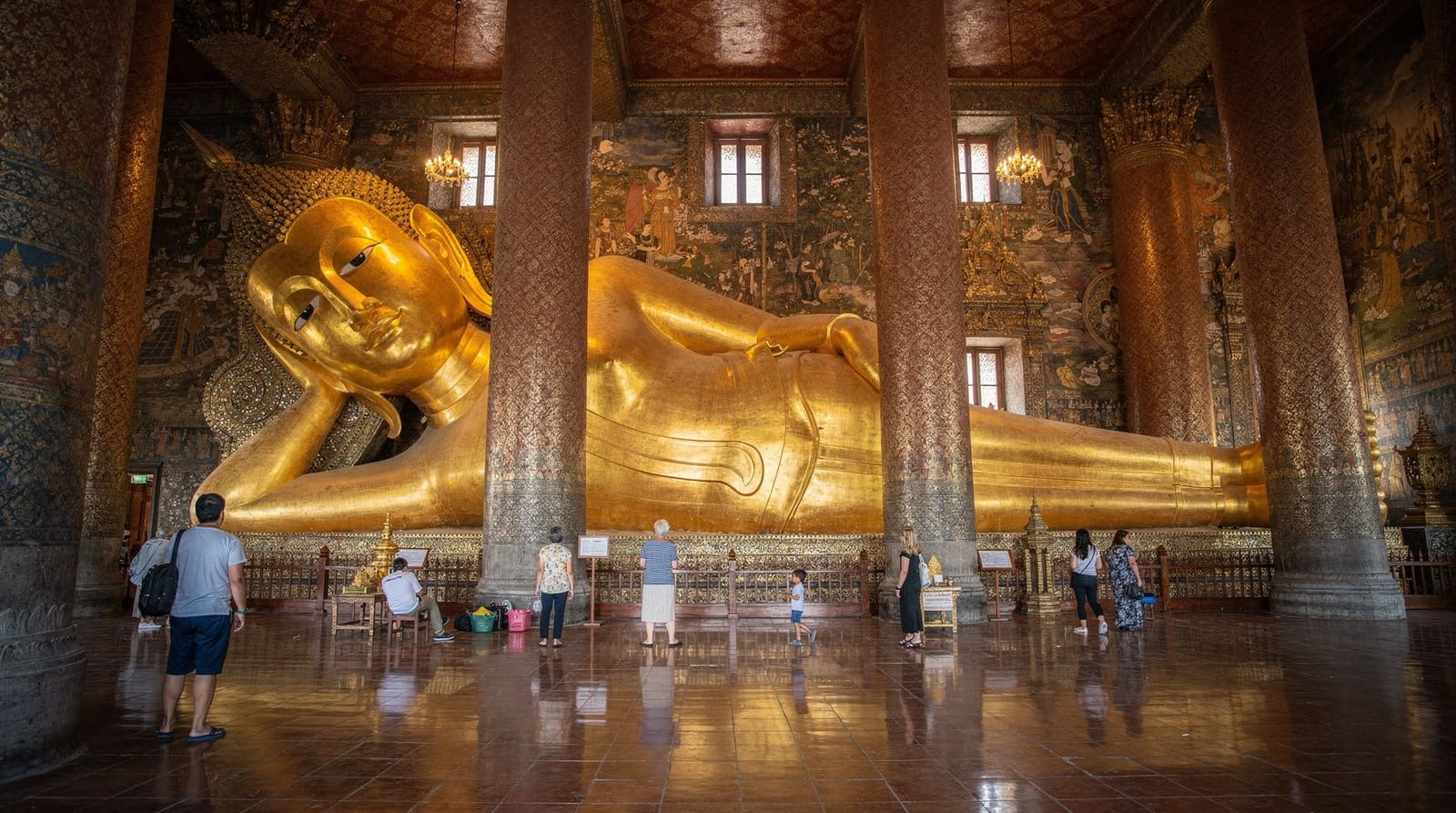
A short walk south of the Grand Palace, Wat Pho is, for many visitors, the more enjoyable temple of the two — calmer, shadier and home to the colossal 46-metre reclining Buddha, its feet inlaid with mother-of-pearl. Wat Pho is also the birthplace of traditional Thai massage and still houses the country’s most respected massage school, where you can take a genuinely excellent massage in the temple grounds.
Entry is around 300 THB (roughly 9 USD) and includes a small bottle of water. The complex of chedis, courtyards and Buddha images rewards slow wandering, and it makes a natural second stop after the Grand Palace. The Wat Pho guide, the Wat Pho massage school guide and the Grand Palace vs Wat Pho comparison help you weigh them.
Wat Arun across the river
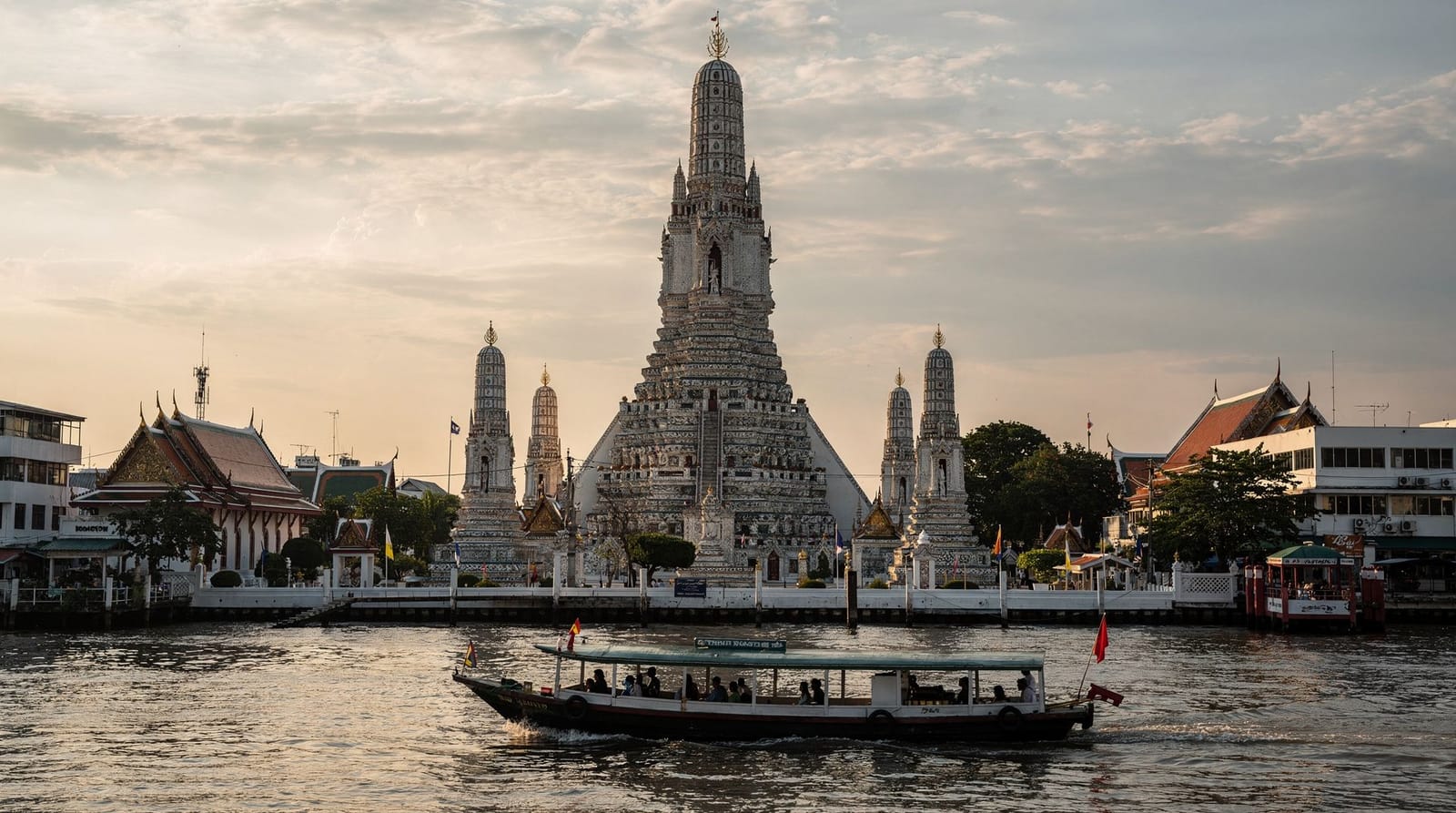
From the Tha Tien pier beside Wat Pho, a small cross-river ferry shuttles passengers over to Thonburi in a couple of minutes for a few baht — the easiest river crossing in Bangkok. On the far bank stands Wat Arun, the Temple of Dawn, its 70-metre central prang encrusted with broken porcelain that catches the light, glowing at sunrise and blazing orange at sunset.
Wat Arun is the most photogenic temple in the city, and the smart play is to see the Grand Palace and Wat Pho in the morning, then cross for Wat Arun in the late afternoon and sunset, when the light is kindest and the crowds thin. Entry is around 200 THB. The Wat Arun guide, the Wat Arun photography guide and the Wat Arun area destination page cover it, and the temple-hopping route ties the trio together.
| Grand Palace | Wat Pho | Wat Arun | |
|---|---|---|---|
| Cost | ~500 THB | ~300 THB | ~200 THB |
| Time needed | 1.5–2 hours | 45–60 minutes | 30–45 minutes |
| Best time of day | Early morning | Late morning | Late afternoon/sunset |
| Signature sight | Wat Phra Kaew, Emerald Buddha | 46m reclining Buddha, massage school | Porcelain-encrusted prang across the river |
Where to eat without leaving the Old City
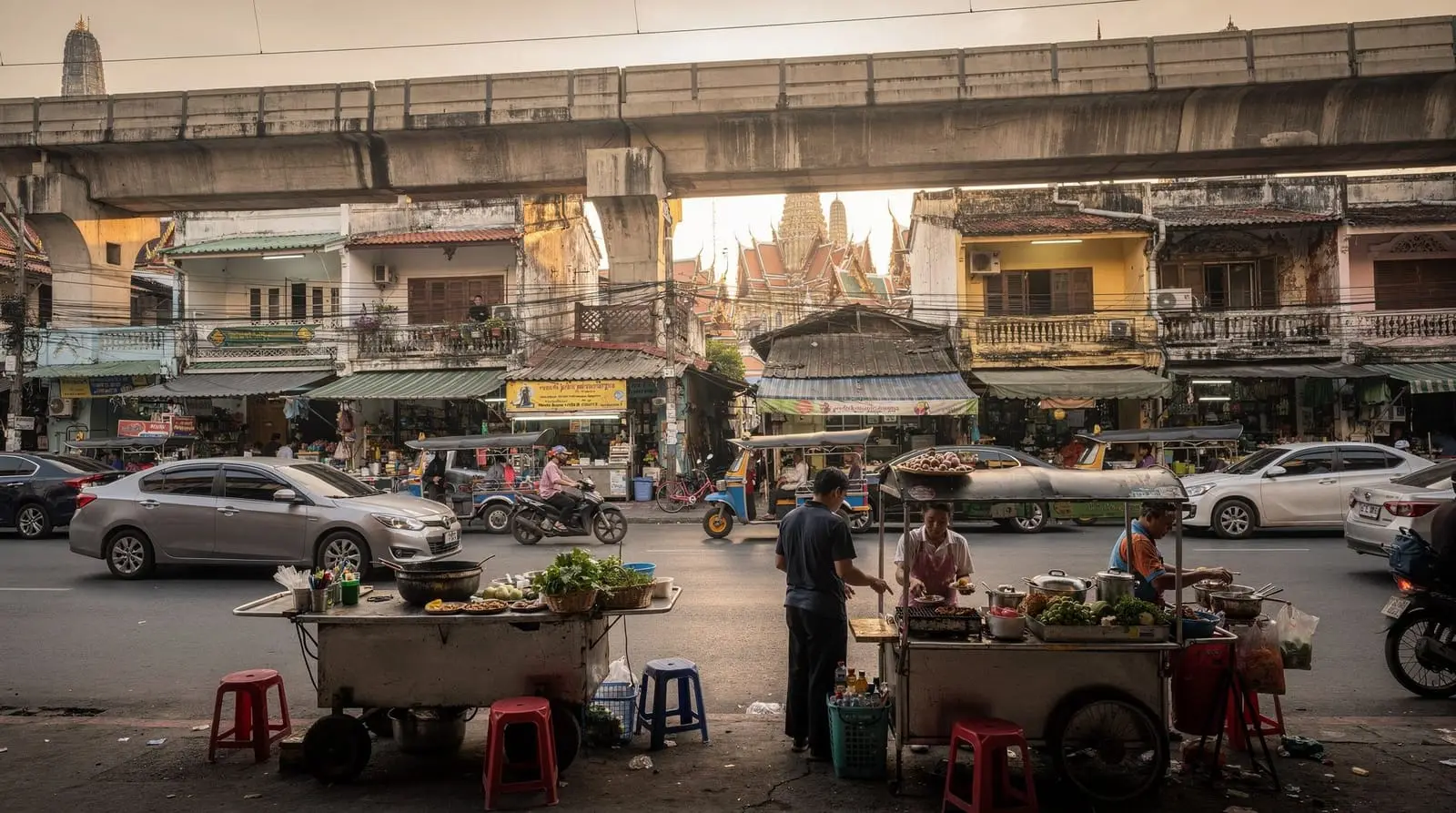
Sightseeing this dense is thirsty, hungry work, and Rattanakosin has real food, not just tourist cafés. Near the Giant Swing, Kor Panich is the Old City’s heritage name for mango sticky rice, covered in full in the mango sticky rice guide, and it makes a natural sweet stop between temples. For savoury food, the Maha Chai Road area near the Golden Mount holds several of the city’s most celebrated stalls, detailed in the Michelin street food guide. Keep it simple on a temple day: eat near wherever you finish a temple visit rather than trekking across the island chasing a specific name, and carry water — shade is scarce on the open palace grounds.
Combining Rattanakosin with Chinatown
Rattanakosin sits directly beside Chinatown (Yaowarat), and the two make a natural full-day pairing for a first visit: temples by day, street food by night. From Wat Pho or the Grand Palace, it is a short taxi or a walk-and-MRT hop via Sanam Chai and Wat Mangkon to reach the Chinatown gates. The Chinatown Bangkok guide and the Yaowarat food guide cover the evening half of this pairing in detail. If temples and old-Bangkok streets are more your pace than nightlife, the guesthouse-heavy Khao San and Banglamphu area right next door offers a cheaper, more laid-back base for the same sights.
The quieter Rattanakosin: City Pillar, museum and Sanam Luang
Beyond the famous trio, Rattanakosin holds gentler, less-crowded sights worth the extra time on a longer visit. The City Pillar Shrine (Lak Mueang), near the Grand Palace, houses the foundation pillar from which all distances in Thailand are measured, and is a busy local place of worship. The National Museum, the largest in Southeast Asia, occupies a former palace and traces Thai history and art across centuries of galleries. The vast open Sanam Luang field, between the Palace and the museum, hosts royal ceremonies and cremations and is the ceremonial green at the city’s heart.
A short walk east, just beyond the canal ring, Wat Saket and the Golden Mount crown a man-made hill with a golden chedi and one of the best panoramic views over the Old City — a worthy add-on. The best temples guide, the Wat Saket Golden Mount guide and the Golden Mount Phra Nakhon destination page cover these calmer corners.
Doing it well: tours and timing
You can absolutely do Rattanakosin independently, and many people do. But a guide adds real value here for two reasons: it neutralises the scams entirely, and it adds the history that turns gilded buildings into a comprehensible story. A guided tuk-tuk loop is an efficient, atmospheric way to cover the historic core and the surrounding markets without the scam hassle.
Old Bangkok temples and markets by tuk-tuk — a guided loop of the historic coreFor visitors who want the headline temples covered in one well-organised sweep, a guided Grand Palace, Wat Pho and Wat Arun tour handles tickets, dress-code logistics and the river crossing in a single morning.
Grand Palace, Wat Pho and Wat Arun guided tour — the three icons in one tripAnd for those who want a flexible private day that blends the icons with the old quarters and a touch of hidden Bangkok, a private highlights tour adapts to your pace.
Private Bangkok highlights tour — temples, palaces and old quarters with a guideThe best Bangkok tours guide and the Bangkok temples itinerary help you choose, and the Bangkok for first-timers guide sets expectations for a first day in the Old City.
Staying comfortable in the heat
The temple trio is a lot of walking on open, sun-exposed ground, and the Old City has fewer air-conditioned refuges than the modern city centre. Build in a rest stop: Wat Pho’s shaded courtyards are the best mid-route break, with benches and a slower pace than the Grand Palace’s crowds. Bottled water is sold throughout the complex and at streetside stalls; buy more than you think you need, since the heat and the walking add up faster than in an air-conditioned mall day. Public restrooms exist at each major site but queue at busy times, so use them when you see them rather than waiting until you need one urgently. If the heat becomes genuinely too much, a short taxi or Grab to a nearby café is a perfectly reasonable way to reset before continuing — there is no prize for pushing through discomfort on what should be an enjoyable day.
Practical essentials
A few honest notes for a smooth visit. Dress correctly from the start — covered shoulders and knees, shoes you can slip off — to avoid renting cover-ups at the gate. Go early, soon after 08h30, and aim to be off the open palace grounds before the midday furnace. Carry water and sun protection; the historic core is shadeless in places. Bring cash for entry fees and ferries. Be polite and respectful at all sites — this is the monarchy’s ceremonial heart, and Thailand’s lèse-majesté laws are strict, so treat royal and Buddhist imagery with care, as the monarchy respect guide and the temple etiquette guide explain.
Do all that, ignore the man who tells you the Palace is closed, and Rattanakosin delivers the single greatest day of sightseeing in Thailand. To weave it into a wider trip, the Bangkok in 3 days itinerary builds the Old City into a balanced first visit.
Frequently asked questions about Old City Rattanakosin: Bangkok's royal island, an honest
How do I get to Rattanakosin Old City without a BTS station?
What is the Grand Palace 'closed' scam?
What are the main sights in Rattanakosin?
How many days do I need for Rattanakosin?
What should I wear to visit the Grand Palace and Old City temples?
Is Rattanakosin a good area to stay in Bangkok?
When is the best time of day to visit the Old City?
How do I get from Wat Pho to Wat Arun?
Top experiences
Bookable activities with verified prices and instant confirmation on GetYourGuide.