Golden Mount & Phra Nakhon
Climb Wat Saket's golden hilltop chedi for old-Bangkok rooftop views, then explore Phra Nakhon's Giant Swing, Wat Suthat and quiet temple lanes.
Bangkok: Golden Mount, Metal Castle, and Giant Swing Tour
Quick facts
- Nearest transit
- MRT Sam Yot (Blue Line) ~15 min walk; or boat to Phan Fa Lilat on the Saen Saep canal
- Character
- Atmospheric old-Bangkok temples and craft lanes; far calmer than the Grand Palace
- Key food
- Old-town stalls, the Banthat Thong food street nearby, historic riverside coffee
- Key sight
- Wat Saket (Golden Mount) hilltop chedi; the Giant Swing and Wat Suthat
- Best time
- Late afternoon for the climb and sunset views; cool season for comfort
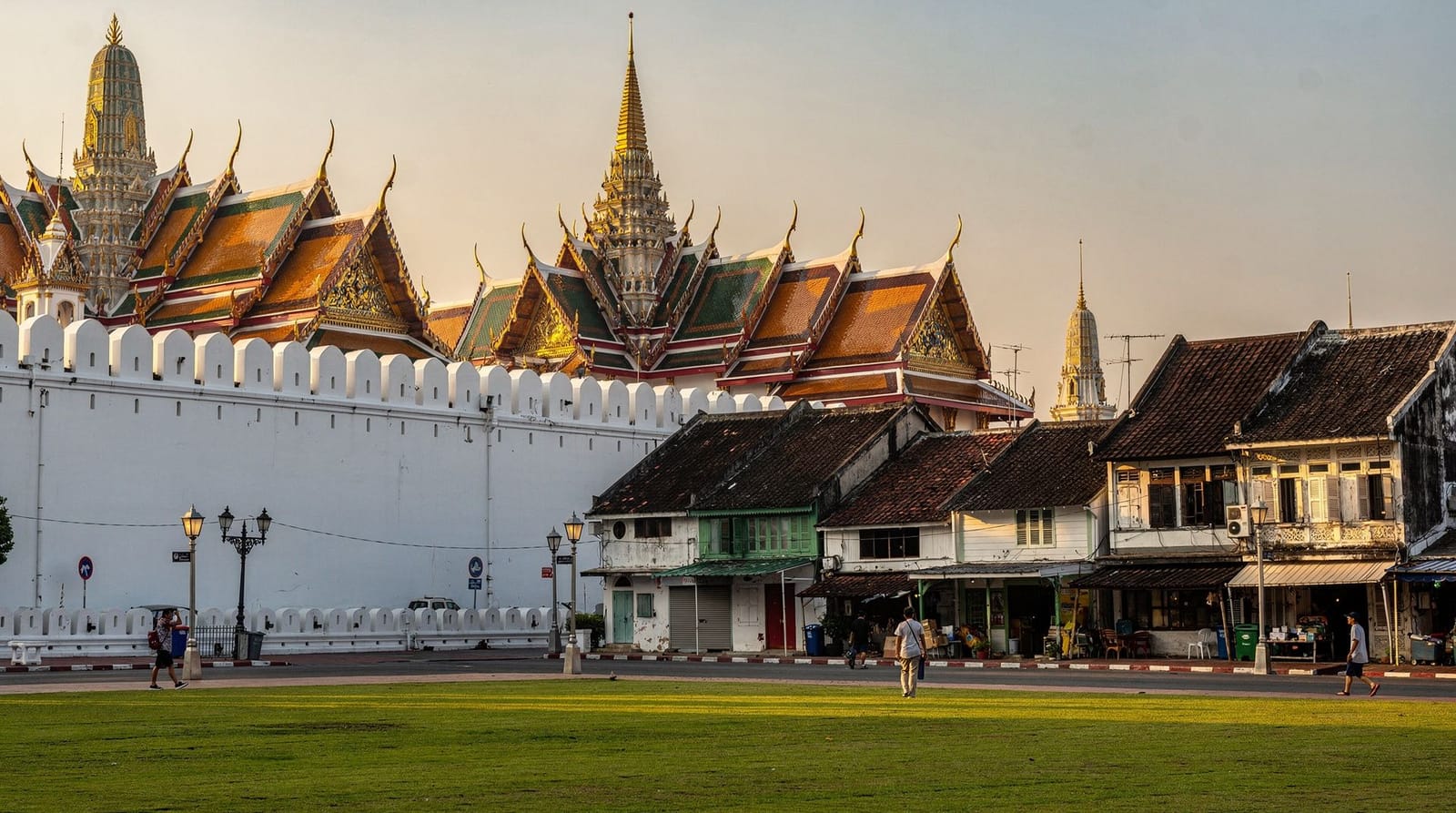
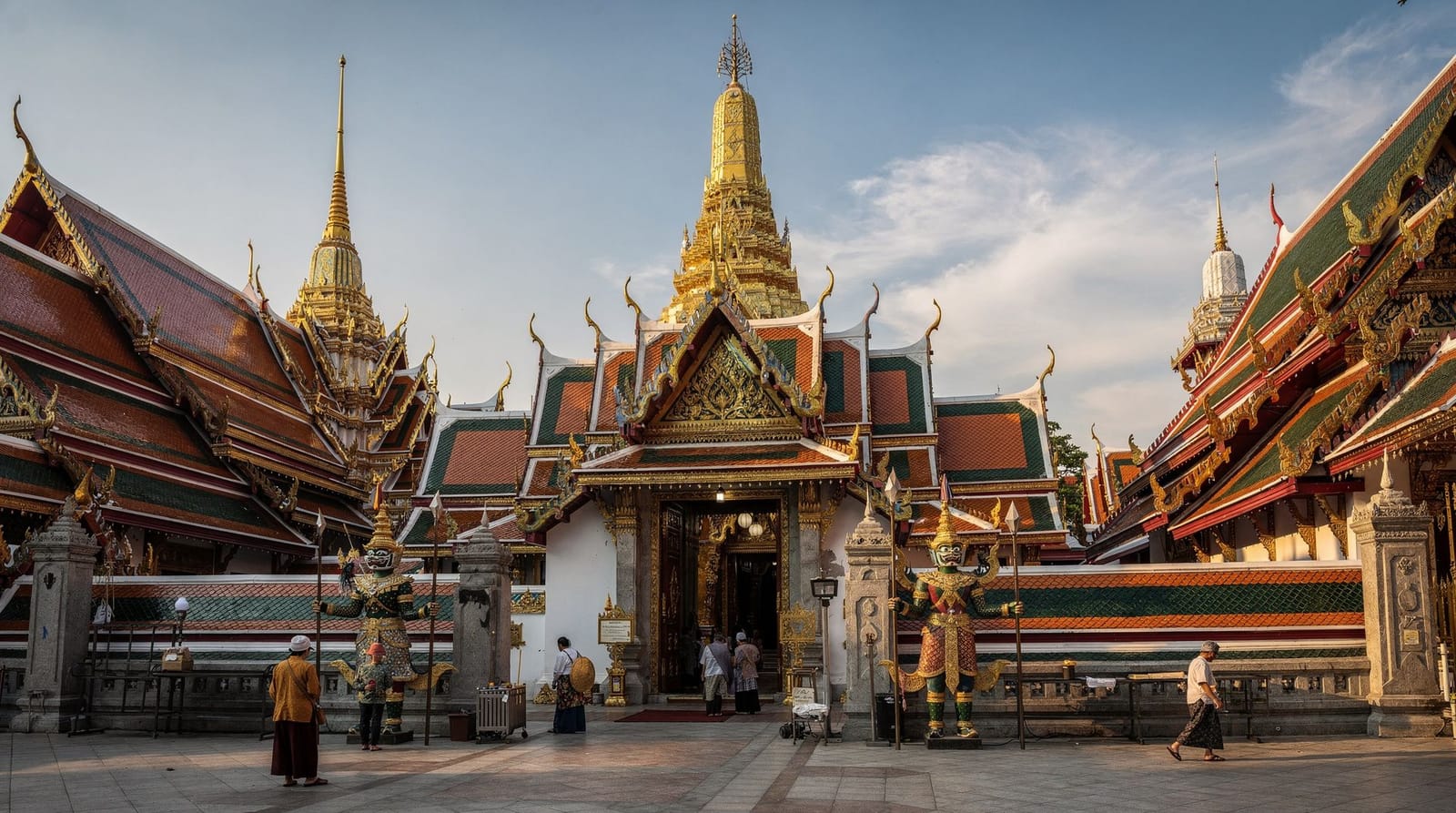
Just east of the Grand Palace, where the tour buses thin out and the old city gets quieter, sits the Golden Mount — a 79-metre artificial hill crowned by a gleaming golden chedi, the only real high point in flat, historic Bangkok. Climb the 344 spiralling steps and you are rewarded with a 360-degree view over the rooftops of Rattanakosin and Phra Nakhon, the most atmospheric panorama in the old city. Around its base spreads Phra Nakhon district: the Giant Swing, the cavernous Wat Suthat, lanes of Buddha-image makers and monk-supply shops, and a slower, more lived-in version of old Bangkok that most visitors race past on their way to the palace.
| Where | East of the Grand Palace, MRT Sam Yot ~15 min walk |
| Entry | Golden Mount: check Wat Saket’s official site |
| Time needed | Half a day |
| Getting there | MRT Sam Yot, Saen Saep canal boat, or Grab/taxi |
| Best time | Late afternoon, for the climb and sunset |
A hill that was never meant to exist
The Golden Mount’s odd, man-made shape has a genuinely dramatic backstory. In the early 19th century, King Rama III set out to build an enormous chedi at Wat Saket in imitation of a famous temple in Ayutthaya — but Bangkok’s soft, waterlogged soil could not support the weight, and the huge structure collapsed mid-construction, leaving a mountain of rubble that locals nicknamed the “broken chedi” and left to grow wild with grass and trees for decades.
It was King Rama IV and later Rama V who had the ruin reshaped and reinforced into a stable hill, capping it with a chedi built to enshrine a Buddha relic gifted by the British after excavations near Kolkata, India — hence the small, genuinely sacred pilgrimage that still happens at the summit today. The concrete retaining walls that hold the hill together were added under Rama VII in the 1940s. What looks like a natural feature is, in other words, a century-long engineering rescue.
Wat Saket and the Golden Mount
Wat Saket dates to the Ayutthaya era, but the Golden Mount (Phu Khao Thong) that defines it was built in the 19th century, when a collapsed chedi was reshaped into the present hill. The walk up winds past prayer bells, fluttering flags and small shrines, with breezes that make the climb manageable even in the heat. At the top, a gilded chedi said to enshrine a Buddha relic is circled by pilgrims, and the terrace gives uninterrupted views west to the Grand Palace’s spires and across a sea of low rooftops.
It is open daily and is at its best in late afternoon, when the light softens and you can watch the sun set over the old city. Every November, the Wat Saket temple fair wraps the hill in red cloth and fills the grounds with food stalls, performances and a fairground — one of Bangkok’s great traditional festivals. For the full visit details see the Wat Saket Golden Mount guide.
The Giant Swing and Wat Suthat
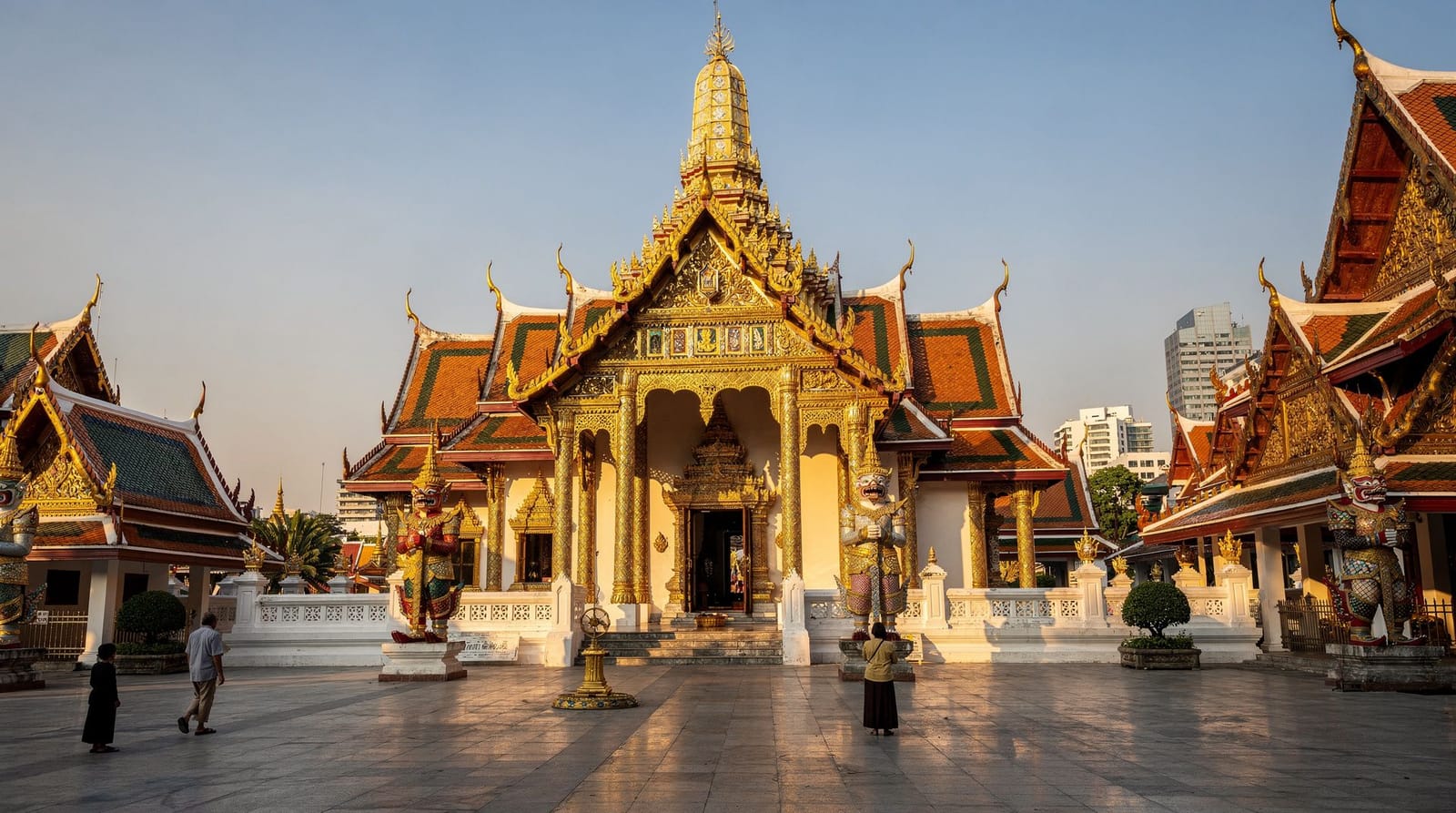
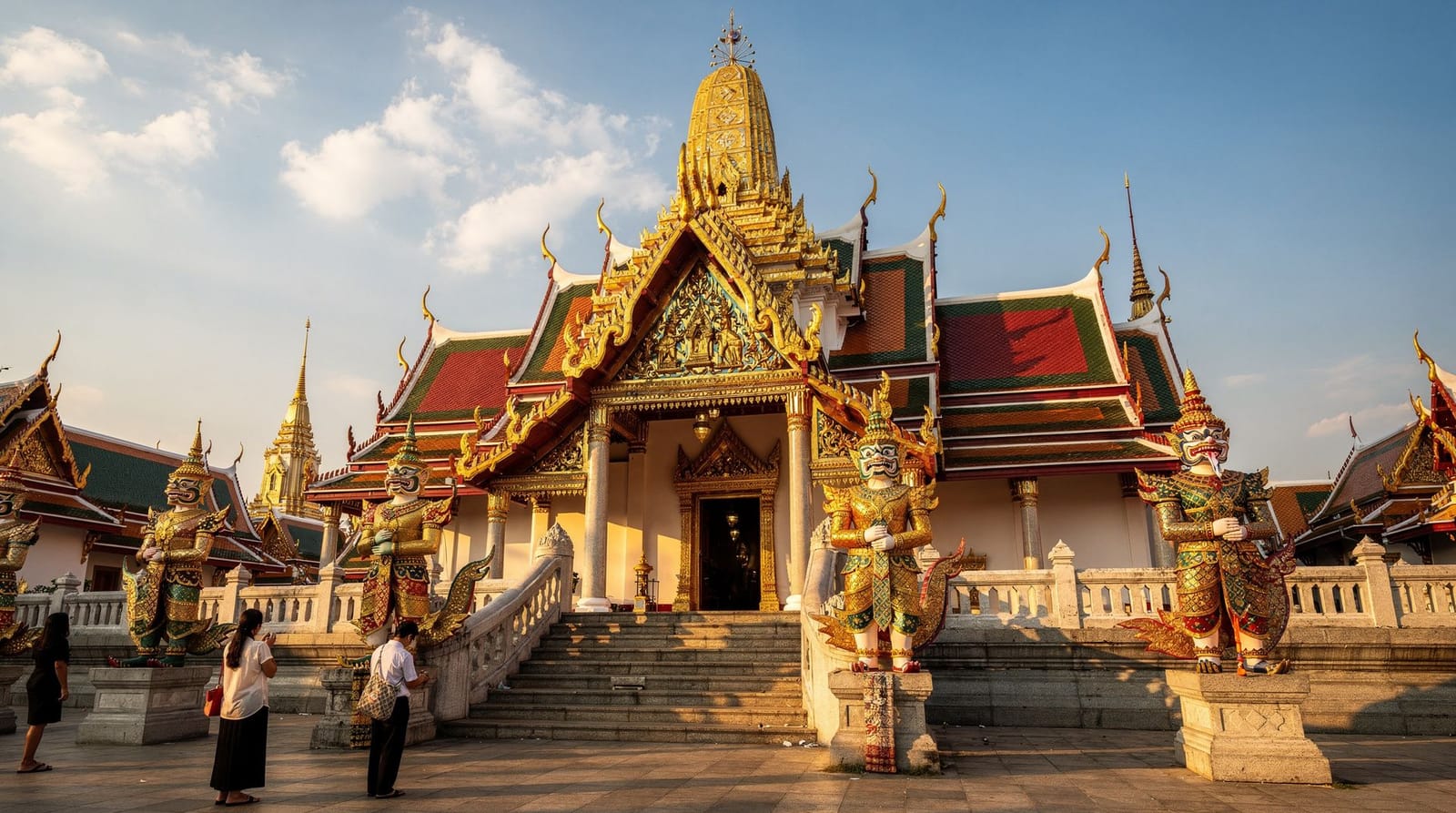
A short walk southwest brings you to the Giant Swing (Sao Ching Cha) — a towering red teak frame, 21 metres high, that once hosted a perilous Brahmin swing ceremony (long since discontinued after fatal accidents). It now stands as a striking landmark in front of Wat Suthat, one of Bangkok’s oldest and most impressive temples. Wat Suthat’s vast ordination hall holds a serene 8-metre bronze Buddha brought from Sukhothai, and its murals are among the finest in the city. It sees a fraction of the Grand Palace’s crowds, so you can sit in the cool, dim hall in genuine peace.
The temples cluster tightly here, which makes a guided loop efficient. The Golden Mount, Metal Castle and Giant Swing tour links Wat Saket with Wat Ratchanatdaram — whose 37 black metal spires (the Loha Prasat, or Metal Castle) are unique in Thailand — and the Giant Swing. The Wat Suthat, Giant Swing and Wat Saket tour covers the same compact zone with a guide to decode the iconography, and the top three temples tour is a good option if you want this area folded into a wider morning of temple-hopping.
The craft lanes of Phra Nakhon
Phra Nakhon is one of the few central districts where traditional Bangkok trades survive in the open. Bamrung Muang Road, running past Wat Suthat, is the city’s street of Buddhist supplies — shop after shop selling Buddha images of every size, monk’s robes, alms bowls, candles and ceremonial gold. Even if you are not buying, walking this lane is a quiet, fascinating glimpse of religious Bangkok at work. Nearby, the Metal Castle (Loha Prasat) at Wat Ratchanatdaram is genuinely unusual — climb its central spire for another set of old-city views. The Wat Ratchanatdaram, Golden Mount and Wat Traimit tour adds Chinatown’s solid-gold Buddha to the route.
A slow, early-morning bike tour is one of the best ways to experience this neighbourhood before the heat — the old town bike tour winds through the temple lanes and back-alleys that walking tours often skip.
How it connects to the rest of the old city
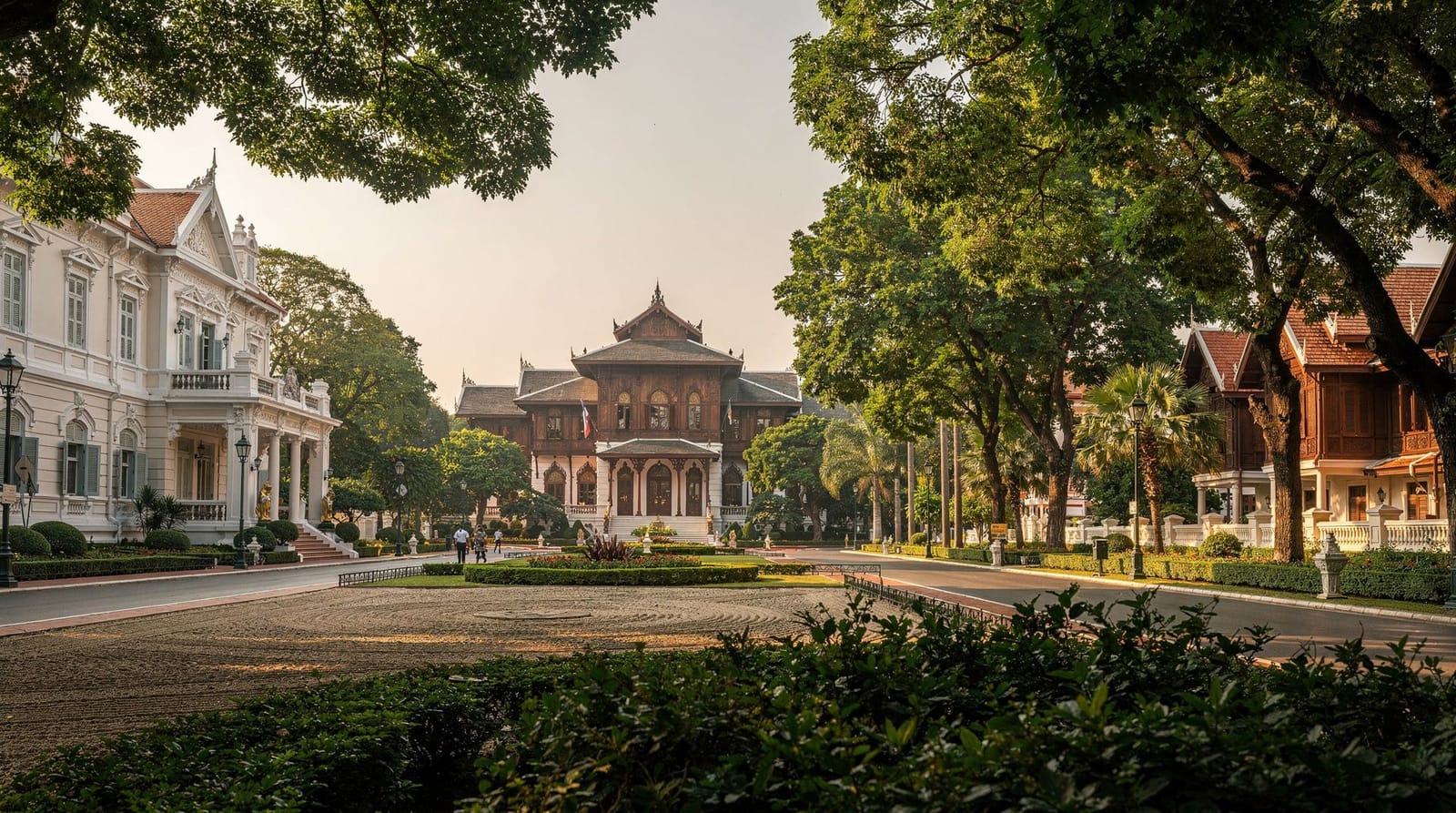
This area is the natural bridge between Bangkok’s headline sights. The Grand Palace and Rattanakosin temples are a 15–20 minute walk west. Khao San Road and Banglamphu — for cheap food and beds — are 10 minutes north. To the northeast, the royal Dusit district with its Ananta Samakhom Throne Hall and the Marble Temple is a short ride away. Threading Wat Saket and Wat Suthat into a temple-hopping day is easy on foot; see the temple-hopping route and the best temples guide. A guided half-day city temples tour ties the lesser-known temples to the famous ones in one go.
Eating in the area
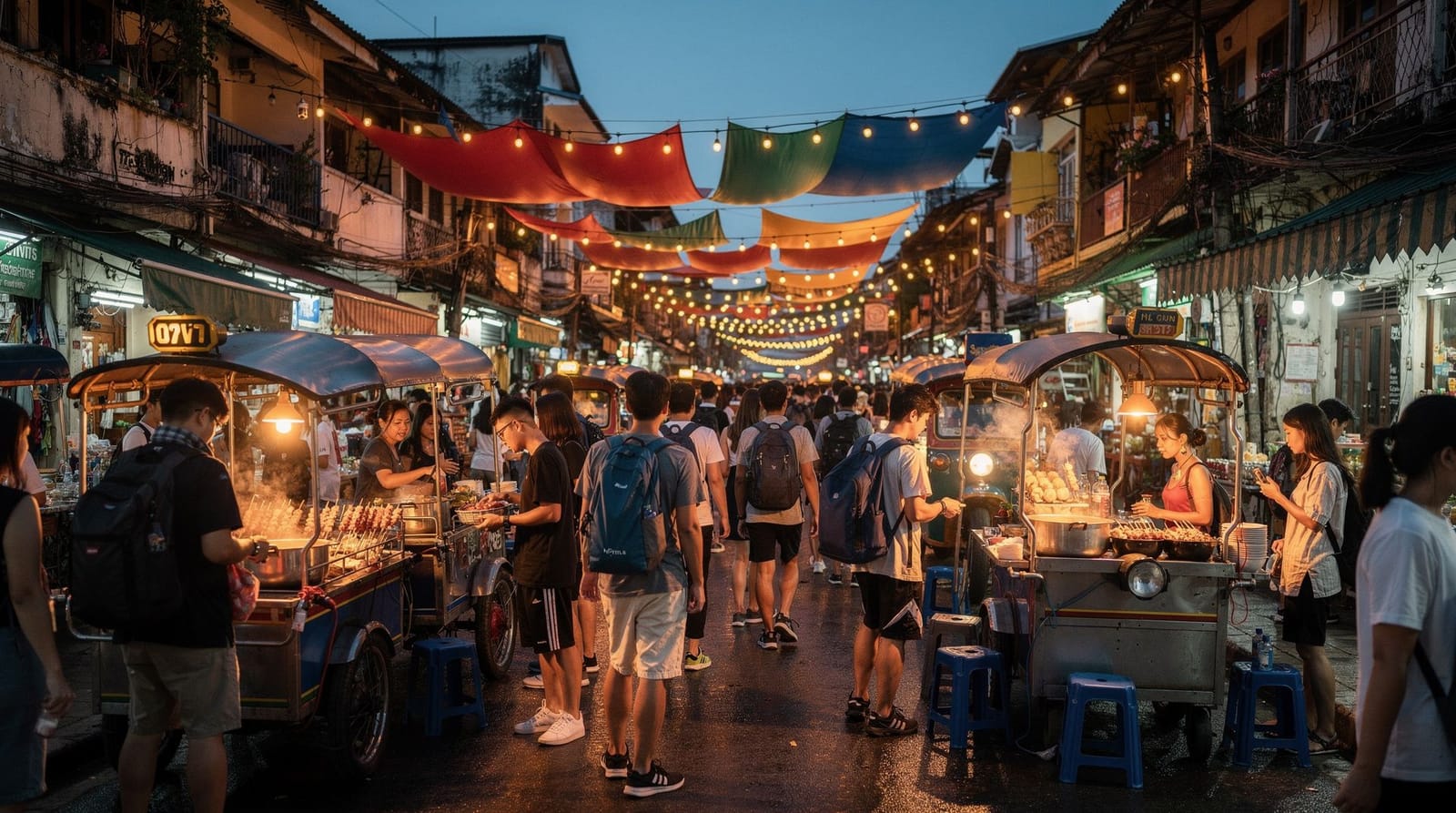
Phra Nakhon eats like the old neighbourhood it is — unpretentious, cheap and good. Stalls around Wat Saket and along the canal serve noodles, curries over rice and grilled skewers. A short ride south, Banthat Thong Road has exploded into one of Bangkok’s most exciting food streets, packed with Michelin Bib Gourmand stalls and viral dessert spots — see the Banthat Thong food guide. For old-Bangkok atmosphere, the historic coffee shops and traditional sweet makers tucked into the lanes here are part of the charm. Browse the wider street food guide and hidden gems guide for more.
Getting there and around
By MRT: Sam Yot station (Blue Line) is about a 15-minute walk from the Golden Mount and Wat Suthat — the most reliable rail option, as the old city has no BTS.
By canal boat: The Saen Saep express boat stops at Phan Fa Lilat pier, a five-minute walk from Wat Saket — a fast, traffic-dodging way to arrive from the Pratunam/Siam direction. See the getting around Bangkok guide.
On foot: Easily combined with Rattanakosin and Khao San; all within a 20-minute walk, though midday heat is intense.
By Grab or taxi: Straightforward, but old-city traffic clogs late morning. Insist on the meter or use Grab — see the Grab and taxi guide.
Remember the temple dress code applies here as everywhere — shoulders and knees covered, shoes off inside the halls; see the temple etiquette guide. For a full day plan that includes these temples, see the Bangkok temples itinerary.
Shaping your half-day here
The simplest rhythm is to treat the area as a slow afternoon rather than a checklist. Start with the quieter ground-level stops, Wat Suthat and the lanes around the Giant Swing, while the light is still high, then drift toward the Golden Mount so that the climb lands in the soft late-afternoon light. This order also means the best view of the day comes last, when you have the most patience for it and the old city is turning gold below you.
If you only have a short window, choose one anchor and let the rest be a bonus. Culture lovers will get the most from the ordination hall at Wat Suthat; photographers should protect their time for the terrace at the top. Either way, leave a little slack in the plan: the temple grounds reward wandering, and some of the best moments here are unplanned, a monk sweeping a courtyard, a shopkeeper polishing a Buddha image, a cat asleep beside a shrine.
What to look for on the way up
The climb is more than a means to a view. The spiral path passes small shrines, bells and plaques, and it is worth pausing at the landings rather than pushing straight to the top. Looking back, you can watch the neighbourhood shrink into a pattern of tiled roofs, temple spires and narrow lanes, which makes the layout of the old city much easier to understand. Orient yourself with the Rattanakosin guide before you go and the skyline starts to make sense.
At the summit, take your time on the terrace. Walk the full circuit around the chedi so you see every direction, not only the postcard side facing the Grand Palace. For ideas on composing the shot, the best photo spots guide and the temple photography tips are useful companions, and the Bangkok with a view guide compares this panorama with the city’s modern high points.
Pairing the area with other plans
Because the district sits so close to the headline sights, it slots into almost any itinerary. First-timers can fold it into the must-see list or a one-day Bangkok plan, while a slower trip fits it naturally into the three-day itinerary. If you are building a trip around ruins and relics, the Wat Arun guide and the Wat Pho guide sit on the river side of the old city and make a good contrast with this quieter, inland corner.
Travellers who prefer to avoid the busiest crowds will appreciate how different this feels from the palace zone; the overpriced attractions guide and the Bangkok first-timers guide explain where your time and money go furthest. For a gentler pace in general, the walking tours guide shows how well this compact area suits exploring on foot, and the Bangkok blog on temple hopping by boat offers a personal take on linking the old city’s temples.
Frequently asked questions about Golden Mount & Phra Nakhon
Is the climb up the Golden Mount difficult?
It is 344 steps, but they spiral gently up the hillside with shade, breezes and plenty of spots to pause, so most reasonably mobile visitors manage it comfortably in 10–15 minutes. Go in late afternoon to avoid the worst heat. There is no lift, so it is not suitable for those who cannot do stairs.
What is the best time to visit Wat Saket?
Late afternoon, around 4–5 pm, so you finish the climb in time for sunset over the old city from the chedi terrace. The cool season (November to February) makes the climb far more pleasant. If your trip falls in November, the Wat Saket temple fair is a memorable bonus.
How is this area different from the Grand Palace zone?
It has comparable temple grandeur — Wat Suthat and the Golden Mount are genuinely impressive — but a fraction of the crowds and none of the scam pressure that surrounds the Grand Palace. It feels more like a working neighbourhood, with craft lanes and local food, rather than a pure tourist site.
Can I combine the Golden Mount with the Grand Palace in one day?
Yes, easily. They are a 15–20 minute walk apart. A common plan is the Grand Palace and Wat Pho in the morning (at opening, before the heat), lunch, then the Golden Mount and Wat Suthat in the late afternoon, finishing with sunset from the chedi.
Is there a dress code at these temples?
Yes — the same as elsewhere in Bangkok. Cover shoulders and knees, and remove your shoes before entering the temple halls. Wat Suthat and Wat Saket are active places of worship, so dress and behave respectfully.
How do I get here without a BTS station nearby?
The MRT Blue Line’s Sam Yot station is about 15 minutes’ walk. Alternatively, the Saen Saep canal boat stops at Phan Fa Lilat pier, five minutes from Wat Saket, which is a quick way in from the Pratunam and Siam areas. Grab and taxis work too, though traffic is heavy late morning.
Why is the Golden Mount an artificial hill?
Because the original plan failed. King Rama III tried to build a massive chedi here in the 19th century, but Bangkok’s soft ground couldn’t bear the weight and it collapsed mid-construction, leaving a mound of rubble for decades. Later kings reshaped and reinforced it into the stable hill you climb today, capping it with a chedi enshrining a Buddha relic gifted by the British — turning a structural failure into one of the old city’s most beloved landmarks.
Top experiences
Bookable activities with verified prices and instant confirmation on GetYourGuide.