My first 48 hours in Bangkok: what I got right and wrong
I landed at Suvarnabhumi at 11pm with a printed hotel address, no SIM card, and the smug confidence of someone who had read three blog posts on the plane. By midnight I had paid roughly double the meter fare for a taxi because I did not yet know that the airport rank queue gives you a metered car and that you should insist the driver flips it on. That 250-baht mistake — maybe 7 US dollars — was the cheapest lesson Bangkok taught me, and it set the tone for two days of getting things slightly wrong in ways I now find almost affectionate.
This is the honest version of my first 48 hours: the good, the sweaty, and the things I would tell my jet-lagged self if I could.
| Where | Grand Palace, Wat Arun, Wat Pho, Chinatown |
| Cost | Well under 100 dollars across two days, excluding hotel |
| Time needed | 48 hours is a strong introduction, not a full visit |
| Getting around | Rabbit card + BTS from the start, Airport Rail Link in |
| Best time | Temples at 8:30am opening, not mid-morning |
Morning one: I underestimated the heat and overestimated my schedule
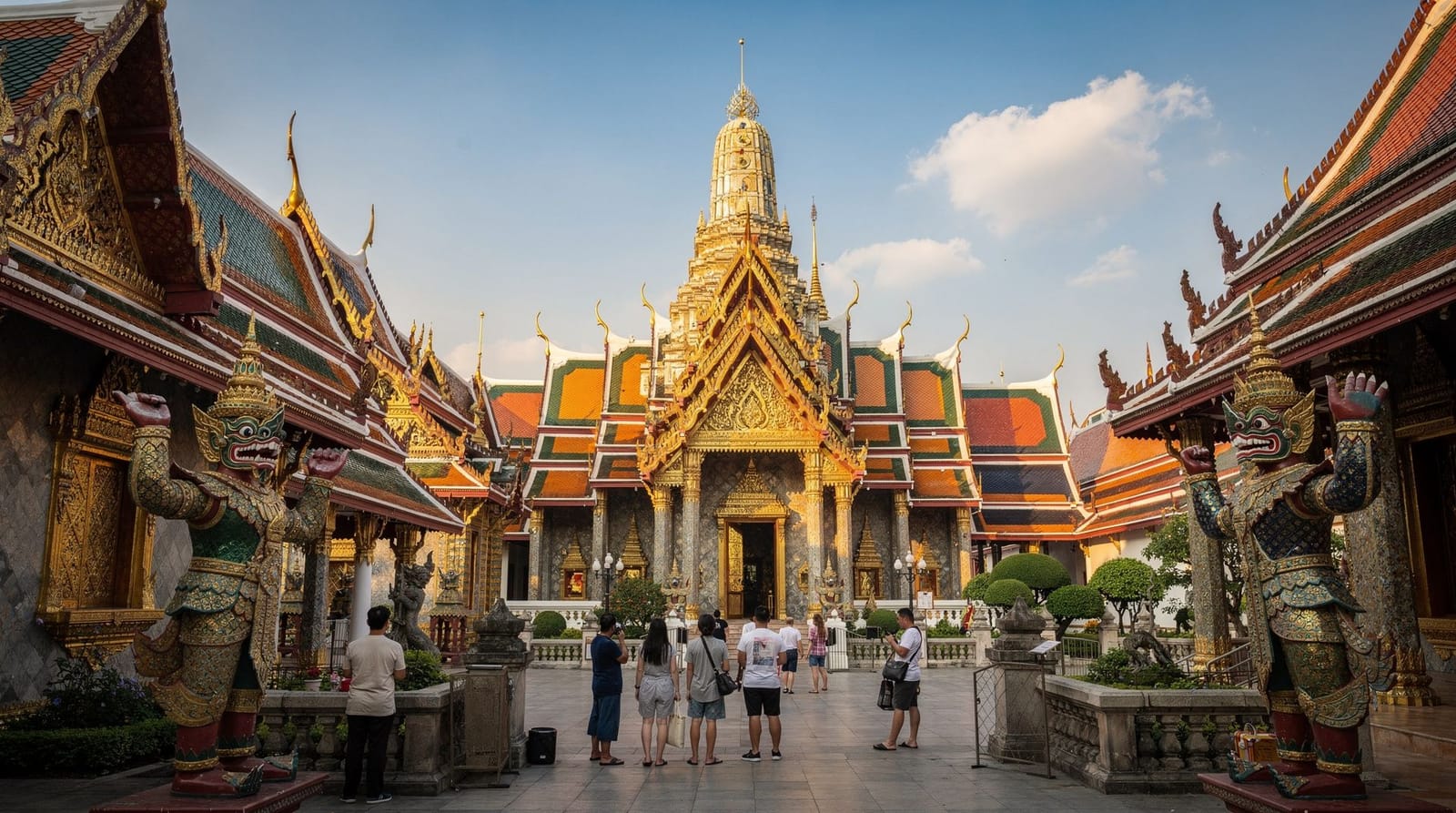
I had blocked out the entire first morning for the Grand Palace, which is the correct instinct, and then ruined it by arriving at 10:30am instead of 8:30am. By mid-morning the courtyards radiate heat off the marble and the crowds have thickened into a slow shuffle. I was wearing shorts, which meant a detour to rent the sarong-style trousers they keep at the entrance for people exactly like me. If you read nothing else about the Grand Palace dress code, know that shoulders and knees must be covered and they enforce it without sympathy.
The palace itself silenced my complaining. The Emerald Buddha sits smaller than you expect, high on its gilded pedestal, and the whole compound glitters in a way photographs flatten. I spent two hours and could have spent three. The full Grand Palace guide would have told me to budget the morning properly, and the tickets and skip-the-line page would have spared me twenty minutes in a queue. Entry was 500 baht, around 14 dollars, which felt steep until I was inside.
A word of warning that I wish someone had shouted at me at the gate: a friendly, well-dressed man approached as I walked up and told me the palace was “closed for a royal ceremony until 1pm” and offered to take me to a gem shop instead by tuk-tuk. This is the single most common scam in the city. The palace is open. Read the Grand Palace scam warning before you go and simply keep walking toward the official entrance. The variant I heard twice more that morning was a tuk-tuk driver offering a “special government promotion, 20 baht all day” — which always ends at a tailor or a gem shop where the driver collects commission. The honest rule is brutally simple: nobody official stops you in the street to redirect you, and any unsolicited tour of “lucky Buddha” temples for a flat 20 or 40 baht is a setup. The tuk-tuk scams page lays out every version, and the gem scam one is worth two minutes before you go anywhere near a jewellery shop.
Crossing the river to Wat Arun
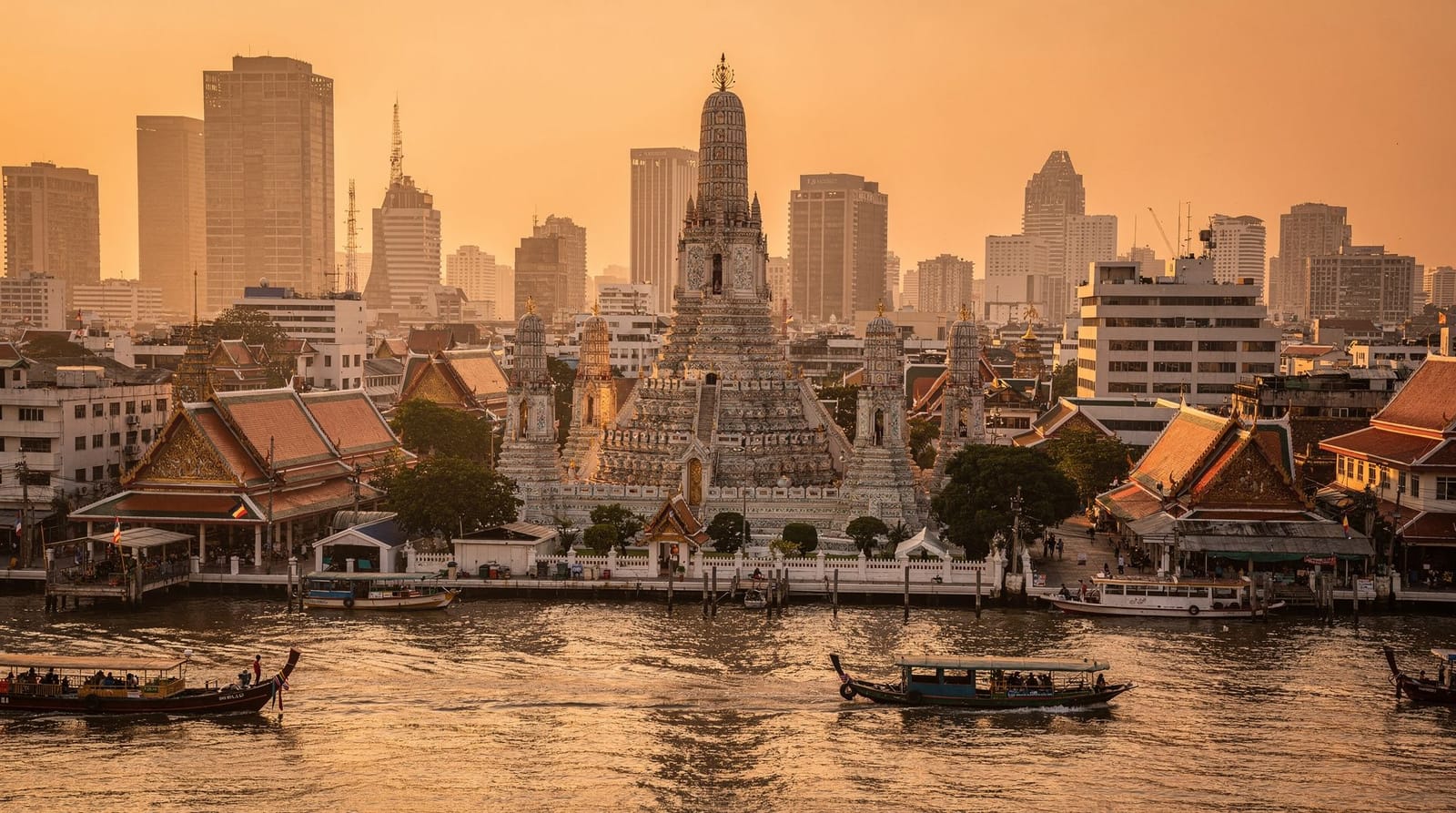
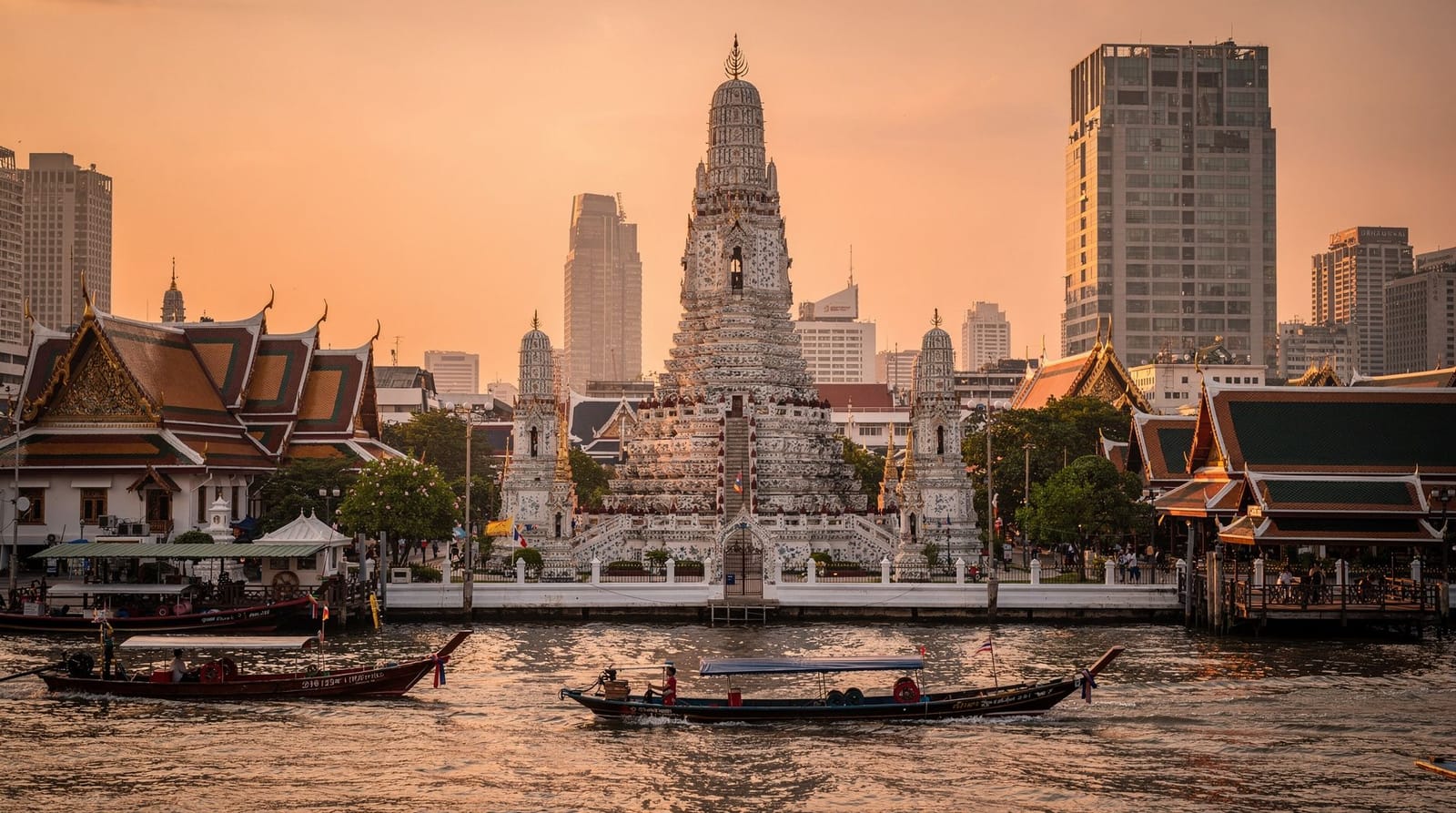
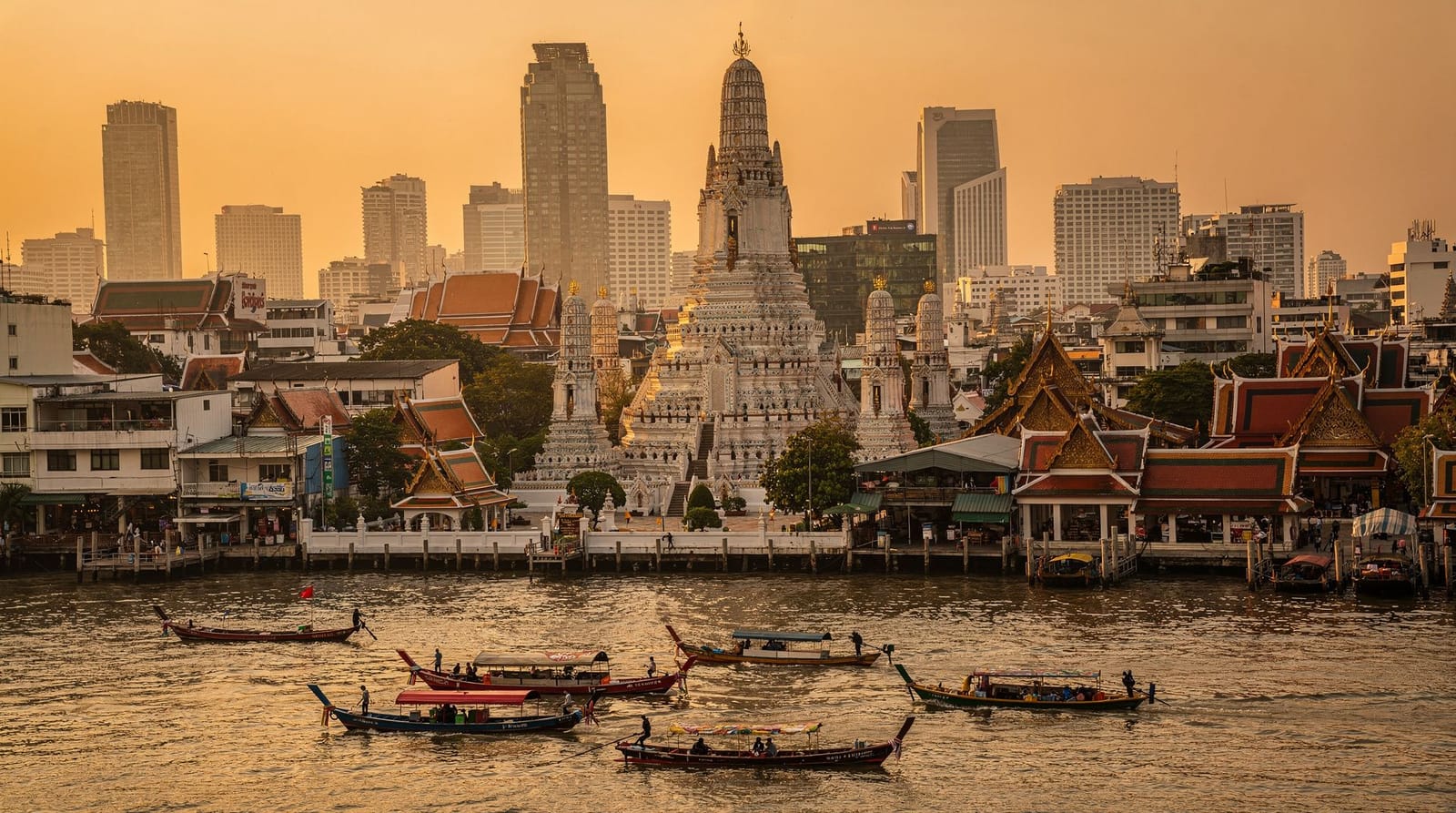
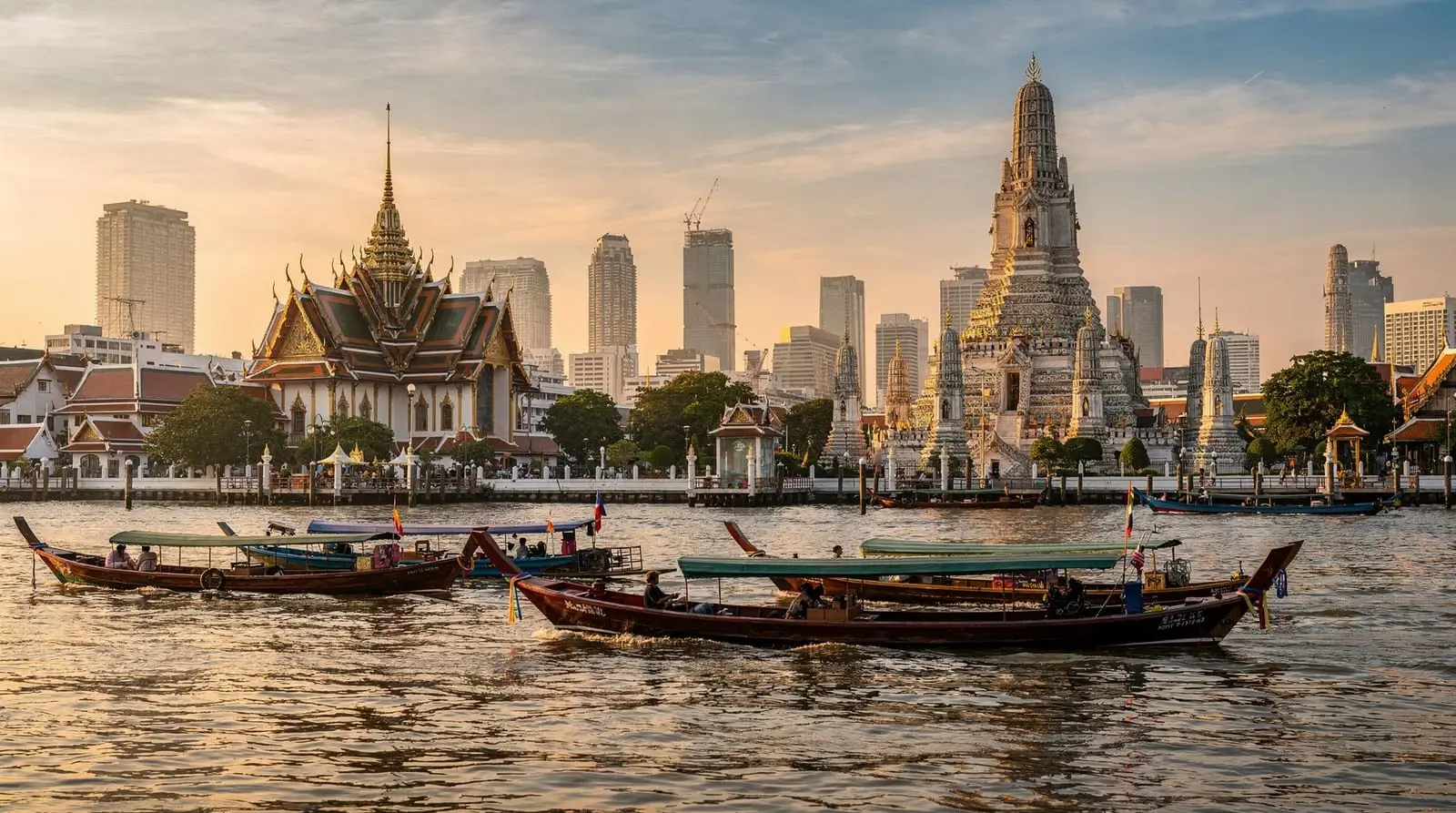
From the palace I walked down to Tha Tien pier and took the cross-river ferry to Wat Arun for 5 baht. Five baht. The smallest coin in my pocket bought me a river crossing and the best fifteen minutes of the day. The temple’s central prahang, encrusted with broken porcelain that catches the light, is the kind of thing you climb a few steep steps to half-understand. I went back two days later at sunset and understood it completely. If I were planning again I would read the Wat Arun guide first and simply go at golden hour the first time.
By early afternoon I had hit the wall. The wall in Bangkok is humidity plus jet lag plus the dawning realisation that you have been sweating for six straight hours. I retreated to an air-conditioned mall, drank an iced coffee that cost more than my lunch, and recalibrated. I want to be specific about that wall, because nobody warned me: it tends to arrive between 1pm and 3pm, it feels like your body simply switching off, and the only cure is fifteen minutes of cold air and 500ml of water. From day two I started planning a deliberate air-conditioned pause into every afternoon — a mall, a museum, a long lunch — and the whole trip improved. The 7-Eleven on every corner became my best friend: 7 baht for a litre of cold water, 15 baht for a sports drink, and an air-conditioned doorway to stand in for a minute.
Afternoon one: the BTS finally clicked
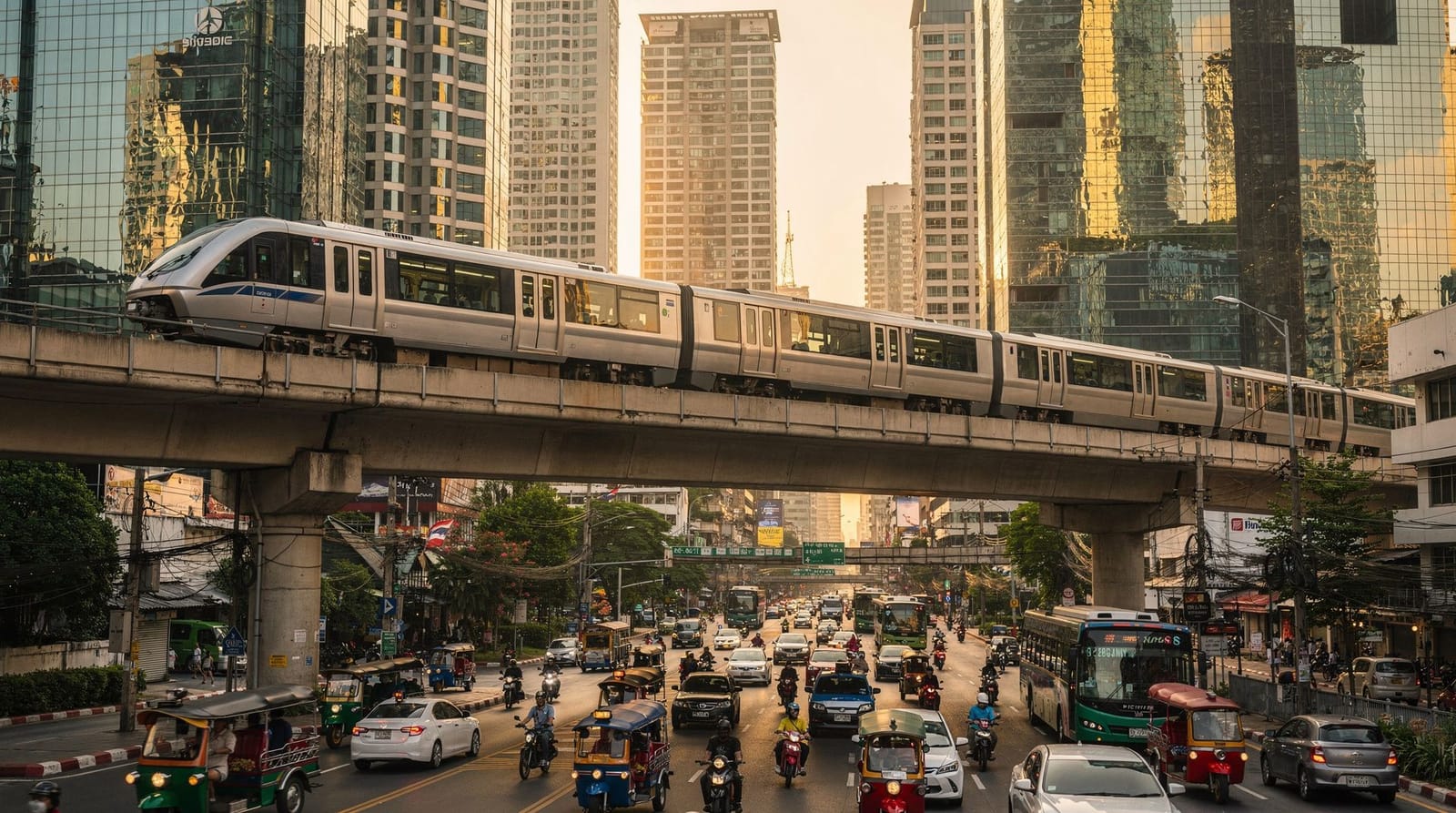
My biggest practical failure on day one was not buying a Rabbit card immediately. I fumbled coins into the BTS ticket machines twice before someone kindly pointed me toward the counter. The BTS Skytrain guide and the Rabbit card guide both make this obvious in hindsight: get the stored-value card, tap in and out, never think about it again. A single ride runs roughly 17 to 62 baht depending on distance, and the trains are clean, frequent, and gloriously cold.
Once I had the card, the city reorganised itself. Siam became the hinge of everything — the malls, the interchange, the crowds of Thai teenagers. I drifted through the air-conditioned cathedral of consumption that is the Siam shopping district, bought nothing, and felt thoroughly recovered.
Evening one: my first real street food, and my first real fear
Dinner the first night was timid. I ordered pad thai from a stall near my hotel in Sukhumvit because it was the one dish I could name, and it cost 60 baht and was excellent and I felt like a coward. I had walked past a dozen stalls steaming with things I could not identify and chosen the safe option. The street food safety advice is genuinely reassuring once you read it: busy stalls with high turnover are your friend, and the food is cooked in front of you. I would spend the next two days correcting my timidity one skewer at a time.
Day two: I finally relaxed into it
Morning two started better because I had learned. Up early, BTS to the river, and a long slow morning along the Chao Phraya. The Chao Phraya Express boats are the city’s most underrated transport — a tourist boat pass exists but the regular orange-flag locals’ boat is 16 baht and goes everywhere you want. I read the Chao Phraya boats guide the night before and it made the colour-coded flag system make sense.
I had booked a guided temple morning for day two because I wanted someone to explain what I was looking at, and it was the right call for a first-timer. A half-day guided loop through the Grand Palace, Wat Pho and Wat Arun turned three monuments I would have glanced at into three monuments I understood, and the guide handled the boat logistics so I did not have to.
Wat Pho was the surprise of the trip. Everyone photographs the reclining Buddha, all 46 metres of gold-leafed serenity, but the real pleasure was the quiet courtyards of stupas behind it where almost no one walks. Entry was 300 baht, around 8 dollars, and included a small bottle of water. I ended the visit with a thirty-minute traditional massage at the temple’s famous school for 480 baht, which is where the founders of Thai massage trained, and walked out feeling rearranged.
Evening two: Chinatown ate my caution
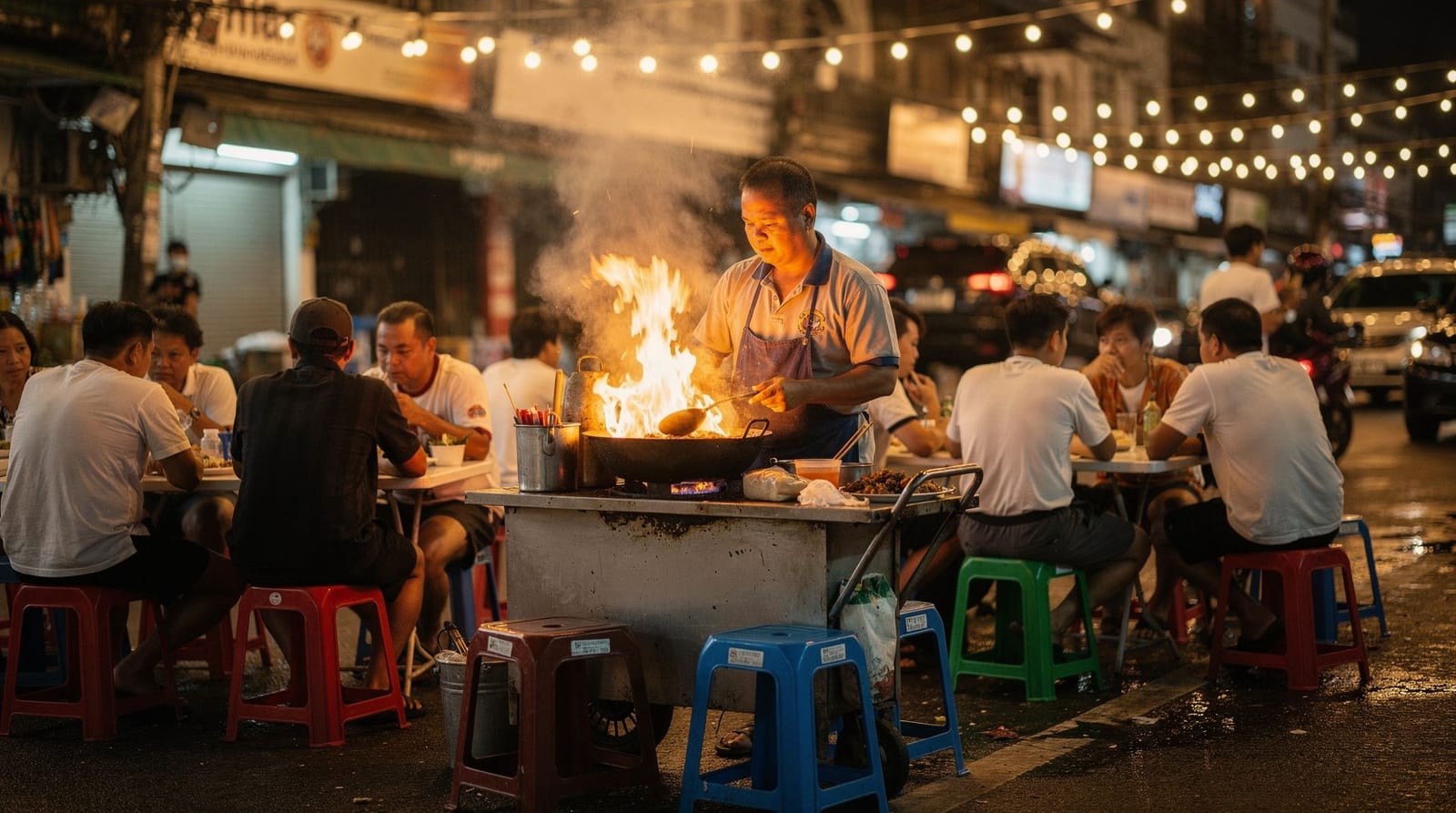
The second evening I went to Chinatown with the explicit goal of being braver, and Yaowarat Road delivered. The street transforms after dark into a corridor of neon, charcoal smoke, and woks the size of bicycle wheels. I ate grilled prawns, a bowl of fishball noodles, mango with sticky rice, and a cup of something orange and sweet I never identified. I spent maybe 400 baht and ate better than I had in months. The Yaowarat Chinatown food guide maps the stalls properly; I just followed my nose and the queues, which is its own valid strategy.
The SIM card and the airport taxi, fixed in hindsight
The two things I got wrong before I even left the airport are the two things easiest to get right. The SIM card first: there are AIS, TrueMove and dtac counters in the Suvarnabhumi arrivals hall, and a tourist SIM with a week or so of generous data runs around 300 baht. I skipped it out of stubbornness and spent my first day hunting wifi like it was 2008. Get the SIM, or buy an eSIM before you fly — the Bangkok SIM and eSIM guide compares the options and the eSIM route means you walk out of the plane already online.
The airport taxi second: ignore every man who approaches you inside the terminal offering a ride. Walk down to level 1, join the public taxi queue, take the little ticket from the machine, and insist the driver runs the meter. A metered ride into the city centre is roughly 250 to 400 baht plus a 50-baht airport surcharge and any expressway tolls, which come to maybe 70 baht — so budget around 400 to 500 baht total, not the 700 the touts quote. The Suvarnabhumi to city guide also explains the Airport Rail Link, which is 45 baht to Phaya Thai and connects to the BTS, and is what I use now whenever I am travelling light.
Where I stayed, and where I’d stay next time
I booked a generic mid-range hotel in lower Sukhumvit near Nana BTS, chosen purely because it was cheap and central, and it was fine — close to the Skytrain, walkable to food, easy to get back to when the wall hit. But two days taught me that where you base yourself shapes the whole trip. If your priority is temples and the river, the old city around Rattanakosin or the backpacker energy of Khao San puts you in walking distance of the headline sights, though it is poorly served by the BTS. If you want food, nightlife and transport links, Sukhumvit or Silom sit right on the train lines. The where to stay guide breaks down each neighbourhood by traveller type; for a first 48 hours I would still choose proximity to a BTS station over everything else, because the Skytrain is what makes a short trip feel unhurried.
The apps I wish I’d had running before I landed
The single biggest upgrade between my shaky day one and my much smoother day two was having the right apps ready before I ever left the jet bridge. Grab, for cars and food delivery, needs an account and a linked card set up in advance, not fumbled at 11pm with no data. Google Maps works better offline-cached for the neighbourhoods you will walk, since signal dips underground on the MRT. And the BTS’s own app makes sense of the fare and line system faster than the paper maps at the machines. None of this is complicated, but doing it on the plane rather than jet-lagged at the airport would have saved me my first confused hour entirely. The getting around guide is worth skimming before you fly for exactly this reason.
My two days, side by side
| Morning | Afternoon | Evening | |
|---|---|---|---|
| Day 1 | Grand Palace (too late, learn from this) | Wat Arun, mall AC break, Siam | Timid street food in Sukhumvit |
| Day 2 | Guided Grand Palace/Wat Pho/Wat Arun loop | Wat Pho massage | Chinatown street food, braver |
What I’d tell my first-timer self
Slow down. Two days is not enough to “do” Bangkok, and trying to tick boxes is the fastest way to enjoy none of them. If I planned those 48 hours again I would read the first-timers guide and follow a loose two-day itinerary, buy the Rabbit card at the airport, get a SIM card in arrivals, and go to the temples at dawn. I would also accept that I would still get a few things wrong, because getting things wrong is, it turns out, how you fall for this city.
Frequently asked questions about a first Bangkok visit
Is 48 hours enough for Bangkok?
It is enough to see the headline temples, eat extremely well, and get a feel for the rhythm of the city, but not enough to explore neighbourhoods or take a day trip. Treat it as a strong introduction rather than a complete visit.
What is the biggest first-timer mistake?
Overpacking the schedule and underestimating the heat. Plan two or three anchor activities per day with air-conditioned breaks between them, and start early.
How much does a first 48 hours cost?
Modestly. Temple entries, transport, street food and a couple of sit-down meals ran me well under 100 dollars across two days, excluding accommodation. Bangkok rewards travellers who eat at stalls and use the BTS.
Should I get a SIM card at the airport?
Yes, or buy an eSIM before you fly. A tourist SIM with a week of data is around 300 baht from the AIS, dtac or TrueMove counters in arrivals, and having data immediately makes navigating, ordering a Grab and translating menus dramatically easier on day one.
How do I get from Suvarnabhumi airport to central Bangkok?
The cheapest route is the Airport Rail Link, 45 baht to Phaya Thai where you change to the BTS. A metered public taxi from the level-1 rank runs roughly 400 to 500 baht all in, including the airport surcharge and tolls. Ignore anyone offering a ride inside the terminal.
What is a good third day in Bangkok?
A day trip to Ayutthaya by train, or a slow exploration of one neighbourhood like Chinatown or the riverside. The how many days in Bangkok guide and a loose three-day plan help you build on a strong first 48 hours.