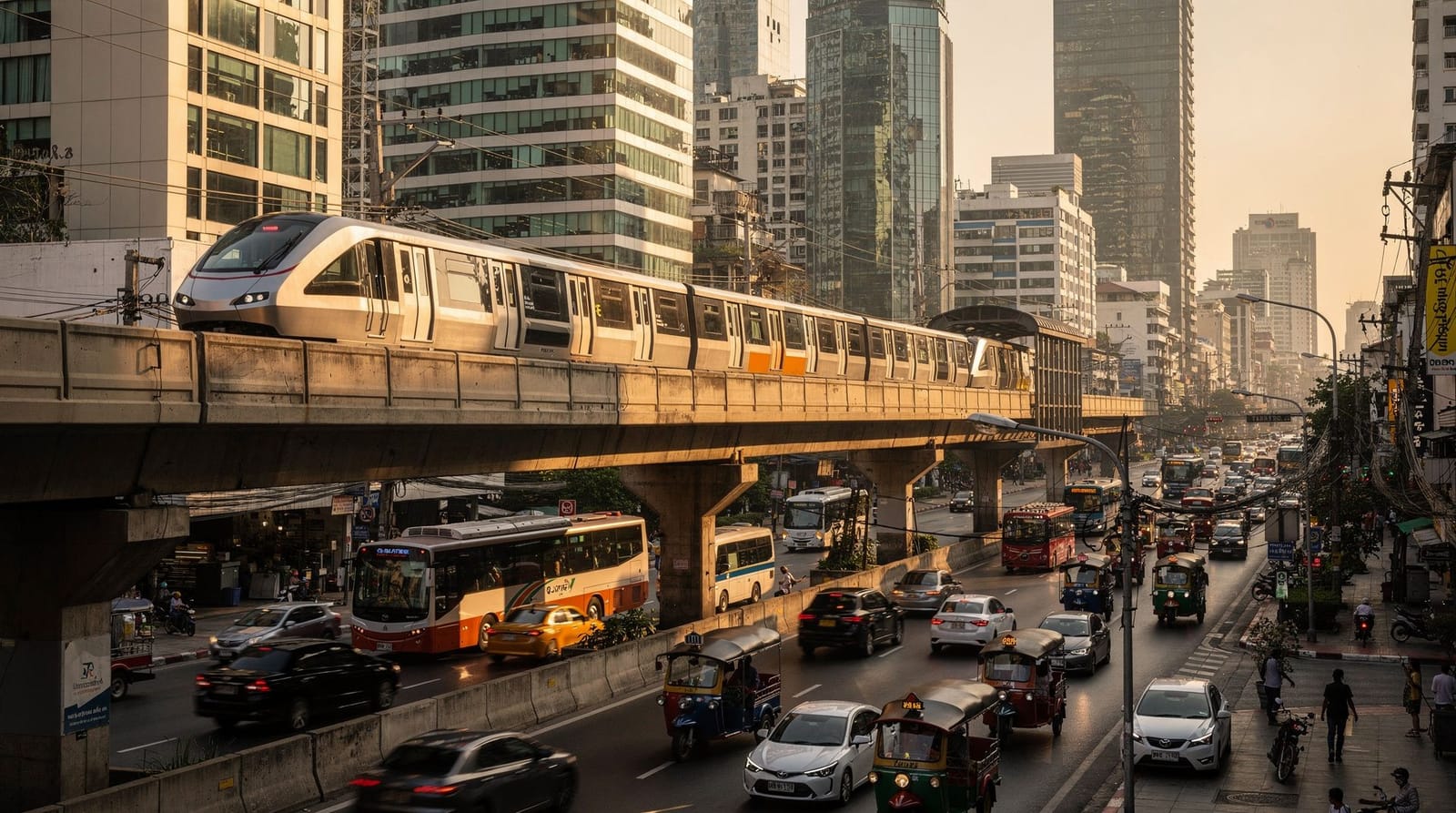
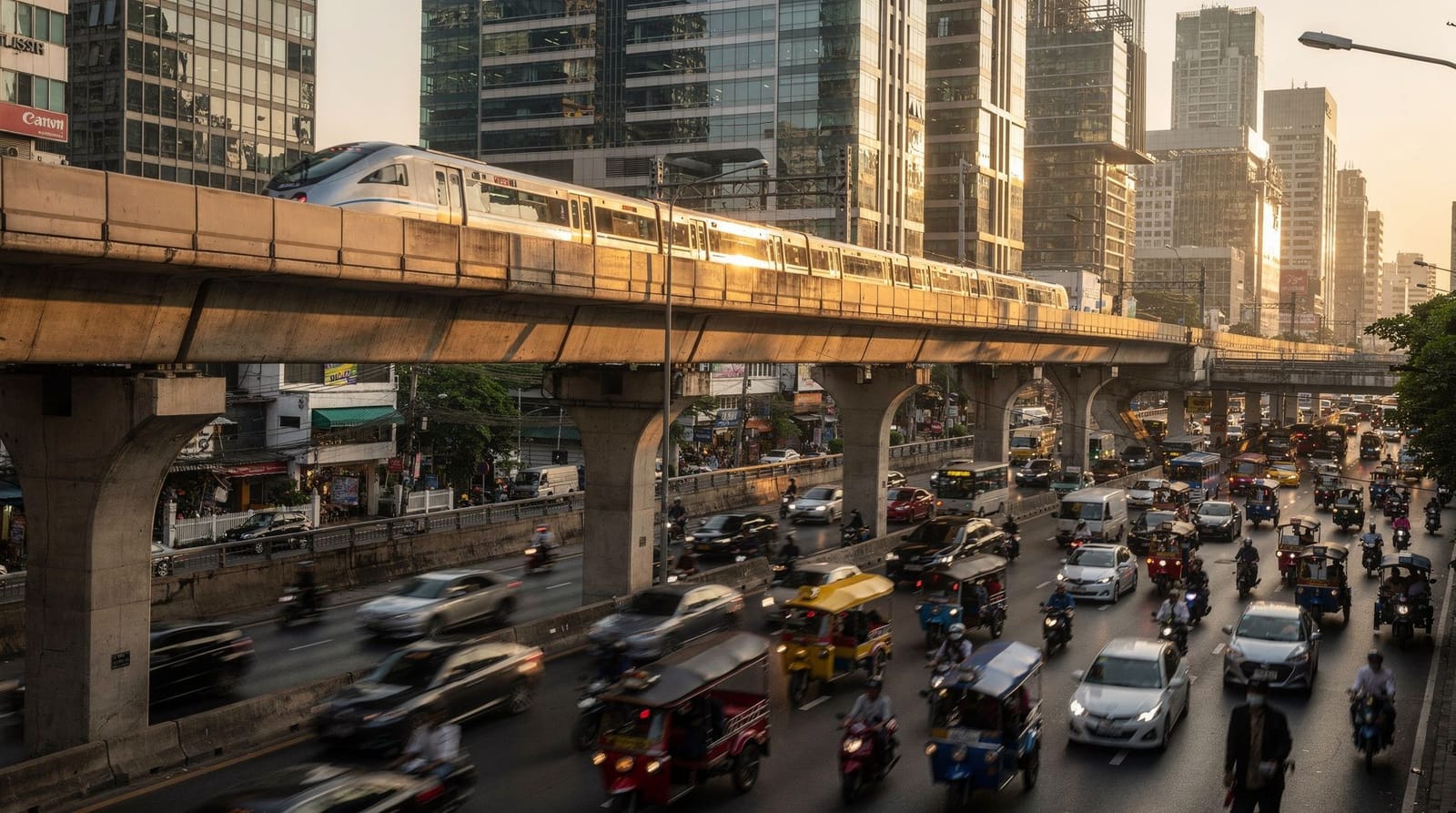
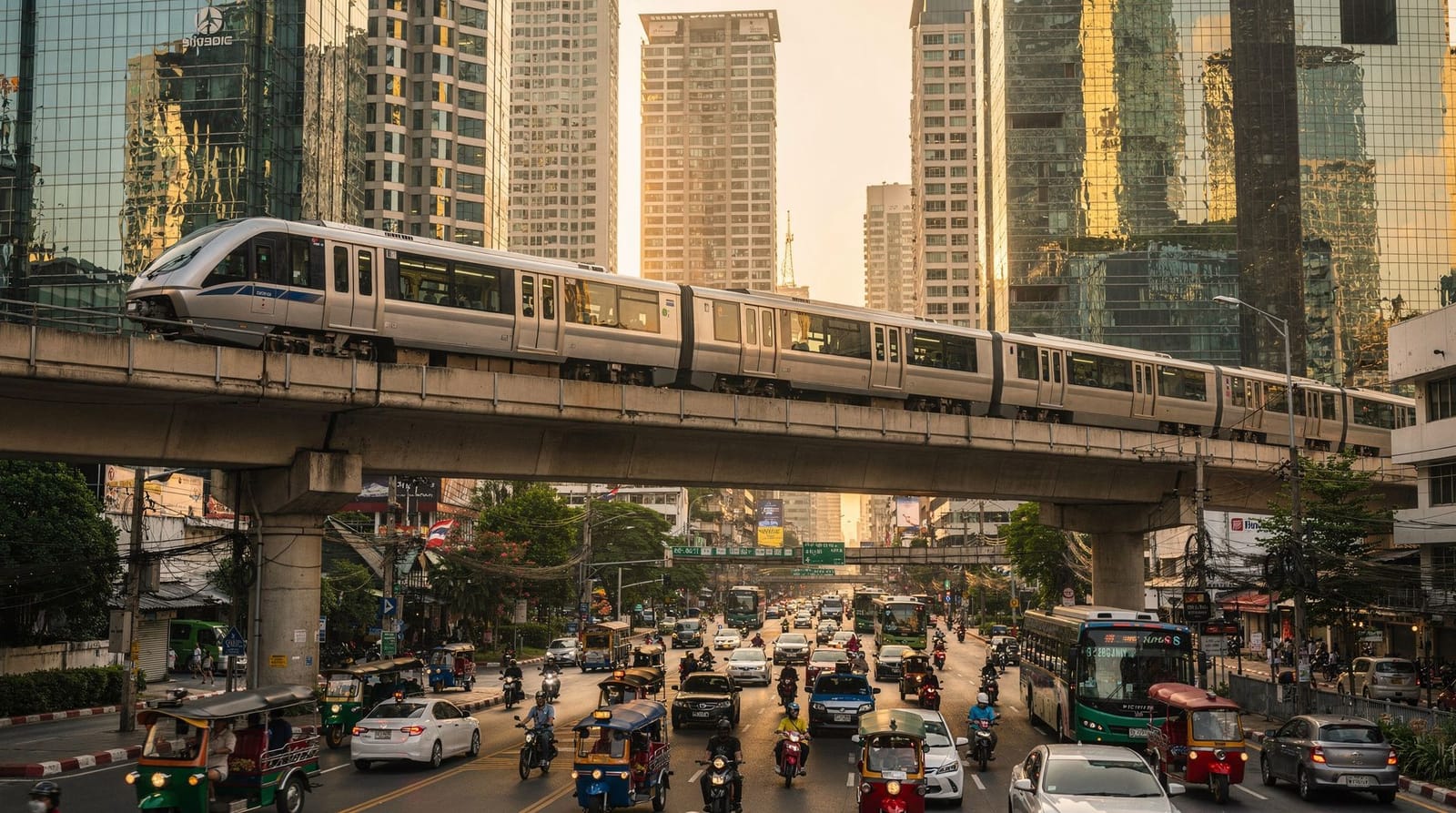
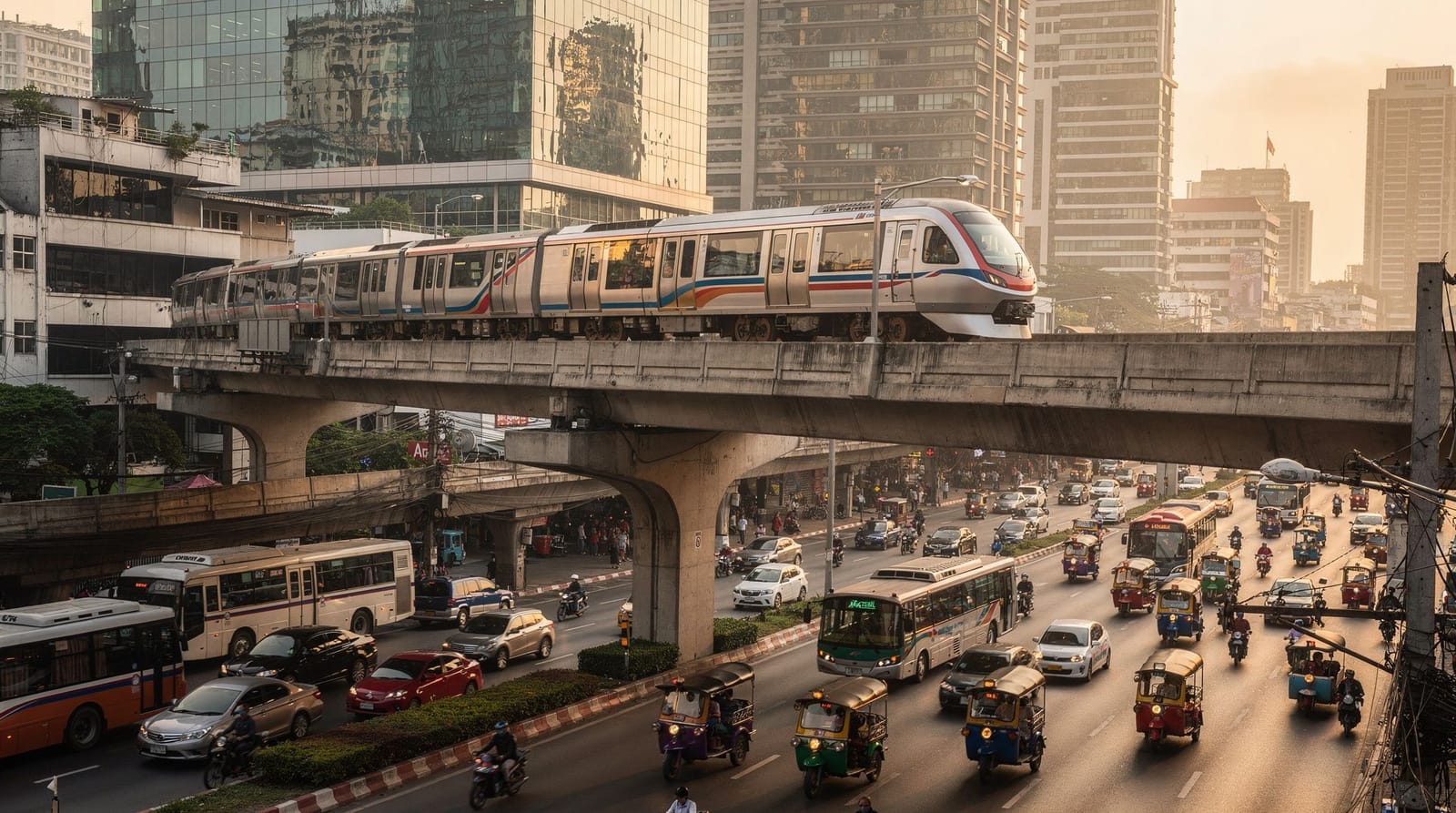
Suvarnabhumi airport to Bangkok city: every option compared
Bangkok and Nearby Private Car & Driver
What is the best way to get from Suvarnabhumi airport to central Bangkok?
The Airport Rail Link train is fastest and cheapest at busy times — about 30 minutes to Phaya Thai BTS station for the fare on the operator's official site, beating road traffic. A metered taxi from the official rank costs roughly 250–400 THB plus tolls and is door-to-door but slower in congestion. Grab gives a fixed upfront price and avoids taxi haggling. Pick the train if your hotel is near a BTS station, a taxi or Grab if you have heavy luggage.
Suvarnabhumi (pronounced roughly “su-wan-na-poom”, airport code BKK) is Bangkok’s main international gateway, about 30 km east of the city centre. Your first decision on arrival — train, taxi, Grab or private transfer — sets the tone for the whole trip, and the right answer depends on where your hotel is, how much luggage you have, and what time you land. This guide compares every option honestly on price, time and hassle so you can stride out of arrivals knowing exactly what to do.
For the budget airport’s own routes, see the separate Don Mueang airport to city guide — and double-check your ticket, because the two airports are far apart.
The quick verdict
- Near a BTS station and travelling light? Take the Airport Rail Link — fast, cheap and traffic-proof.
- Heavy luggage, family, or staying in the Old City or riverside? Take a metered taxi from the official rank or a Grab door-to-door.
- Arriving late at night, or want zero friction? Pre-book a private transfer with a name-board pickup.
Airport Rail Link — fastest at busy times
The Airport Rail Link (ARL) is the smart default for visitors whose hotels sit near the BTS. Trains run from the airport’s basement level (B) — follow the clear signage down — to Phaya Thai station in about 30 minutes for the fare on the operator’s official site. Because the line is grade-separated, it completely ignores the road traffic that can turn the same trip into 90 minutes by car at rush hour.
The ARL stops at Makkasan (where you can transfer to the MRT subway at Phetchaburi) before terminating at Phaya Thai, which connects to the BTS Skytrain Sukhumvit Line. From Phaya Thai, a short Skytrain ride reaches Siam, Sukhumvit and most modern hotels. Trains run roughly 06h00 to midnight, every 10–15 minutes. Buy a Rabbit Card at a BTS station once you arrive if you plan to use the Skytrain more than once or twice — it saves queuing at the ticket machines with luggage each time.
The catch is the transfer with luggage: you’ll navigate stairs, escalators and a change of train, which is fine with a backpack or carry-on but awkward with two large suitcases. If your hotel isn’t near a BTS station, the train’s advantage evaporates once you add a taxi at the other end.
Metered taxi — door-to-door, watch the rank
Bangkok’s metered taxis are cheap and convenient door-to-door — if you use them correctly. Go to the official public taxi rank on level 1 (the floor below arrivals), take a queue ticket from the machine, and you’ll be assigned a metered cab. Confirm the meter is running before you set off.
Expect roughly 250–400 THB on the meter to central districts like Sukhumvit or Silom, plus a 50 THB airport surcharge and 25–70 THB in expressway tolls that you pay (the tolls are worth it to skip surface traffic). Total: often 350–500 THB all-in.
Avoid the touts who approach you inside the terminal offering “taxi, limousine, fixed price” — these are several times the metered fare. The official rank downstairs is the only one to use, and the meter is your protection. The broader rules of Bangkok taxis are in the Grab, taxi and tuk-tuk guide.
Grab — fixed price, no haggling
Grab (and its rival Bolt) operate at Suvarnabhumi from a designated ride-hailing pickup area — follow the in-terminal signage, which directs you to the correct level. You book in the app, see the exact fare upfront, and pay by saved card or cash. There’s no meter dispute and no surcharge surprise.
Grab pricing is usually similar to, or a little above, a metered taxi all-in — but the certainty is the selling point, especially after a long flight or late at night when street-taxi meter refusal is most common. The app handles your destination in English, so you never have to explain a route to a driver. For solo travellers and families arriving tired, the predictability is often worth the small premium. The solo travel Bangkok guide explains why GPS-tracked Grab is reassuring on a night arrival.
Private transfer — the no-friction option
A pre-booked private transfer is the most expensive route but the least stressful: a driver waits in arrivals with a name board, helps with luggage, and takes you straight to your hotel with no queue, no app and no negotiation. It’s the right choice if you’re arriving on a red-eye, travelling with elderly companions or young children, carrying a lot of luggage, or simply want the trip handled.
If you want a vehicle on tap for the whole stay rather than just the transfer, hiring a private car and driver in Bangkok and nearby covers the airport pickup and then doubles as your transport for scattered sightseeing or day trips — useful for families and packed itineraries.
Before you leave the terminal
The most useful minutes of your arrival are spent before you pick a transport mode. Immigration queues can be slow, so do not book anything with a tight pickup window until you have cleared passport control and collected your bags. Check the entry requirements in the Thailand visa and TDAC guide before you fly, so the paperwork is done and you are not filling in forms on your phone in the queue.
Once you are through, sort out connectivity. A local data plan makes every option in this guide easier: you can follow the route, message your hotel and open the Grab app straight away. The Bangkok SIM and eSIM guide explains the choices, and an eSIM installed before landing means you can book a ride from the baggage hall. Keep your hotel’s name and address saved in Thai script as well as English, so any driver can read it at a glance.
Which option for which hotel area
Matching the mode to the neighbourhood saves more than any trick at the rank.
- Sukhumvit, Nana, Asok and Phrom Phong: these sit on the Skytrain line, so the train plus a short BTS ride is natural. See the Sukhumvit guide and the Phrom Phong district page for what each stretch is like.
- Siam, Ratchaprasong and Pratunam: also easy by train via Phaya Thai, with Siam and Ratchaprasong a short Skytrain hop away.
- Silom and Sathorn: reachable by rail, but a taxi or Grab avoids the transfer; the Silom and Sathorn guide shows where the stations fall.
- Old City, Khao San and Rattanakosin: no station nearby, so a taxi or Grab straight to the door is usually the calmer choice. Read the Old City guide and the Khao San Road guide before you pick.
- Riverside and Chinatown: boats and the subway help once you are settled, but from the airport a car is simplest. The riverside guide and the Chinatown guide cover the area.
If you are still undecided on a base, the Bangkok neighbourhoods guide and the Thonglor and Ekkamai guide compare the options, and the first-timers guide gives a wider orientation.
Arriving late at night
A late landing changes the calculation. The train stops running around midnight, so if your flight is delayed you may find it closed, and a taxi or Grab becomes the only sensible route. At that hour the roads are quicker, but it is also when you most want certainty about the fare and a driver you can trace. Booking through an app, or arranging a private pickup in advance, removes the worst of the tiredness and the risk of a dispute. If you are a woman or travelling alone, the solo travel guide has practical advice on night arrivals, and the common Bangkok scams guide lists the tricks that tend to target tired travellers at transport hubs. Whatever you choose, tell your hotel your arrival time so someone is at reception to let you in.
Common arrival tricks to ignore
A few patterns repeat at airports everywhere. A driver who says the meter is broken, a stranger who claims your hotel is closed or full, or a “helper” who offers to carry bags and then wants payment are all worth politely declining. Walk on, head for the official rank or your app pickup, and do not feel obliged to explain. The tuk-tuk scams guide and the tourist traps guide describe the same behaviour in the city, and spotting it at the airport makes you sharper for the rest of the trip. A calm, unhurried “no thank you” works better than any argument.
Going back to the airport
The return journey deserves more planning than the arrival, because a missed flight costs far more than a slow taxi. Leave early, especially for an afternoon or evening departure, and avoid cutting it close on rainy days; the Bangkok in the rain guide explains how a downpour can stall roads that are normally clear. If your hotel is near a station, the train is the most predictable way back because it does not care about traffic. If you take a car, ask your hotel to arrange it the day before, or book a Grab with a generous buffer. Keep your passport, boarding pass and any remaining baht accessible, and remember that the Don Mueang guide applies instead if you are flying from the other airport.
Combining the transfer with your first day
If you arrive in the morning and your room is not ready, you do not have to wait in the lobby. Most hotels will hold luggage, and a first afternoon can be gentle: a walk in Lumphini Park, a meal from the street food guide, or an easy loop through the Bangkok highlights for first-timers. Heading to a market or temple on day one is tempting, but jet lag makes choices harder, so keep the first day light. The how many days in Bangkok guide and the Bangkok 2 days itinerary help you shape the next few days, and the weather by month guide tells you what to expect from the sky when you step outside.
If you would rather not work out the temples on your own once you have rested, a private guided day around the Grand Palace, Wat Pho and Wat Arun keeps the logistics in someone else’s hands, which suits a day when you are still adjusting to the heat and the time difference. Book it for the second morning rather than the day you land, so a late flight or a slow immigration queue never puts it at risk.
Cost and time at a glance
| Option | Typical cost | Time to centre | Best for |
|---|---|---|---|
| Airport Rail Link + BTS | the fare on the operator’s official site + BTS fare | ~30 min + transfer | Light luggage, hotel near BTS |
| Metered taxi (official rank) | ~350–500 THB all-in | 40–90 min (traffic) | Luggage, door-to-door, Old City/riverside |
| Grab / Bolt | similar to taxi, fixed | 40–90 min (traffic) | Certainty, late night, no haggling |
| Private transfer | premium | 40–90 min (traffic) | Families, red-eyes, zero friction |
Road times swing wildly with traffic and rain — allow generous margins, especially for the return trip to catch a flight, where missing the airport is a real risk during the evening rush.
Layovers and short stays
If you’re transiting with a long layover, the ARL makes a quick dash into the city feasible — but factor the round trip, immigration and security. The dedicated Bangkok layover itinerary maps what’s realistic in a few hours. For most layovers under six hours, staying airside or near the airport is the safer call than risking the traffic both ways.
Choosing where to stay before you leave the airport
Your transport choice and your hotel choice are really the same decision made twice. If you already know your hotel sits a short walk from a BTS station, the Airport Rail Link is close to unbeatable on cost and reliability. If you haven’t booked yet, the where to stay in Bangkok guide is worth reading before you land, since choosing a hotel near a station saves money and hassle on every single trip out, not just the one from the airport. Whichever mode you choose, budget it into your overall trip spending — the Bangkok travel costs guide gives a realistic daily figure that the airport transfer fits neatly on top of, generally as a one-off rather than a recurring cost.
On luggage and comfort: if you’re arriving jet-lagged with a stroller, elderly travel companions, or simply prefer not to think about logistics after a long flight, the private transfer earns its premium. If you’re travelling light and alert, the ARL or a Grab are both perfectly comfortable. Either way, keep valuables and travel documents in easy reach rather than buried in checked luggage, and change a small amount of currency at the airport counters (rates are worse than in the city, so change only enough for your first taxi, meal or SIM card) — the what to pack for Bangkok guide covers the rest of the pre-departure checklist.
Your hotel address decides how the Suvarnabhumi transfer works, so have the exact name and the arrival time of your flight to hand when you compare private options, and check that the quote covers the whole trip to the hotel door, luggage included. A driver who is told the hotel in advance spares you any negotiating in the arrivals hall, and you can look at private transfers on Kiwitaxi for Suvarnabhumi pick-ups.
Frequently asked questions about Suvarnabhumi airport to Bangkok city: every option compared
How much is a taxi from Suvarnabhumi to central Bangkok?
How do I take the Airport Rail Link to the city?
Is Grab available at Suvarnabhumi airport?
How far is Suvarnabhumi from central Bangkok?
Should I pre-book a private transfer from the airport?
Which airport is Suvarnabhumi and how is it different from Don Mueang?
Can I get to my hotel by public transport with luggage?
Top experiences
Bookable activities with verified prices and instant confirmation on GetYourGuide.