Don Mueang airport to Bangkok city: the budget-airport guide
Bangkok and Nearby Private Car & Driver
What is the best way to get from Don Mueang airport to central Bangkok?
The SRT Dark Red Line train is the fastest traffic-proof option from Don Mueang (DMK), connecting at Bang Sue Grand Station to the MRT. The A1/A2 airport buses are cheapest, running to the BTS at Mo Chit/Chatuchak for around 30–50 THB. A metered taxi from the official rank costs roughly 250–400 THB plus tolls door-to-door, and Grab gives a fixed upfront price. Choose the train or bus if light, a taxi or Grab if loaded with luggage.
Don Mueang (airport code DMK) is Bangkok’s older, northern airport and the hub for low-cost carriers — AirAsia, Nok Air, Thai Lion Air and the like. If you’re arriving on a budget flight, this is almost certainly where you land, and it’s a different proposition from the main international airport. It sits about 25 km north of the centre, has fewer slick transport links than Suvarnabhumi, and rewards a little planning. This guide compares every realistic route into the city honestly.
Crucially, check your ticket: Don Mueang (DMK) and Suvarnabhumi (BKK) are on opposite sides of Bangkok, and confusing them can cost you a flight.
The quick verdict
- Travelling light and watching the budget? Take the A1 bus to Mo Chit BTS, or the SRT Dark Red Line train.
- Loaded with luggage, or arriving late? Take a metered taxi from the official rank or a Grab door-to-door.
- Family or zero-friction arrival? Pre-book a private transfer.
A1 and A2 express buses — the budget classic
The cheapest reliable route is the A1 express bus, which runs frequently from Don Mueang to Mo Chit / Chatuchak, where you connect to both the BTS Skytrain (Mo Chit station) and the MRT (Chatuchak Park / Kamphaeng Phet). The fare is around 30–50 THB, paid onboard to the conductor. The A2 runs a slightly different route to Victory Monument BTS.
From Mo Chit you’re on the rail network and can reach Siam, Sukhumvit and the rest of the city traffic-free. The downside: the bus itself sits in road traffic between the airport and Mo Chit, so allow extra time at rush hour. For budget travellers, the A1-to-BTS combination is the classic move — cheap, simple, and detailed further in the Bangkok on a budget guide.
SRT Dark Red Line — the traffic-proof train
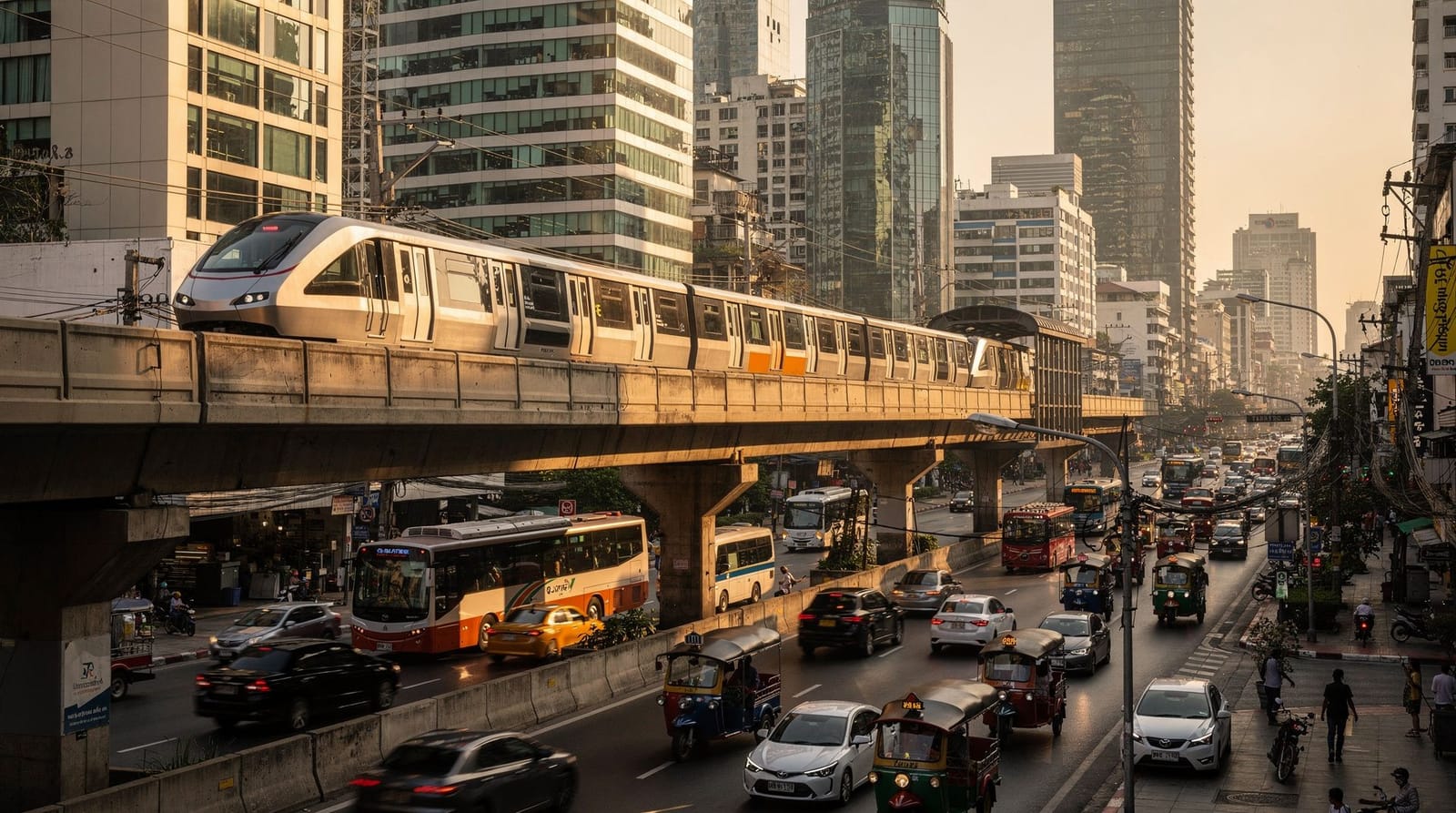
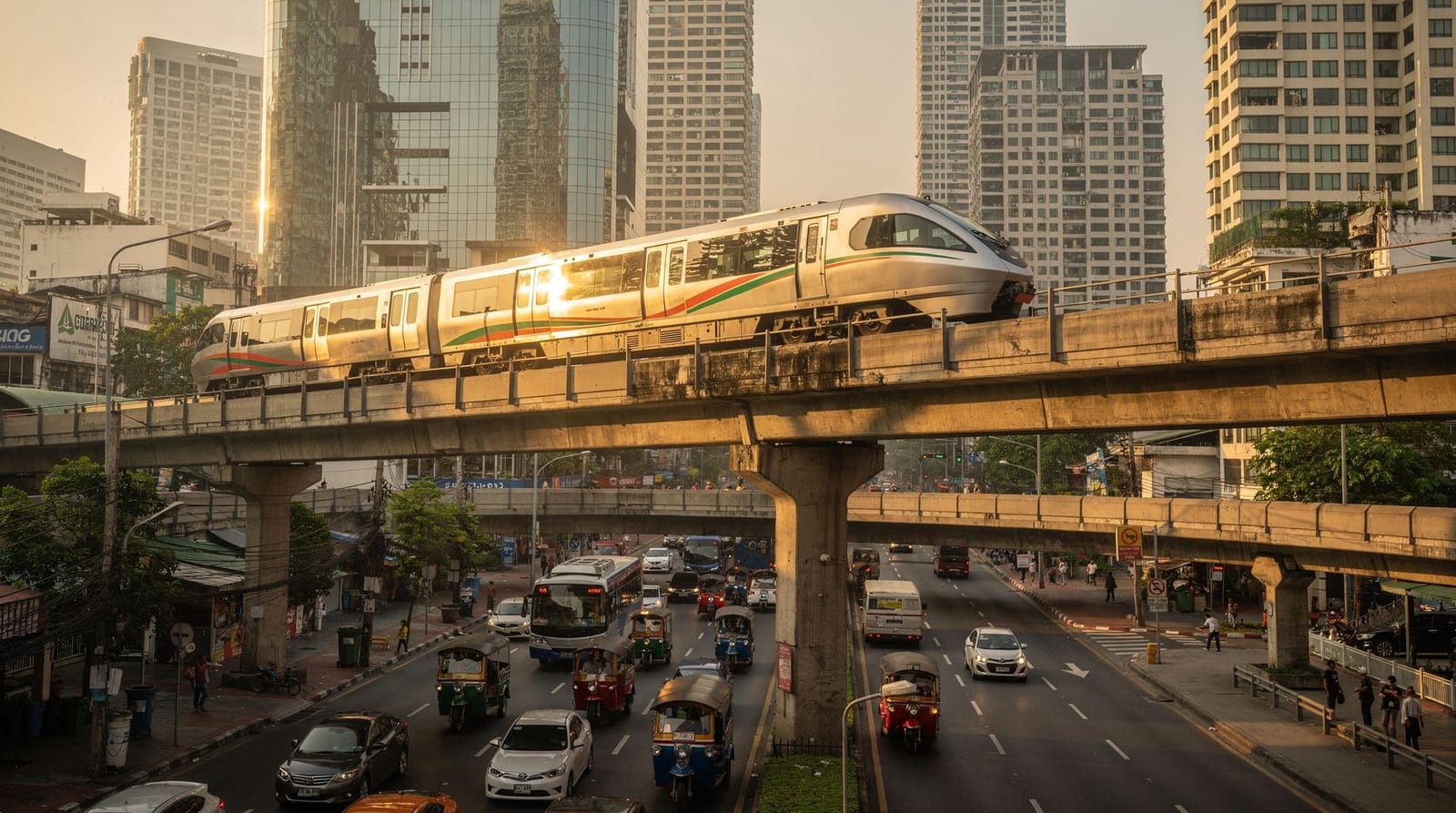
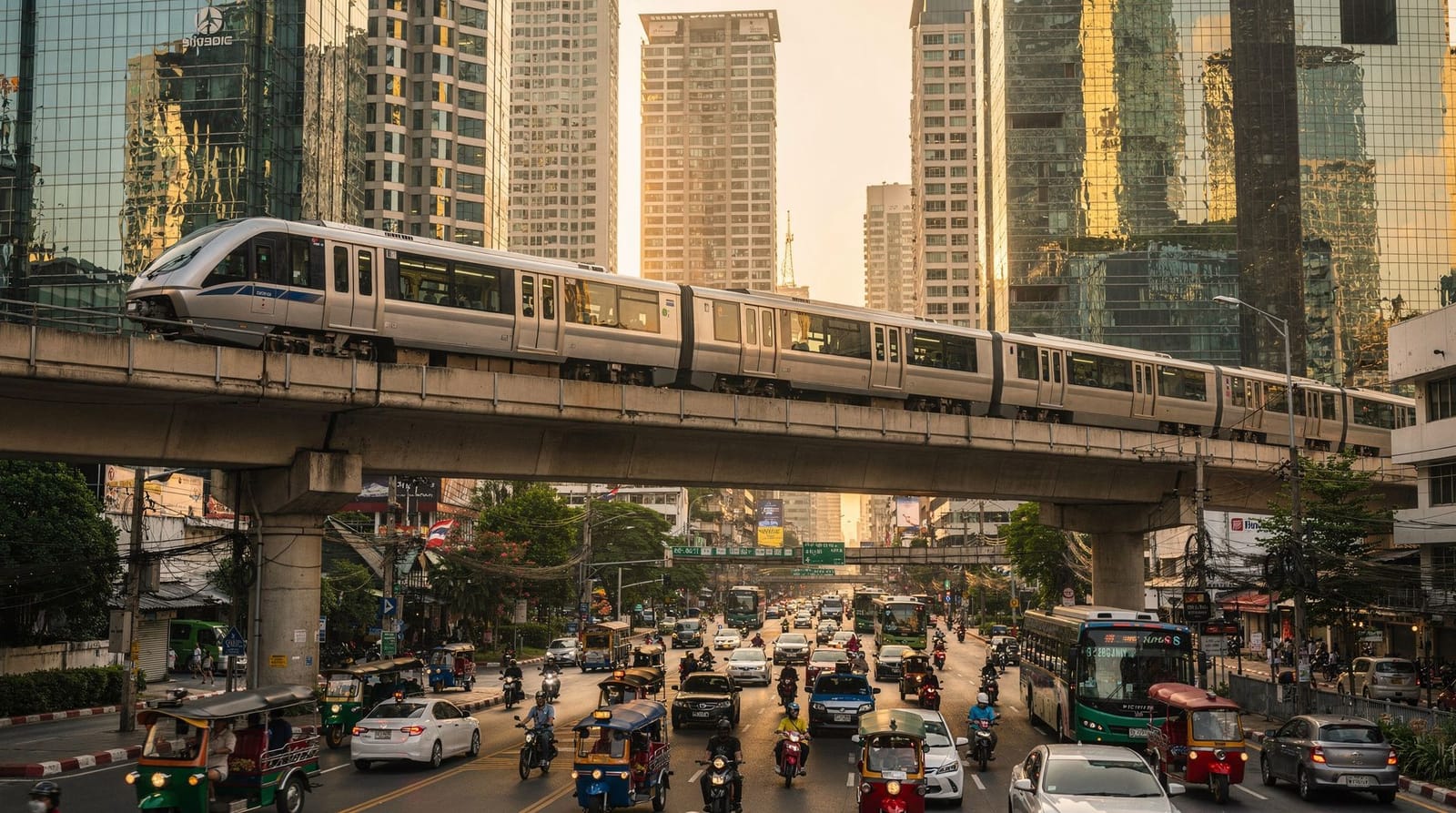
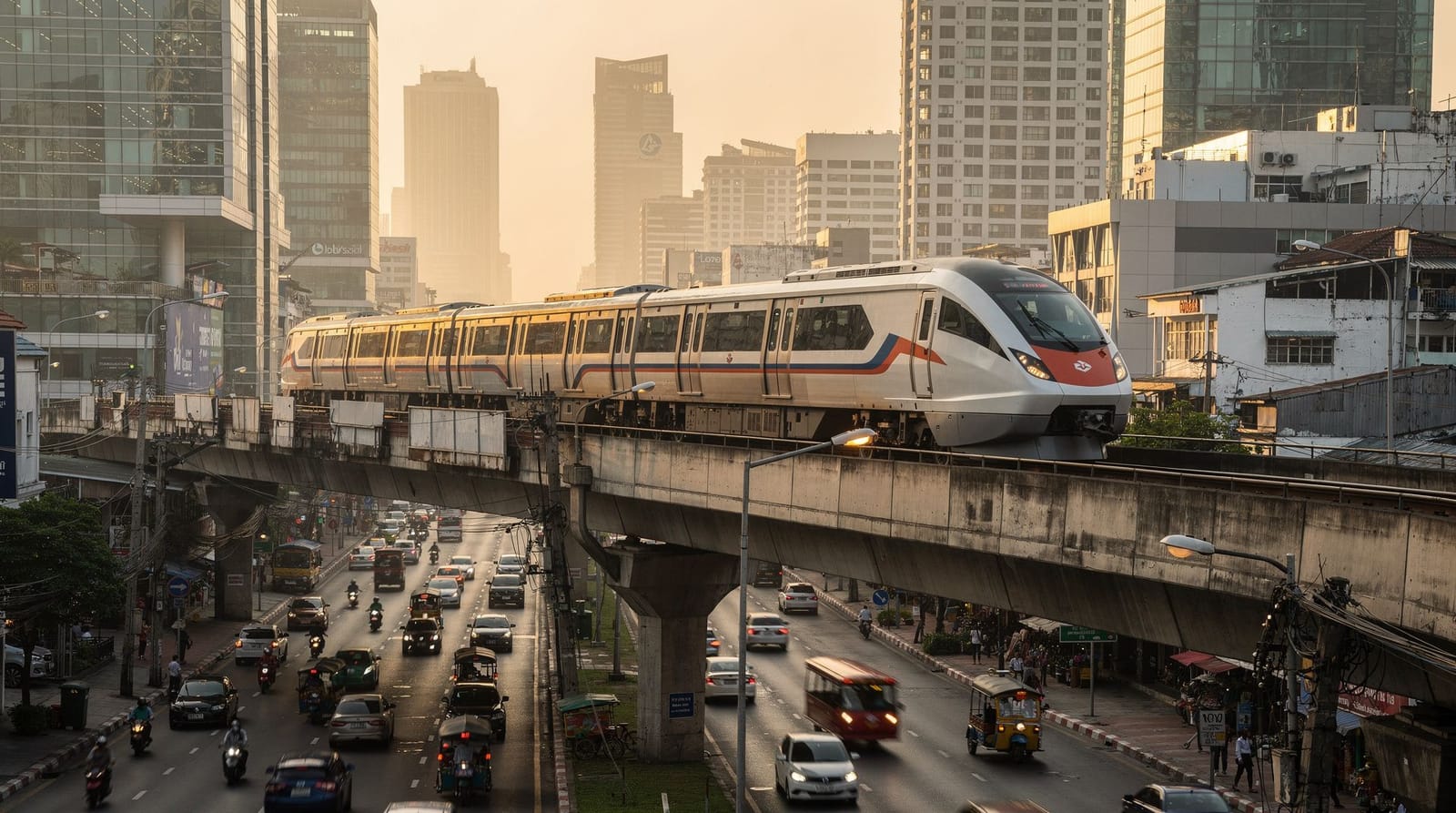
Don Mueang now has its own SRT Dark Red Line station, the suburban rail line that runs south to Bang Sue (Krung Thep Aphiwat) Grand Station. From Bang Sue you transfer to the MRT Blue Line to reach the city centre, including Chinatown and the central interchanges.
The big advantage is that the train, like the BTS and MRT, is grade-separated and ignores the road traffic — so it’s predictable even at rush hour. The Dark Red Line is relatively new and the station-to-terminal walk and timetable are worth checking on arrival. For many budget travellers the A1 bus to Mo Chit is still the more familiar route, but the train is the faster bet when the roads are gridlocked.
Metered taxi — door-to-door from the official rank
Don Mueang has an official metered taxi rank outside the arrivals hall. As at Suvarnabhumi, take a ticket from the dispatch desk, confirm the meter is on, and you’ll pay roughly 250–400 THB on the meter to central districts, plus a 50 THB airport surcharge and expressway tolls (25–70 THB) that you cover. Total all-in is often 350–500 THB.
The same caution applies: ignore the touts inside the terminal offering fixed-price rides — they cost far more than the metered fare. The official rank and the meter are your protection. The broader taxi rules are in the Grab, taxi and tuk-tuk guide.
Grab — fixed price, no haggling
Grab and Bolt operate at Don Mueang from a designated ride-hailing pickup area — follow the signage. You book in the app, see the fare upfront, and pay by card or cash. Pricing is comparable to a metered taxi, but the certainty matters because many budget flights land late at night or in the small hours, exactly when street-taxi meter refusal is most common.
For a tired solo traveller or a family arriving at 02h00, the predictability and GPS-tracked ride of Grab are worth a small premium. The app handles your hotel address in English, so there’s no route negotiation with a sleepy driver.
Private transfer — the no-friction option
A pre-booked private transfer gives you a name-board pickup, luggage help and a direct ride with no queue or negotiation — the right call for families, travellers with elderly companions, or anyone arriving on a red-eye who just wants the journey handled.
If you’d rather have a car for more than the transfer, hiring a private car and driver in Bangkok and nearby covers the airport pickup and then serves as your transport for sightseeing or day trips out of the city.
Cost and time at a glance
| Option | Typical cost | Time to centre | Best for |
|---|---|---|---|
| A1 / A2 bus + BTS/MRT | ~30–50 THB + rail | 40–70 min (traffic) | Budget, light luggage |
| SRT Dark Red Line + MRT | low | ~30–40 min + transfer | Traffic-proof, light luggage |
| Metered taxi (official rank) | ~350–500 THB all-in | 40–70 min (traffic) | Luggage, door-to-door |
| Grab / Bolt | similar to taxi, fixed | 40–70 min (traffic) | Late night, certainty |
| Private transfer | premium | 40–70 min (traffic) | Families, red-eyes |
Don Mueang’s northern location
Because Don Mueang is north of the city, it’s relatively close to Chatuchak, the northern districts and Ari, but a long haul to the Old City and riverside in the south. If your hotel is in Rattanakosin or by the river, factor in a longer, costlier road trip — and consider whether the SRT train plus MRT, ending closer to the centre, beats a long taxi ride in traffic.
Arriving late at night or very early
Budget airlines flying into Don Mueang frequently land in the small hours. If you touch down after midnight, the A1/A2 buses run less frequently and the SRT Dark Red Line has reduced service, so a metered taxi from the official rank or a pre-booked Grab is usually the practical choice — both operate 24 hours. Agree or confirm the fare before moving off, keep your hotel address ready in Thai script if possible (many drivers appreciate it, even late at night), and expect emptier roads to work slightly in your favour on travel time. If your flight is at an awkward hour and you would rather not think about any of it, a pre-booked private transfer removes the guesswork entirely.
First-time arrival tips
Immigration and baggage claim at Don Mueang can take 30–60 minutes on a busy flight, so build that into your onward-transport plan rather than timing a pickup to your landing slot. SIM cards and currency exchange counters are available airside and post-immigration — rates are usually reasonable, though the Bangkok on a budget guide has tips on where better rates wait in the city if you only need enough cash for the ride in. Free WiFi is available in the terminal if you need to confirm a Grab pickup point or message your hotel.
For a private ride from Don Mueang, check that the driver tracks your flight number, that the meeting point is spelled out in writing, and that the hotel address is entered in both English and Thai. Send those details to your hotel too, so a late landing never leaves anyone guessing, and you can arrange a Don Mueang pick-up through Kiwitaxi for your Bangkok transfer.
Choosing by where your hotel is
The right route depends less on the airport than on where you sleep. Don Mueang’s position in the north means the same ride can be easy or awkward depending on your destination, so it helps to decide on the hotel’s district first and work backwards.
- Sukhumvit, Nana, Asok and Thonglor. The A1 bus to Mo Chit puts you on the BTS Skytrain, which runs straight through this part of town. The Sukhumvit guide and the Thonglor and Ekkamai guide explain what to expect when you arrive, and the BTS Skytrain guide covers tickets and station layout.
- Siam, Pratunam and the shopping belt. Also a clean BTS ride from Mo Chit, and the A2 to Victory Monument is a handy alternative if you are heading toward Pratunam.
- Chinatown, Silom and Sathorn. The SRT Dark Red Line and MRT combination is the natural fit. The MRT subway guide shows how the Blue Line links the interchanges, and the Silom and Sathorn guide is useful if your hotel is in the business district.
- Old City and riverside. The longest haul from Don Mueang. Many travellers simply take a taxi or Grab here and save the rail network for sightseeing, while the riverside guide helps you pick a pier-side base.
- Khao San and Banglamphu. No rail line reaches the door, so a taxi or Grab is usually the least stressful finish. The Khao San Road guide describes the area, and you can always ride the rail network part of the way to cut cost.
Paying for the ride into town
Whichever route you pick, a little preparation at the airport saves hassle later. Cash is the simplest way to pay the bus conductor and any expressway tolls on a taxi ride, so keep small notes handy rather than relying on a large bill. Grab lets you pay by card, which is convenient if you have not yet changed money.
If you plan to use the Skytrain and subway a lot during your stay, the Rabbit card guide explains how the stored-value card works and whether it suits your trip. Having one sorted early makes the transfer from Mo Chit smoother, though single-journey tickets work perfectly well for a first ride.
Connectivity matters too. Getting a local data plan before you leave the terminal means your maps and ride-hailing app work the moment you walk out, and the Bangkok SIM and eSIM guide compares the options. An eSIM installed before landing can save you the queue entirely.
Which option suits which traveller
Solo travellers on a tight budget usually do best with the A1 bus and the BTS. It is cheap and easy to follow once you are on the rail network, and it is how many backpackers start their trip. For more ideas on keeping costs down after you arrive, see the Bangkok travel costs guide.
Couples and small groups often find a metered taxi or Grab split between everyone is barely more than separate bus and train tickets once luggage and tiredness are factored in. It also removes the need to carry bags up and down station stairs.
Families with young children should weigh the stress of crowded buses against the small extra cost of a car. The Bangkok with kids guide has more on smoothing out arrival day when everyone is tired.
Anyone arriving on a tight schedule, such as a connecting tour or an early meeting, should lean on predictable options. The train avoids road traffic, while a taxi or Grab gives you a direct ride. Neither is perfect, so leave breathing room.
Layover passengers with only a short window in the city have their own considerations. The Bangkok layover itinerary shows how to use a few hours well, and it is worth reading before deciding whether to leave the airport at all. If you do go out and want the main sights handled without logistics, a private half-day tour of the Grand Palace and Wat Pho keeps the timing predictable.
Your first evening after landing
Once you have dropped your bags, resist the urge to plan anything ambitious. Budget flights often arrive tired travellers at awkward hours, and a short walk, a simple meal and an early night usually set up the next day better than a rushed first outing. If you are hungry, the Bangkok street food guide will point you to easy, reliable first meals, and the street food safety guide is reassuring if you are nervous about your stomach on night one.
If you have more time to plan, the Bangkok for first-timers guide and the 3-day itinerary are good places to turn once you are settled. The Thailand visa and TDAC guide is worth rereading before you fly if you have not yet completed the arrival formalities, because that paperwork is far easier to finish before you reach the immigration hall.
Staying safe on arrival day
Arrival is when scams are most tempting, because you are tired and unfamiliar with prices. The advice in this guide, using the official rank and confirming the meter, covers the most common problem at the airport itself. For the wider picture, the common Bangkok scams guide and the tuk-tuk scams guide describe the tricks to recognise in the first days of a trip.
A good rule is that anyone who approaches you first is selling something. Walk past, head to the signed pickup area or the rank, and make your own choice. Keep your phone charged, keep your hotel’s name and address saved offline, and screenshot your booking so you are never stuck without it if the signal is poor.
Planning the rest of your stay
Don Mueang’s northern location can work in your favour on a longer trip. Chatuchak Weekend Market is close by, which makes it an easy first or last stop if your flight times line up. If you are thinking about leaving the city, the Bangkok day-trip transport guide explains how to reach places such as Ayutthaya, and the north-side departure point can even shorten some of those journeys compared with starting from the south.
Once you are rested and ready for the big temple sights, a skip-the-line Grand Palace entry ticket is a sensible way to avoid spending your first morning in a queue.
For general orientation, the getting around Bangkok guide pulls together every transport mode in one place, and it is a useful companion to this page for the rest of your trip.
Frequently asked questions about Don Mueang airport to Bangkok city: the budget-airport
How do I get from Don Mueang to the city by train?
How much is a taxi from Don Mueang to central Bangkok?
What are the A1 and A2 buses at Don Mueang?
Is Grab available at Don Mueang airport?
How far is Don Mueang from central Bangkok?
How do I transfer between Don Mueang and Suvarnabhumi?
Which airlines use Don Mueang?
Top experiences
Bookable activities with verified prices and instant confirmation on GetYourGuide.