Maeklong Railway Market: the market on the train tracks
Bangkok: Maeklong Railway Market and Amphawa Floating Market
What is the Maeklong Railway Market and how do you see the train?
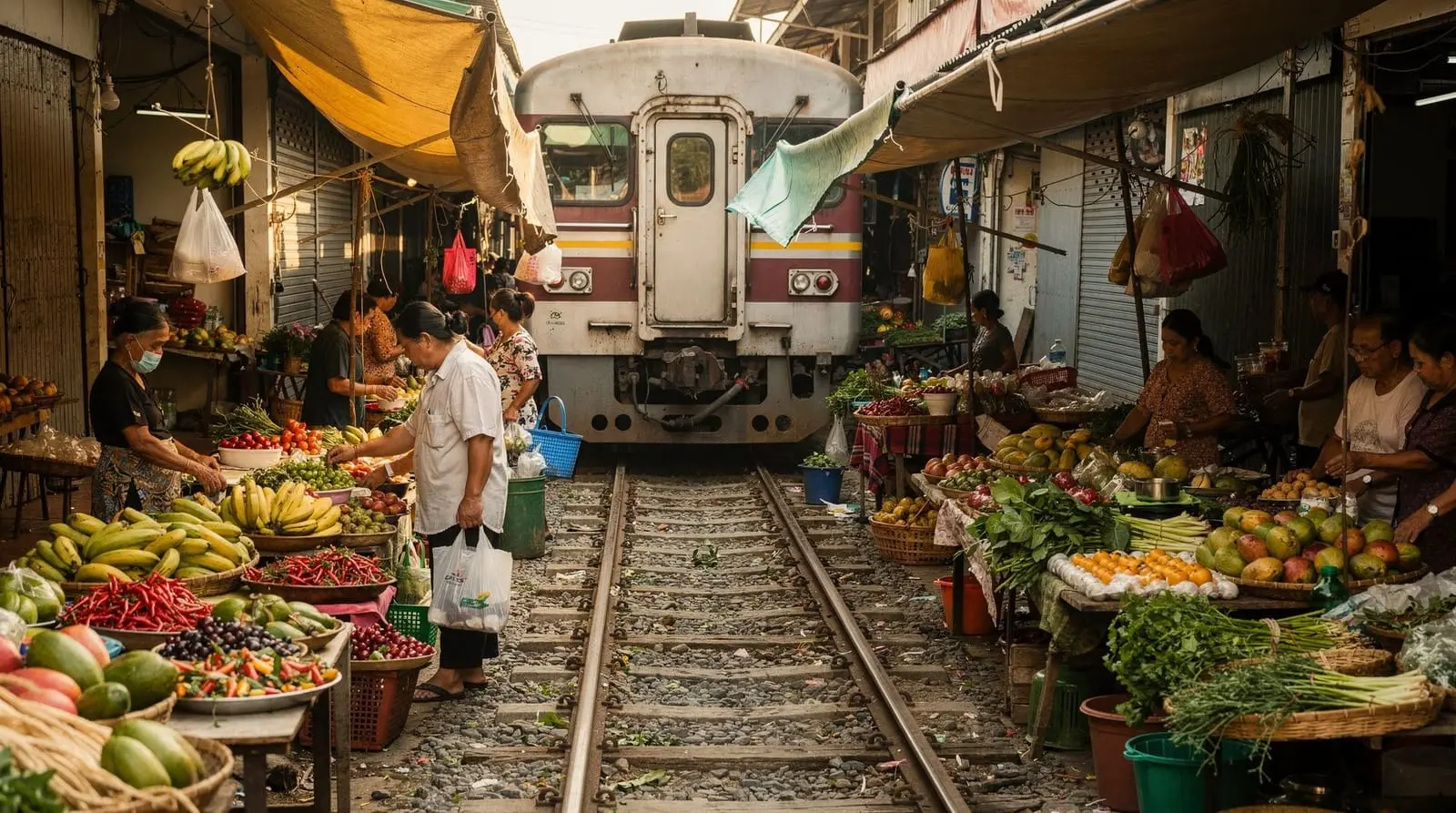
Maeklong Railway Market, nicknamed Talat Rom Hup ('the umbrella pulldown market'), is a fresh market where vendors lay out their produce directly on and beside an active railway line. Several times a day a train passes through at walking pace, and vendors swiftly fold their awnings and slide their goods clear, then replace everything seconds after it passes. To witness it, you must time your visit to one of the scheduled train passages — roughly four to eight per day. Stand back, keep limbs clear of the tracks, and watch the choreography.
There are few sights in Thailand as genuinely startling as the Maeklong Railway Market. Vendors lay out fruit, vegetables, and fresh seafood directly on and beside an active railway line, their wares inches from the rails. Then, several times a day, a horn sounds, and in a few practised seconds every vendor folds back an awning and slides a tray of produce clear as a train rumbles through at walking pace, close enough to touch. The instant it passes, everything snaps back into place. The locals call it Talat Rom Hup — the “umbrella pulldown market” — and it is one of the region’s most memorable spectacles. This guide explains how to witness it, when the trains run, how to get there, and how to combine it with the floating markets.
Unlike some of the more touristy attractions in the area, Maeklong is a genuine working market that serves the local community of Samut Songkhram province. The train choreography is not staged for tourists — it is how this market has functioned for decades, because the railway was built straight through an existing market and the vendors simply refused to move.
| Where | Samut Songkhram province, ~70–80km southwest of Bangkok |
| Cost | Free to browse; organised tours run around 800–1,500 THB with transport |
| Time needed | 30–45 minutes at the market itself; a half or full day combined with a floating market |
| Getting there | Minivan from Sai Tai Mai, the DIY train-and-ferry route, or an organised tour |
| Best time | Timed to a scheduled train passage — see the times below |
How the umbrella pulldown works
The Maeklong line runs from Ban Laem to Maeklong, and its final approach passes directly through the covered fresh market. Rather than relocate, the vendors adapted: each set up a retractable awning and a system for sliding their produce trays back from the rails on command. When a train approaches, a warning is given, and within seconds the awnings fold up and the goods retract, opening a clear corridor for the train. The train inches through with only a few centimetres of clearance on either side, and the moment it has passed, awnings and trays slide straight back over the tracks as if nothing happened.
The whole spectacle — fold, pass, replace — takes a couple of minutes. That brevity is exactly why timing your visit to a scheduled train passage is essential. Show up at the wrong moment and you will see a busy fresh market with an unusual amount of produce near some rails, but miss the choreography entirely.
For where Maeklong fits among the region’s other markets, see the floating markets near Bangkok guide.
Train times: plan around the passages
The train schedule is the crux of a Maeklong visit. Trains have typically passed through the market section at roughly:
- 06h20
- 08h30 (and around 09h00)
- 11h10 / 11h30
- 14h30
- 15h30
- 17h40
These times shift periodically and the exact set of passages varies, so treat them as a guide rather than gospel. Confirm current times on the day — station staff and vendors know, and the times are usually posted. Arrive at least 15–20 minutes before a passage to find a good viewing spot, because the moment itself is so brief and the best positions fill up.
If you would rather not gamble on the schedule, an organised tour solves the timing problem entirely by arranging the visit around a confirmed passage. The Maeklong and Amphawa floating market tour times the railway market stop to coincide with a train, and combines it with the Amphawa floating market for a full day.
Getting there from Bangkok
Maeklong is about 70–80 km southwest of Bangkok in Samut Songkhram province, around 1.5 hours by road.
Organised tour: The most reliable option, because it removes both the transport and the train-timing problems. Tours almost always combine Maeklong with Damnoen Saduak or Amphawa, which is the sensible way to justify the trip. Recommended for most visitors.
Minivan: Minivans run from the Southern Bus Terminal (Sai Tai Mai) directly to Maeklong town for a low fare. From the drop-off it is a short walk to the market. The cheapest independent option, though you then manage train timing yourself.
DIY train route (for railway enthusiasts): A characterful, slow alternative — take the commuter train from Wong Wian Yai station to Mahachai, cross the river by ferry at Ban Laem, then continue on the second train line into Maeklong. It is a half-day adventure in itself and a memorable experience for train lovers, but far slower than the minivan.
For the broader day-trip logistics, see the Amphawa day trip guide and the Damnoen Saduak day trip guide, depending on which floating market you pair with Maeklong.
Safety: respect the train
Maeklong is safe provided you use common sense around the rails.
- Keep clear of the tracks when the warning sounds — step into a stall recess or a designated viewing spot. The train leaves very little clearance.
- Mind your belongings — bags, tripods, and camera straps must be kept off the rails and out of the train’s path.
- Hold children firmly. Do not let anyone stand on the rails to photograph an oncoming train.
- Follow the vendors’ lead. They have done this thousands of times; when they retract, you retract.
Treated with respect, watching the train pass from a few feet away is thrilling, not dangerous.
Beyond the spectacle: a real market
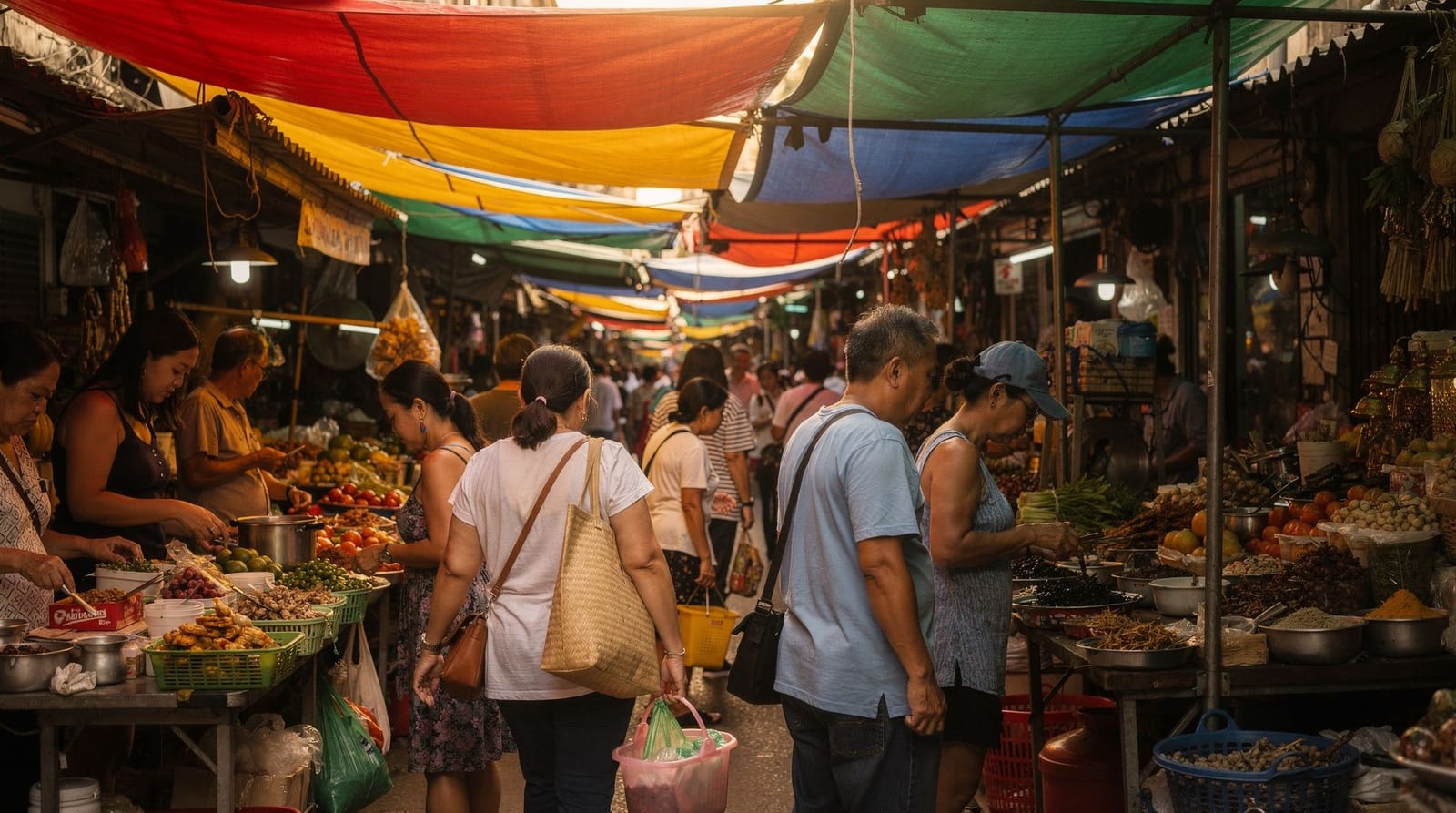
Around the train passages, Maeklong functions as a genuine, busy fresh market — and a very good one. Samut Songkhram is a coastal province famous for its seafood, so the market is heavy with fresh fish, prawns, crab, and shellfish, alongside fruit, vegetables, dried goods, flowers, and prepared food. The regional speciality is pla thu, steamed short-bodied mackerel sold in little woven baskets, a Samut Songkhram signature.
Crucially, because the market primarily serves locals, the pricing is fair and honest — a refreshing contrast to the tourist mark-ups at the more commercialised floating markets. It is worth lingering after the train has passed to browse and eat. For more on the region’s food markets generally, see the best food markets guide and the broader Bangkok markets guide.
Combining Maeklong with the floating markets
Maeklong’s location makes it a natural pairing with the floating markets, and combining them is how almost everyone visits:
- Maeklong + Amphawa: About 15–20 minutes apart. The classic combination — daytime railway market choreography plus Amphawa’s evening market and firefly cruise. The Amphawa and railway markets day tour with boat ride packages both.
- Maeklong + Damnoen Saduak: About 30–40 minutes apart. The standard early structure — Damnoen Saduak at dawn, Maeklong timed to a mid-morning train. See the Damnoen Saduak guide. A half-day guided Damnoen Saduak floating market tour is the easiest way to lock in the dawn timing without driving yourself.
Either combination turns a long drive into a richly rewarding day. The Amphawa floating market guide covers the evening half of the most popular pairing.
Photographing the umbrella pulldown
The shot everyone wants is the train inches from the produce, and getting it without disrupting the vendors takes a little discipline. Position yourself in a stall recess or a marked viewing spot well before the warning sounds — do not stand in the aisle where vendors need to retract their trays, and never step onto the rails to line up an angle. A wide lens works better than a long zoom in the cramped covered section, since the train passes close and fast. Switch off flash entirely; it does nothing useful at that distance and startles vendors who are already juggling a fast-moving job. Video is often more rewarding than stills here, since the fold-and-replace choreography is a sequence of motion, not a single frame. Once the train has passed, resist the urge to wander onto the tracks for a “clear shot” of it retreating — wait until the market fully reopens.
For the wider context of framing markets and street scenes respectfully in Thailand, the street food safety guide and the what to eat in Bangkok guide cover similar etiquette around vendors who are working, not posing.
Costs and combining with your day-trip budget
Independent travel to Maeklong is cheap: the minivan fare is low, food at the market costs local prices, and the only real expense is a tour if you choose one. An organised day trip combining Maeklong with Amphawa or Damnoen Saduak typically runs somewhere in the 800–1,500 THB range per person including transport, which is reasonable given it removes both the train-timing risk and the logistics of stringing together minivans and ferries yourself. For how a Maeklong day fits into an overall Bangkok trip budget, see the Bangkok travel costs guide. If you are weighing which day trips deserve a slot in a short itinerary, the day trips from Bangkok overview ranks Maeklong against the other options, and the destination page for Maeklong has the practical logistics in one place.
The honest verdict
Maeklong Railway Market is one of the most worthwhile day-trip stops in the Bangkok region precisely because it is real. It is not a tourist set piece; it is a working market that happens to share its floor with a railway, and the resulting choreography is genuinely unique. The only thing you must get right is timing your visit to a train passage — and that is easily solved by an organised tour or a little planning. Pair it with Amphawa or Damnoen Saduak, respect the rails, and stay to eat the seafood.
Frequently asked questions about Maeklong Railway Market: the market on the train tracks
What are the Maeklong train times?
How do I get to Maeklong Railway Market from Bangkok?
Is the Maeklong Railway Market dangerous?
How long does the umbrella pulldown last?
Can I combine Maeklong with a floating market?
What can I buy at Maeklong Railway Market?
Is Maeklong Railway Market worth visiting?
Top experiences
Bookable activities with verified prices and instant confirmation on GetYourGuide.