Maeklong Railway Market
Maeklong is the market built on live train tracks — stalls fold away as trains pass, eight times a day. How to visit from Bangkok and when trains run.
Bangkok: Maeklong Railway Market & Floating Market Tour
Quick facts
- Distance from Bangkok
- ~70 km southwest (1–1.5 hr by minivan, car or tour)
- Getting there
- Minivan from Mo Chit, the quirky train via Maha Chai, or organised tour
- Key sight
- Market stalls on live train tracks that fold away as trains pass
- Time needed
- 1–2 hours; usually combined with a floating market
- Best time
- Time your visit to a scheduled train passing (about 8 a day)
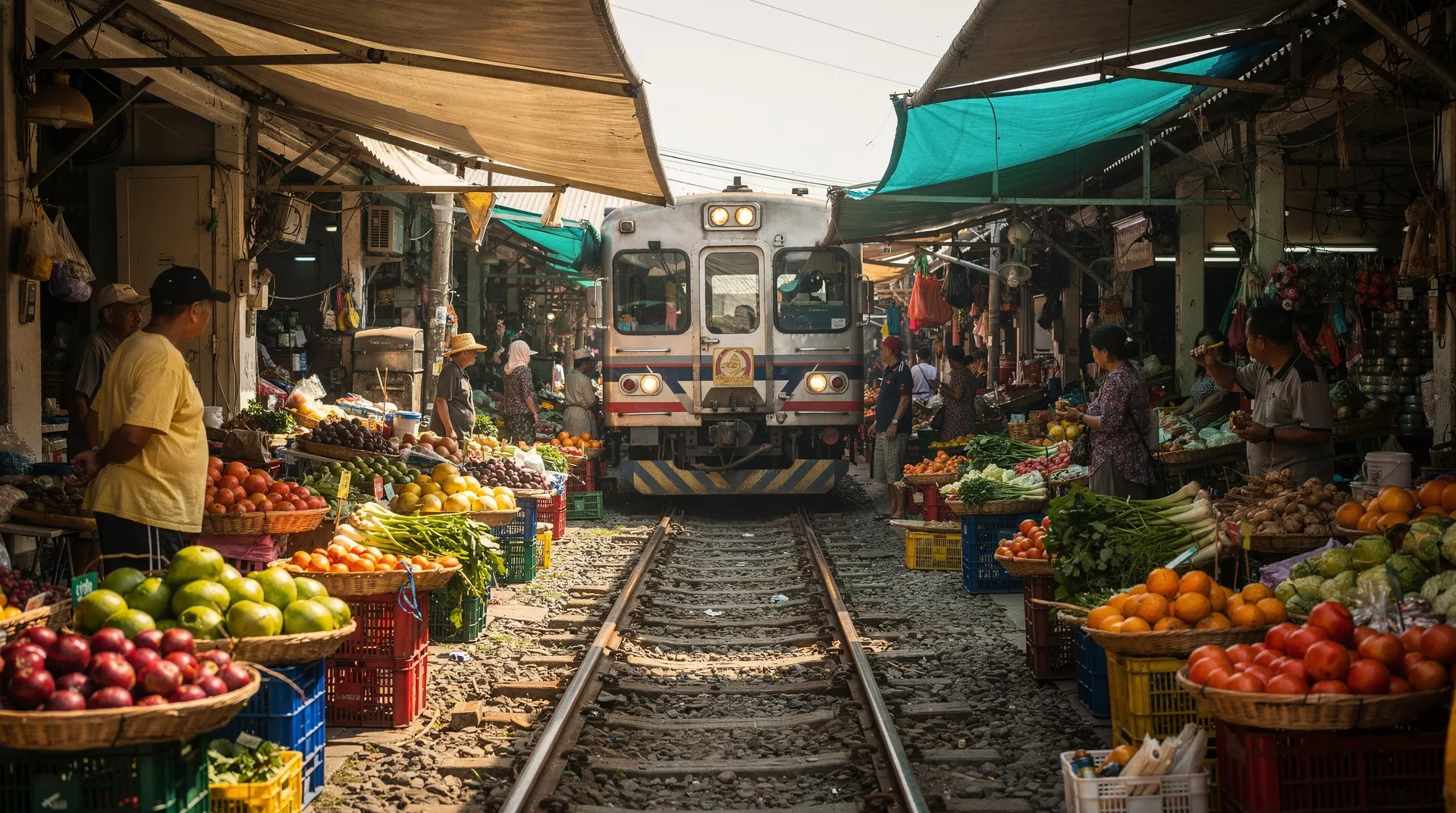
The Maeklong railway market is one of those sights that sounds like an exaggeration until you see it. In the town of Maeklong, about 70 km southwest of Bangkok in Samut Songkhram province, a wet market of fruit, vegetables, fish, and meat is set up directly on and beside a live railway line. Vendors lay their awnings and produce across the tracks — and roughly eight times a day, when a train approaches, the whole market performs a swift, practised retreat: awnings retract, baskets slide back, and the train trundles through inches from the goods before everything unfolds again the moment it passes. Locals call it Talat Rom Hup — the “umbrella pulldown market.”
Is it worth the trip? On its own, Maeklong is a short visit — an hour or two of browsing punctuated by one remarkable train passing — so few people make a dedicated trip just for it. But paired with a floating market (Damnoen Saduak or Amphawa, both nearby), it is a genuinely worthwhile and memorable half-day. This page explains how the market works, how to time the trains, and how to combine it.
How the market works
The market trades right up against, and over, the working tracks of the short Maeklong line, which still runs passenger services. For most of the day it operates as an ordinary, busy local wet market — fresh produce, dried fish, spices, prepared snacks — except that the central “aisle” is literally the railway. When a train is due, a warning sounds, and vendors calmly pull back their canopies and shift any produce that overhangs the rails. The train passes at walking pace, close enough to touch; then the market reassembles in seconds as if nothing happened.
It is a real working market, not a show staged for tourists, which is much of its charm — though the train passings have inevitably become a spectator event, with crowds lining the platform and the tracks for the photo. Stand to the side, follow the vendors’ lead, and never stand in the gauge of the track as the train approaches.
Timing the trains
The whole experience hinges on catching a train passing, so timing is everything. The Maeklong line runs only a handful of services a day (around eight passings counting both directions), with scheduled times that shift periodically — recent schedules cluster around the late morning and afternoon. Schedules do change, so confirm locally or with your tour the day you go, and aim to arrive 20 to 30 minutes before a passing to get a spot. If you turn up between trains, you will still see a lively market, but you will miss the signature moment.
This timing constraint is the main reason an organised tour is convenient here: a good operator plans your arrival to land on a train. For the wider context, see the Bangkok markets guide and floating markets of Bangkok.
What to buy and eat
Because it is a genuine local market, Maeklong is a good place to graze and to see Thai produce up close: mounds of tropical fruit, fresh and dried seafood (the coast is close), chillies, curry pastes, and prepared snacks. Look for mae kong mackerel, regional sweets, and fresh coconut products from this coconut-growing province. Prices are local-market reasonable. A few snacks and a drink will cost very little; it is more about the atmosphere and a couple of tastes than a sit-down meal.
Combine it with a floating market
Almost everyone visits Maeklong as half of a pairing, because it sits between Bangkok and the region’s two famous floating markets. Two combinations dominate:
- Maeklong + Damnoen Saduak: the classic. Do the floating market early, then Maeklong for a late-morning or midday train. The Damnoen Saduak and Maeklong railway market tour is the standard format; the Old Siam: Damnoen Saduak and Maeklong is a fuller small-group version.
- Maeklong + Amphawa: the weekend option. Do Maeklong in the afternoon, then Amphawa as its food market opens, finishing with the firefly boat. The Maeklong railway and Amphawa floating market day trip is built around this.
A simpler half-day option focused on the railway market and a floating market is the Maeklong railway market and floating market tour.
Getting there from Bangkok
Minivan: minivans to Samut Songkhram / Maeklong run from Bangkok (Mo Chit / Northern Bus Terminal) in about 1 to 1.5 hours for roughly 80–100 THB. From the drop-off the market is a short walk or songthaew ride. Independent visitors should check train times before setting out so they arrive for a passing.
The Maeklong train (the quirky route): the most characterful way in. From Bangkok’s Wongwian Yai station you take a commuter train to Maha Chai, cross the river by ferry to Ban Laem, then board the short Maeklong-line train into Maeklong — arriving, fittingly, right at the market. It is slow, requires changes, and only suits travellers who enjoy the journey for its own sake, but it is delightful.
Tour: the easiest way to guarantee you catch a train and to pair Maeklong with a floating market without juggling schedules. See Bangkok to day trips transport for all the routes.
Practical information
Train times: confirm the day’s schedule locally or with your tour; aim to arrive 20–30 minutes early. Roughly eight passings a day.
Safety: stand to the side and follow the vendors; never stand in the track’s gauge as the train approaches, and mind your bags and feet.
Crowds: the passings draw spectators; arrive early for a good vantage point along the platform.
Photography: great light along the covered aisle; be considerate of vendors actually trying to trade.
Cash: small notes only; it is a local wet market.
The train, minute by minute
| Time before train | What happens |
|---|---|
| ~10 min | Vendors start glancing at the tracks; a warning bell or announcement sounds |
| ~3 min | Awnings retract, baskets and produce are pulled back from the rails |
| Passing | The train rolls through at walking pace, inches from the stalls |
| Immediately after | Awnings unfold, produce slides back, the market resumes as if nothing happened |
The whole retreat-and-return cycle takes only a few minutes, so don’t wander far once a passing is due.
The moment itself
Nothing quite prepares you for how close the train actually runs. Standing at the edge of the covered aisle, you can feel the draft as the carriages pass within arm’s reach of the stalls, market awnings folded flat against the produce crates just beside the tracks. Vendors go about this several times a day with a practised, unbothered calm that says more about how routine it has become to them than any guidebook description could. It’s over in under a minute, and then the ordinary business of a wet market resumes instantly — fish, chilli paste and fruit peelings back in their place as if the train had never come through.
Frequently asked questions about Maeklong railway market
What is special about Maeklong railway market?
It is a working wet market built directly on a live railway line. Roughly eight times a day, as a train approaches, vendors pull back their awnings and produce so the train can pass within inches, then reassemble the market the moment it has gone. It is a real local market, not a staged show, which is much of its appeal.
How do I time my visit to see a train pass?
The Maeklong line runs only a handful of services a day, with scheduled passing times that shift periodically. Confirm the day’s schedule locally or through your tour, and arrive 20 to 30 minutes early to get a spot. If you come between trains you will still see a busy market but miss the signature folding-away moment.
Is Maeklong worth a trip on its own?
On its own it is a short visit — an hour or two — so most people pair it with a floating market (Damnoen Saduak or Amphawa, both nearby) to make a worthwhile half- or full-day trip. As part of that combination it is a memorable and genuinely unusual stop.
How do I get to Maeklong from Bangkok?
By minivan from Mo Chit (~1–1.5 hours, 80–100 THB), by the quirky commuter-train-and-ferry route via Maha Chai for travellers who enjoy the journey, or on an organised tour. A tour is the easiest way to guarantee you catch a train passing and to combine Maeklong with a floating market.
Is it safe to stand by the tracks?
Yes, if you are sensible. Follow the vendors’ lead, stand to the side of the aisle, and never stand within the gauge of the track as the train approaches. The train moves at walking pace, but it passes very close, so keep your bags, feet, and children well clear.
Should I combine Maeklong with Damnoen Saduak or Amphawa?
Either works well. Pair it with Damnoen Saduak for a morning floating market followed by a midday train (any day of the week), or with Amphawa for an afternoon train followed by an evening food market and firefly boat (weekends only, as Amphawa runs Friday to Sunday).
Top experiences
Bookable activities with verified prices and instant confirmation on GetYourGuide.