Khao Yai day trip from Bangkok: national park guide
From Bangkok: Khao Yai Spectacular Waterfalls Day Trip
Is Khao Yai worth a day trip from Bangkok?
Yes, if nature is your priority. Khao Yai is Thailand's oldest and most accessible national park — a UNESCO-listed forest about 200km northeast of Bangkok, home to wild Asian elephants, gibbons, hornbills and dramatic waterfalls. At 2.5–3 hours each way it is the longest viable single-day trip and genuinely tiring, and wildlife is never guaranteed in a day. But a good guided tour with an early start gives you a real chance at elephants and the spectacular Haew Suwat and Haew Narok falls.
Khao Yai is the day trip for travellers who want forests, waterfalls and wild animals rather than temples and markets. Thailand’s oldest national park, established in 1962 and now part of a UNESCO World Heritage forest complex, it sprawls across roughly 2,000 square kilometres of jungle-clad mountains about 200km northeast of Bangkok. It is home to wild Asian elephants, gibbons, hornbills, macaques, deer and — rarely glimpsed — leopards and clouded leopards, alongside the dramatic Haew Narok and Haew Suwat waterfalls (the latter made famous by the film The Beach). This guide is honest about what you can and cannot achieve in a single day from the capital.
| Where | Khao Yai National Park, ~200km northeast of Bangkok |
| Cost | 1,500-3,000 THB/person tour, plus 400 THB park entry |
| Time needed | Full day — 2.5-3hrs each way, plus a day inside the park |
| Getting there | Guided tour with pickup, or private car with driver |
| Best time | November-February, cool and dry |
See the Khao Yai destination page for an overview of the wider area, including the vineyards and Pak Chong town.
The honest verdict
Khao Yai is the longest viable day trip from Bangkok and the most tiring — 2.5 to 3 hours each way means a lot of car time. It is also the day trip where a tour earns its keep most clearly, because distances inside the park are large and you genuinely need a vehicle to move between trailheads, waterfalls and wildlife viewpoints. Do it as a day trip and you will have a memorable, nature-filled day; but if you can spare a night near Pak Chong, you will see far more, because wildlife is most active at dawn and dusk — exactly the windows a day trip misses.
Getting there
Khao Yai is about 200km northeast of Bangkok, 2.5–3 hours by road, and there is no convenient public-transport route into the park itself. You could take a train or bus to Pak Chong town and arrange local transport, but that consumes the day. For a single-day visit, a guided tour with hotel pickup or a private car with driver-guide is by far the most practical option.
Khao Yai spectacular waterfalls day trip from BangkokSee the day-trip transport guide for the Pak Chong options if you plan to stay over.
What you can see in a day
A well-run day tour typically covers one or two major waterfalls — Haew Suwat (the swimmable one) and/or the towering Haew Narok — a forest trail, and a wildlife viewpoint or grassland where animals gather. Along the way you have a strong chance of seeing gibbons swinging through the canopy, hornbills, macaques and deer. The 400 THB foreign-adult park entry fee is usually extra on top of the tour price.
Khao Yai National Park jungle trek with lunch from BangkokFor the full rundown of the park’s animals and where to look for them, see the dedicated Khao Yai wildlife guide.
How a typical tour day unfolds
Most scheduled tours follow the same rhythm. You are collected from your hotel early, spend the first stretch of the day in the car, and arrive at the park with the morning already well under way. The middle of the day is the heart of the trip: a waterfall, a forest walk, a lunch stop, and a chance to scan the grasslands and viewpoints for animals. The afternoon is a slower wind-down, perhaps a vineyard or a farm café on the way out, before the long drive back to the city. Expect to be back in Bangkok after dark, tired but with a camera full of green.
Because the day is front-loaded with driving, it pays to settle into the car properly. Sit on the side with the better view on the way in, bring something to read or download a few episodes, and keep snacks within reach. Travellers who treat the journey as part of the experience, watching the landscape change from suburbs to farmland to forested hills, tend to enjoy the day more than those who simply endure it.
If you are comparing this with other excursions, the day trips from Bangkok overview lays out the alternatives side by side, and the Khao Yai destination page gives the wider geography of the area.
Choosing the right kind of tour
Not every Khao Yai tour is the same trip, and the differences matter more here than on a temple day.
- Waterfall-focused tours suit travellers who want scenery and a little swimming, and who are happy with a relaxed pace. The waterfalls option already mentioned above is built around exactly that.
- Trekking-focused tours spend more time on the trails and less in the vehicle, which suits people who came for the forest itself and are comfortable on uneven, sometimes slippery ground.
- Leisure tours with a vineyard or farm stop are gentler and work well for mixed groups, couples or anyone who wants a softer landing after the drive.
Whichever you pick, read what is included before you book. Look at whether lunch is covered, whether the park fee is bundled, how many people share the vehicle, and what time the pickup happens. A smaller group usually means a more flexible guide and better odds of stopping when something moves in the trees. If you are weighing a scheduled group against a car of your own, the private tours Bangkok guide and the wider best Bangkok tours roundup will help you decide.
On the trail: how to see more
Wildlife viewing rewards patience and quiet. The animals of Khao Yai are not on a schedule, and the people who spot the most are rarely the loudest. A few habits make a real difference.
Walk slowly and stop often. Gibbons announce themselves by sound before sight, so when you hear them calling, pause and look up into the canopy rather than pressing on. Hornbills are large and unmistakable once you find them, but they often sit motionless in fruiting trees. Listen as much as you look.
Keep your voice down and your movements calm. Let your guide lead, and follow the guide’s instructions about distance, especially near large animals. This is a protected forest, and the rules exist for your safety as much as the animals’ wellbeing. Never feed wildlife, and never leave food waste behind; macaques in particular learn quickly and become a nuisance when visitors are careless.
Bring binoculars if you can. Even a modest pair turns a distant shape on a grassy hillside into something you can actually identify. The Khao Yai wildlife guide goes deeper on what lives in the park and where it tends to show up, and it is worth reading before you go so you know what you are looking for.
Waterfalls: what to expect
Haew Suwat is the waterfall most travellers picture, with its curtain of water dropping into a wide pool. Whether you can swim depends on conditions on the day, so pack swimwear but be ready to simply enjoy the view if the water or the rules say otherwise. Haew Narok is the more towering of the two, and part of its appeal is the scale of the drop and the sense of being deep inside the forest.
Footing around the falls can be slick, particularly after rain, so closed shoes with decent grip are better than sandals. Take your time on steps and rocks, and keep valuables in a waterproof bag if you plan to get close to the spray. The falls look different in the wet season, fuller and louder, while the cool, dry months make for easier walking and clearer light. If photography matters to you, the Bangkok photo spots guide offers general ideas, and the same patience that helps with wildlife helps with waterfall shots too.
Wild elephants — managing expectations
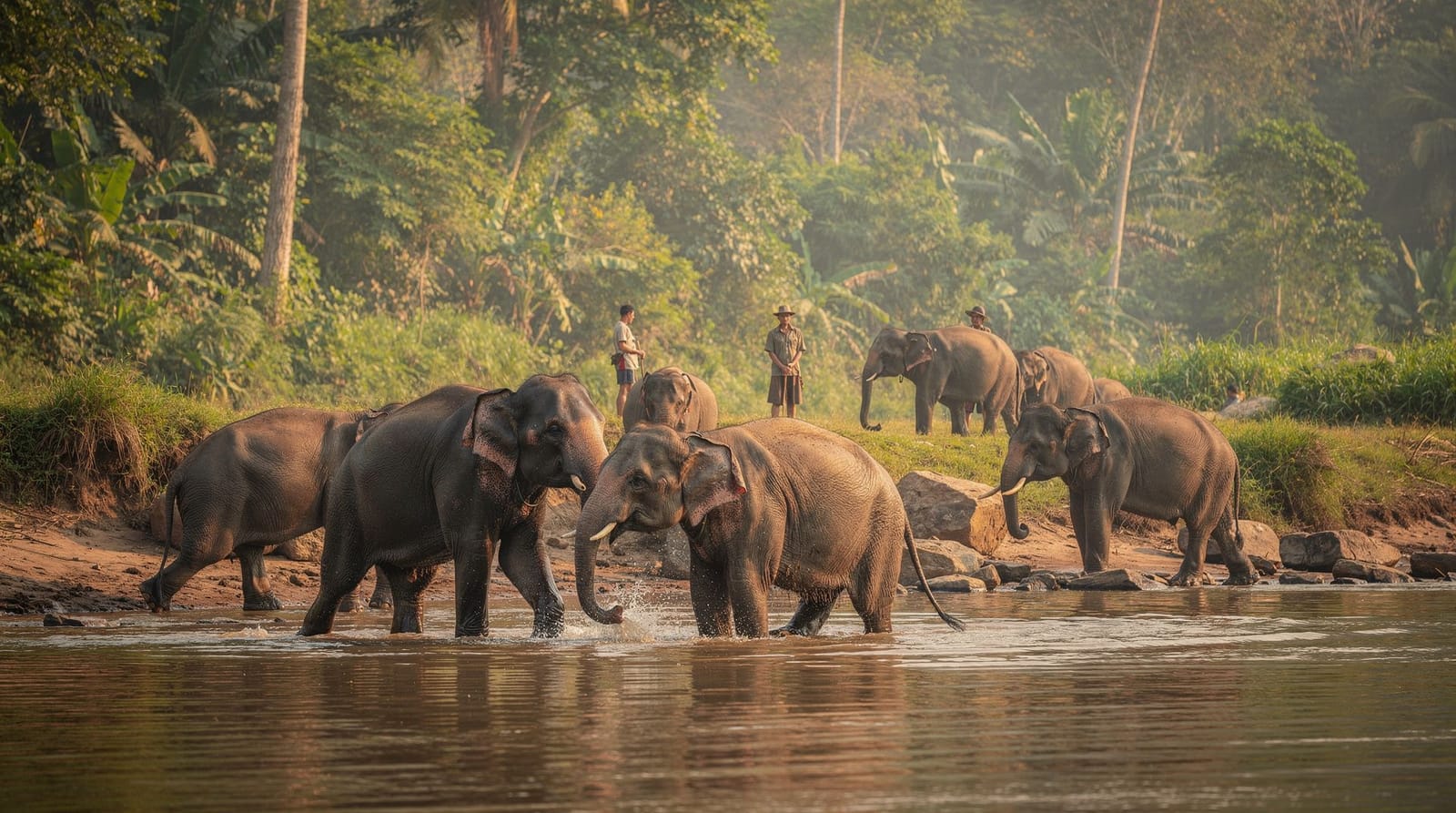
Khao Yai has an estimated 200-plus genuinely wild elephants, and seeing one is the day’s holy grail. But this is a wild park, not a sanctuary: sightings are never guaranteed and are most likely at dawn or dusk near salt licks and grassland edges — which a Bangkok day trip largely misses. A guide who knows the herds’ current movements meaningfully improves your odds. If guaranteed, ethical elephant contact is what you want, an ethical elephant sanctuary near Bangkok or Kanchanaburi is the better choice; Khao Yai is for those who want elephants in the truly wild.
Wine country and farm cafés
The hills around Khao Yai have become Thailand’s leading wine region — vineyards such as GranMonte and PB Valley produce surprisingly drinkable wines at this tropical latitude. Many itineraries pair the park with a vineyard tasting and a Tuscan-style farm-café lunch, a pleasant contrast to a sweaty morning on the trails. Treat it as a relaxing add-on, not the headline.
Khao Yai vineyard tasting and horse farm day tourCosts and what to bring
Guided day tours run 1,500–3,000 THB per person including transport, guide and usually lunch, plus the 400 THB park fee. A private driver-guide costs more (roughly 4,000–6,000 THB for the car) but suits groups — the private tours Bangkok guide explains when a private car is worth the extra cost over a scheduled group tour. Bring closed walking shoes for slippery trails, insect repellent (leeches appear in the wet season), water, a hat, binoculars and a rain layer; add swimwear if a swimmable waterfall is on the itinerary — the what to pack for Bangkok guide covers the rest of your bag. The cool, dry season (November–February) is most comfortable; see the best time to visit Bangkok guide and the Bangkok weather month-by-month guide for how the wetter months change the trails and the wildlife. For budgeting, see Bangkok travel costs.
Day trip vs overnight: an honest comparison
| Day trip from Bangkok | Overnight near Pak Chong | |
|---|---|---|
| Time in the park | Roughly 5-6 hours, midday-heavy | A full dawn-to-dusk day, plus a night drive |
| Elephant odds | Lower — you miss the dawn/dusk windows | Higher — you can be at a salt lick at first light |
| Cost | Lower — one tour price | Higher — adds a hotel night and often a second day |
| Tiredness | High — 5-6 hours of driving in one day | Lower — the drive is split over two days |
| Best for | Travellers with limited time or budget | Wildlife-focused travellers wanting the best odds |
If you can only spare a day, go — it is still a rewarding trip. If wildlife is the whole point of coming, the overnight is honestly the better version of this same trip.
If you decide to stay overnight
The overnight version is the one we would pick if wildlife is your reason for coming. Basing yourself near Pak Chong removes the pressure of the long drive back and lets you enter the park when it is quietest. Mornings in the forest feel completely different from the middle of the day: cooler, calmer, and full of sound.
An overnight also lets you split the activities sensibly. You can give one half-day to the trails and waterfalls, and another to the vineyards and farm cafés, rather than cramming everything into a single hurried loop. If you are travelling with limited time in Thailand, think about whether the extra night is better spent here or in the capital; the how many days in Bangkok guide can help you balance the two.
For the logistics of reaching Pak Chong by public transport and arranging local vehicles, the day-trip transport guide is the place to start. Plan ahead for how you will move around once you arrive, since distances inside the park are large and you will want a vehicle.
Who Khao Yai suits, and who should skip it
Khao Yai suits travellers who like being outdoors, who are comfortable with a long day, and who are happy to accept that nature does not perform on demand. It works well for couples, groups of friends and active families with older children who can handle the drive and the walking. It also suits repeat visitors to Bangkok who have already done the temples and want something completely different.
It is a weaker choice for anyone who gets carsick easily, who has limited mobility on uneven trails, or who needs a guaranteed animal encounter. If you are travelling with very young children or elderly relatives, the Bangkok with kids guide and the Bangkok with elderly travellers guide will point you toward gentler options closer to the city. Travellers who prefer something shorter can look at the Ayutthaya day trip or the Damnoen Saduak day trip instead, both of which keep the time in the vehicle more manageable.
Practical habits that make the day easier
A handful of small decisions improve the trip noticeably. Eat a proper breakfast before pickup, because the first stop may be a while away. Carry a refillable bottle and keep it topped up whenever the tour allows. Wear layers, since the forest can feel cooler than the city and the weather can change quickly. Keep your phone charged and bring a power bank, because you will take far more photos than you expect.
Finally, tell your guide what you most want to see. A guide who knows you care about birds, or waterfalls, or photography, can shape the day around it where the schedule allows. If connectivity matters to you on the road, the Bangkok SIM and eSIM guide covers staying online, and if you want to understand how the rest of your budget holds up, Bangkok on a budget is a useful companion.
How it fits your trip
Khao Yai is a big, tiring day — give yourself a slow evening afterwards and do not stack it next to another long day trip like Kanchanaburi. If wildlife and nature are central to your trip, consider an overnight rather than a day trip. Weigh it against the alternatives in the day trips from Bangkok overview, and slot your choice into the Bangkok with day trips itinerary.
Frequently asked questions about Khao Yai day trip from Bangkok: national park
How do I get to Khao Yai from Bangkok?
What can I realistically see in Khao Yai in one day?
Will I see wild elephants in Khao Yai?
How much does a Khao Yai day trip cost?
What is Khao Yai wine country?
Should I do Khao Yai as a day trip or stay overnight?
What should I bring to Khao Yai?
Top experiences
Bookable activities with verified prices and instant confirmation on GetYourGuide.