The night train north from Bangkok: sleeper berths and dawn light
There is a particular romance to leaving Bangkok by sleeper train at dusk and waking somewhere else entirely as the sun comes up over the rice paddies. I have taken the overnight train north a handful of times now, and while Bangkok is the city I keep coming back to, the night train out of it remains one of my favourite travel rituals anywhere — a slow, rocking, snack-fuelled, oddly sociable way of turning a long distance into a story rather than a chore. If you are basing yourself in Bangkok and want to see more of Thailand, here is what the sleeper journey is actually like.
| Where from | Hua Lamphong or Krung Thep Aphiwat (Bang Sue) station |
| Cost | Second-class sleeper well under 1,000 baht |
| Time needed | Overnight, roughly 12+ hours depending on the line |
| Book ahead | Up to 60 days, essential for weekends and holidays |
| Best berth | Lower berth — wider, has a window, no ladder |
Why the train, when there are planes
You can fly almost anywhere in Thailand from Bangkok in an hour for not much money, so the night train is, on paper, the slow and impractical option. But that is precisely its appeal. The sleeper train trades speed for experience: you board in the evening in the city, eat dinner as the suburbs slide past, sleep to the rhythm of the rails, and arrive in the morning rested and already somewhere new, having lost no daytime to the journey and paid nothing for a hotel that night. It is travel as a verb rather than a transaction. The day trips transport and getting around guides cover Thailand’s rail network, which radiates out from Bangkok’s stations.
Where the trains leave from
Bangkok’s long-distance trains depart from the grand old Hua Lamphong station and, increasingly, from the vast modern Krung Thep Aphiwat terminal at Bang Sue, which has taken over many intercity services — so always double-check which station your specific train uses, because they are far apart and a mix-up is disastrous. The stations themselves are worth arriving early for: Hua Lamphong in particular is a beautiful century-old building, all vaulted ceilings and departure boards, steeped in the romance of rail travel.
Booking a berth: the classes explained
The sleeper trains offer a few classes, and choosing well makes all the difference. Second-class air-conditioned sleeper is the sweet spot for most travellers: a carriage of curtained berths, lower and upper, converted from daytime seats by a steward in the evening, with clean sheets, a pillow and a curtain for privacy. The lower berth costs a little more and is worth it — it is wider, has a window, and you are not climbing a ladder in the dark. First-class gives you a private two-berth cabin if you want it. The fares are remarkably reasonable, with a second-class sleeper berth on a long northern route costing well under 1,000 baht. Book ahead, especially around holidays and weekends, as the sleepers sell out — you can reserve at the station or online through the state railway.
The journey itself
The magic is in the rhythm. You settle into your seat as the train pulls out of Bangkok at dusk, and for the first hour you watch the city dissolve into suburbs and then into countryside, passing through Ayutthaya and the old temple town of Lopburi with its famous monkeys if you are on the right line. Vendors and a meal service come through with food and drinks; you can buy a surprisingly decent dinner and a cold beer brought right to your seat. As night falls the steward comes through folding down the berths, and there is a small ceremony to making up your bed, drawing the curtain, and lying back as the train sways through the dark.
I sleep better on a night train than I have any right to. The gentle rocking, the rhythmic clack of the rails, the soft blue night-light in the carriage — it lulls you under within minutes. You wake in the grey of dawn, lift the window curtain, and there is rural Thailand sliding past: rice paddies catching the first light, water buffalo, palm-fringed villages, monks walking the morning alms round. It is one of the loveliest sights in travel, and you get it for the price of a budget hotel room you did not have to book.
The sociable, snack-fuelled reality
The night train is also more sociable than a plane could ever be. You share the carriage with Thai families, monks, backpackers and weekend travellers, all in the curious intimacy of strangers about to sleep in the same room. Snacks are a whole culture: people board with bags of food, vendors pass through with grilled chicken and sticky rice and fruit, and there is a relaxed, communal, picnic-on-the-rails feeling to the whole thing. Bring your own supplies too — water, snacks, a small towel — and settle in.
Practical tips
Pack a light layer; the air-conditioned sleeper carriages can get genuinely cold overnight. Bring earplugs and an eye mask if you are a light sleeper, since the curtain does not block all the light or sound. Keep valuables on your person or under your pillow — theft is rare but the carriages are open. Choose a lower berth if you can. And do not over-plan the morning of arrival; give yourself room to ease off the train slowly rather than rushing into a packed day after a night of broken-but-pleasant sleep.
What the northern line passes through
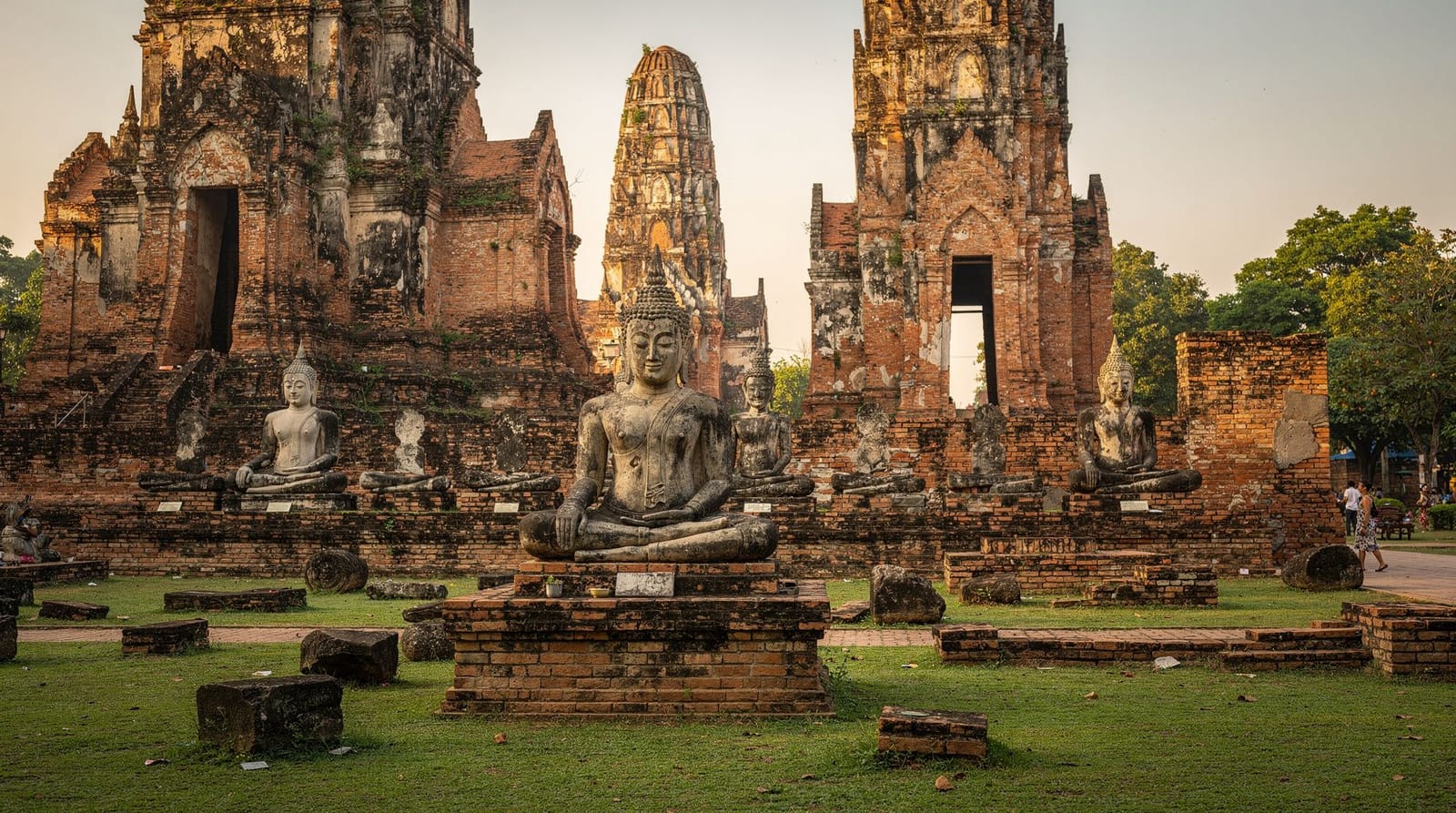
The northern line out of Bangkok is the one I have ridden most, and it strings together some of central Thailand’s most evocative towns. Within the first ninety minutes you pass Ayutthaya, the old Siamese capital whose brick temple ruins are visible from the train in the fading light — many travellers ride this short hop in daylight as a day trip, covered in the Ayutthaya by train piece. A little further north comes Lopburi, the ancient town famous for the troops of monkeys that occupy its Khmer-era ruins and railway station. From there the line climbs gradually toward the north, threading rice plains and low hills, before reaching the far northern terminus the following morning. Even if you sleep through the middle, the bookend stretches — the southern plains at dusk, the northern hills at dawn — are reason enough to take the rails over the runway. The day trips from Bangkok guide covers the closer stops you can reach without an overnight.
A note on the new trains versus the old
The Thai railways have modernised parts of the sleeper fleet, and it is worth knowing what you might board. The newer Chinese-built sleeper carriages, used on the main northern and other long routes, are a genuine upgrade: cleaner, smoother, with reading lights, charging sockets at each berth, and a more comfortable mattress than the older stock. The classic older carriages still run on some services and have their own faded charm but fewer comforts. When you book, the difference usually shows in the train number and the slightly higher fare for the newer rolling stock, and I happily pay the small premium for the sockets and the smoother ride. Either way the second-class air-conditioned sleeper remains the sweet spot — the upgrade is in the hardware, not the fundamental experience of curtained berths and dawn light.
Booking it without stress
The booking itself trips up a lot of first-timers, so here is the clean version. You can reserve sleeper berths up to sixty days ahead through the State Railway of Thailand’s online system or, more simply for many travellers, through a reputable third-party booking site that handles the reservation for a small fee. Buy early for weekends, public holidays and the Songkran and New Year periods, when the sleepers genuinely sell out. Specify a lower berth if it offers the choice — it is wider, has a window, and spares you the ladder. Note your departure station carefully (Hua Lamphong or Krung Thep Aphiwat at Bang Sue), arrive forty-five minutes early to find the right platform, and keep your passport handy as it is sometimes checked. The getting around guide and the trip planning guide point you to the rail resources, and the transport for day trips guide covers the shorter rail journeys too.
The classes, compared
| Class | What you get | Best for |
|---|---|---|
| Second-class, upper berth | Curtained berth, sheets, no window | Budget travellers, solo |
| Second-class, lower berth | Wider, has a window, no ladder | Most travellers — the sweet spot |
| First-class cabin | Private two-berth compartment | Couples, more privacy, higher fare |
Other sleeper routes out of Bangkok
The northern line to Chiang Mai is the one I know best, but it is not the only overnight option radiating from the capital. The northeastern line runs sleepers toward Nong Khai on the Laos border and toward Ubon Ratchathani, opening up the Isaan region the same unhurried way. The southern line heads down the peninsula toward Hua Hin and on to Surat Thani, useful for connecting to the Gulf islands without a flight, though the Hua Hin stretch is short enough that most people do it by day rather than sleeper. Whichever direction you go, the booking mechanics and the second-class sleeper experience described here hold true across the network.
Why the journey beats the destination
I have taken the night train to reach all sorts of places, and the funny thing is that I remember the journeys more vividly than several of the destinations. There is something about surrendering a whole night to slow travel — to the rocking and the snacks and the curtained berth and the dawn light over the paddies — that fixes it in memory in a way a one-hour flight never could. If you are spending time in Bangkok and have the chance to head further afield, do it by sleeper at least once. The plan starts with the trip planning guide, but the real advice is simpler: book a lower berth, bring snacks, and let the train do what trains do best — turn distance into a story.
Frequently asked questions about the night train from Bangkok
Which station do night trains leave from in Bangkok?
Long-distance trains depart from Hua Lamphong station and increasingly from the newer Krung Thep Aphiwat (Bang Sue) terminal. Always confirm which station your specific train uses, as they are far apart.
How much does a sleeper berth cost from Bangkok?
A second-class air-conditioned sleeper berth on a long northern route costs well under 1,000 baht, with the lower berth slightly more than the upper. It is excellent value, effectively saving a night’s accommodation.
Are night trains in Thailand comfortable?
Yes. The second-class air-conditioned sleeper has clean curtained berths with sheets and pillows. Choose a lower berth for more space and a window, bring a layer for the cold air-conditioning, and most people sleep well. The newer Chinese-built carriages add charging sockets, reading lights and a smoother ride.
How far in advance should I book a sleeper train?
You can reserve up to sixty days ahead through the State Railway of Thailand or a reputable booking site. Buy early for weekends, holidays and the Songkran and New Year periods, when sleeper berths sell out well in advance.
What towns does the northern train pass through?
Soon after leaving Bangkok it passes Ayutthaya, with its riverside temple ruins, then Lopburi, famous for the monkeys around its ancient ruins and station, before climbing toward the northern hills and arriving the next morning.