Kanchanaburi and the Death Railway: a day of quiet reflection
Some day trips are about pleasure, and some are about paying attention. Kanchanaburi, two and a half hours northwest of Bangkok, is firmly the second kind. I went expecting a scenic outing — a famous bridge, a train ride through jungle — and came back quieter than I had arrived, having spent a day in the company of one of the Second World War’s most harrowing stories. This is a reflective account rather than a chirpy itinerary, because the Death Railway deserves to be approached as more than a photo stop.
| Where | Kanchanaburi, about 130km northwest of Bangkok |
| Time needed | A full day minimum, two days is better |
| Getting there | Third-class train from Thonburi station, around 100 baht, 2.5–3 hours |
| Cost on-site | Bridge free, war cemetery free, museums modestly priced |
| Tone | A memorial site, not a sightseeing tick |
The history you walk through
Between 1942 and 1943, Imperial Japanese forces drove the construction of a 415-kilometre railway from Thailand to Burma to supply their campaign. They built it using Allied prisoners of war and conscripted Asian labourers under conditions of staggering brutality. Tens of thousands died — estimates run to around 90,000 Asian labourers and over 12,000 Allied POWs — from disease, starvation, exhaustion and violence. The line became known, with grim accuracy, as the Death Railway. The most notorious stretch, Hellfire Pass, was a rock cutting hewn largely by hand, named for the way the lamplight on emaciated, labouring bodies looked like a scene from hell. The Kanchanaburi Death Railway guide tells the full history, and reading it before you go makes the day far more meaningful.
The bridge over the River Kwai
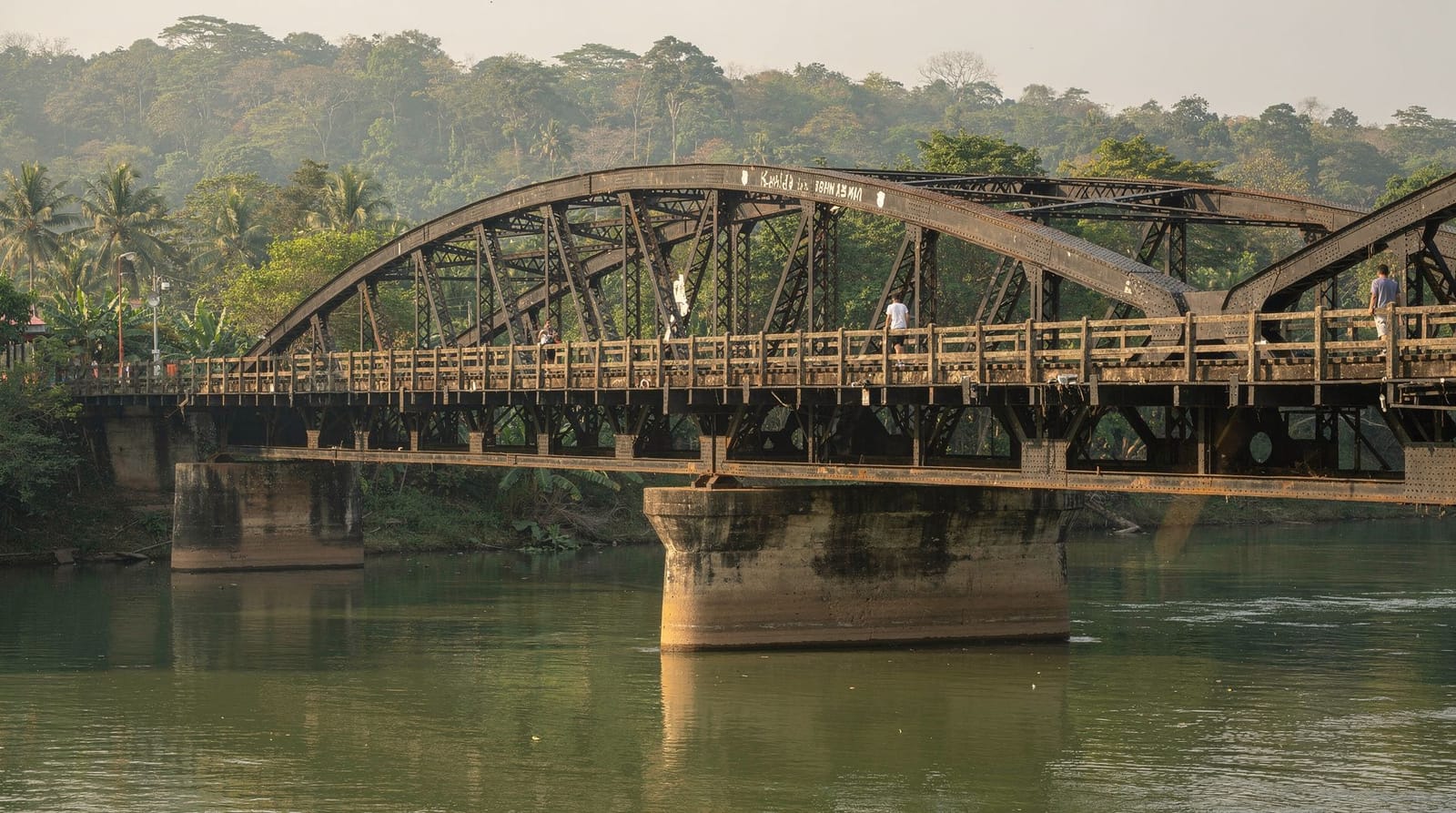
The bridge itself, immortalised by the film, is smaller and more ordinary than its fame suggests, which is somehow part of its power. You can walk across the black iron spans on a pedestrian walkway, stepping into the refuge bays as a tourist train trundles across. It is busy, lined with souvenir stalls and snack vendors, and the contrast between that carnival atmosphere and the weight of what happened there is jarring. I found it best to walk to the quieter far end, away from the crowds, and simply stand for a while looking at the water and thinking about the men who built it.
Riding the railway
Part of the original line still operates, and riding a section of it — particularly the stretch where the wooden trestle viaduct clings to a cliff above the River Kwai at Wang Pho — is the part of the day most people remember. The train moves slowly, the windows are open, the jungle presses close, and for a few minutes you are travelling the very rails that cost so many lives to lay. It is beautiful and unsettling at once. The slow, contemplative pace feels appropriate.
The war cemetery and museum
For me, the most affecting stop was the Kanchanaburi War Cemetery in the town centre — row upon immaculate row of headstones, each carrying a name, an age, a regiment and often a short epitaph chosen by a family far away. Reading the ages is what undoes you: so many of them were nineteen, twenty, twenty-one. The cemetery is beautifully kept and utterly silent, and it grounds the whole story in individual human loss rather than abstract numbers. There are nearly seven thousand graves here, mostly British, Australian and Dutch prisoners, and a second smaller cemetery, Chungkai, sits a little way out of town in a quieter setting by the river. Entry to both is free, and the Commonwealth War Graves Commission maintains them to a standard that itself feels like an act of remembrance.
The nearby Thailand-Burma Railway Centre museum and the Hellfire Pass Memorial Museum, the latter run with Australian support out at the pass itself, both provide essential context. The Hellfire Pass walking trail, where you can walk through the rock cutting itself, is the single most powerful experience of the day, and the audio guide there is excellent and moving.
Doing it independently by train
If you want to reach Kanchanaburi under your own steam, the train is not just transport, it is part of the experience. Services leave from Bangkok’s Thonburi station (also called Bangkok Noi), on the Thonburi side of the river, not from the main Hua Lamphong terminus, which catches people out. There are usually two departures a day, in the morning and early afternoon, and the third-class fare is astonishingly cheap, around 100 baht, on hard wooden bench seats with the windows open to the breeze and the rice fields. The journey takes roughly two and a half to three hours, slow and rattling, and it deposits you a short walk from the bridge.
The most memorable rail moment, though, is the onward stretch from Kanchanaburi station across the bridge and up the line to Nam Tok, the current end of the operating railway. This is the section that runs along the Wang Pho viaduct, the wooden trestle clinging to the cliff above the River Kwai, and at roughly 100 baht for the ride it is one of the great cheap train journeys in Thailand. If you do nothing else on the railway, do this stretch. The day trips transport guide has the current schedules, which shift seasonally, so confirm before you build a day around them.
Where to stay if you give it two days
I went as a day trip the first time and came away wishing I had stayed the night, and I would now gently argue against rushing it. Kanchanaburi the town is a pleasant, laid-back riverside place, and a string of guesthouses and floating raft accommodations line the River Kwai, many of them inexpensive, from around 600 to 1,500 baht a night for a simple room over the water. Waking up to mist on the river, with the day-trippers yet to arrive, lets you visit the cemetery and the museums in the early-morning quiet they deserve, before the tour coaches roll in around mid-morning.
A two-day trip also opens up the wider area beyond the railway story: the Erawan waterfalls in the national park an hour out of town, with their seven turquoise tiers you can swim in, and the more remote Hellfire Pass, which is genuinely hard to reach on a tight day-trip schedule. If you are the kind of traveller who finds a memorial site needs time to land rather than to be ticked off between coach stops, the overnight version is the one I would choose now. The day trips from Bangkok overview covers how Kanchanaburi compares to the lighter outings nearby.
The two museums, and which one to prioritise
If your time is limited, it is worth knowing the two main museums are not interchangeable. The Thailand-Burma Railway Centre, in town near the war cemetery, is the more conventional museum — well laid out, strong on maps and context, and the natural first stop since it explains the whole railway before you go further afield. The Hellfire Pass Memorial Museum, run with Australian support out at the pass itself roughly an hour from town, is smaller but far more visceral, sitting right beside the rock cutting and the walking trail through it, with an audio guide built around individual survivor testimony. If you can only do one, the in-town centre suits a straightforward day trip, while Hellfire Pass rewards those with a full day or an overnight who want the single most powerful stop on the whole route.
Day trip versus two days, compared
| Day trip | Two days | |
|---|---|---|
| Sites covered | Bridge, railway ride, cemetery, in-town museum | All of the above plus Hellfire Pass and Erawan Falls |
| Pace | Compressed, coach-timed | Unhurried, early-morning cemetery visit possible |
| Cost | Lower, no accommodation | Riverside guesthouse from ~600 baht/night |
| Best for | Limited time, want the essentials | Anyone who wants the history to properly land |
How to do this trip respectfully
Kanchanaburi is reachable independently by train from Bangkok — a slow, cheap third-class service runs to the town, and the day trips transport guide covers the options. But this is a day where I think a guide adds real value, because the history is dense and the sites are spread out, and having someone explain the context as you stand in the rock cutting turns sightseeing into understanding.
A guided Death Railway and River Kwai day trip from Bangkok bundles the bridge, the railway ride, the cemetery and the museum with transport and context, and a private tour including Hellfire Pass goes deeper into the most sombre and significant site for those who want to engage fully. The day trips from Bangkok guide lists the alternatives if you would rather pair it with something lighter like Ayutthaya or the greenery of Khao Yai on a longer stay.
A few notes on respect: this is a memorial, not an amusement park, however the souvenir stalls might make it feel. Dress modestly at the cemetery, keep your voice down, do not pose for cheerful photos on the graves, and take a moment to read a few of the headstones. Many descendants of the men buried here still visit, and you may share the cemetery with grieving families.
It is also worth bringing the right things and the right mindset. Carry water and sun protection, because the sites are spread out and much of the day is spent outdoors in full heat. Wear shoes you can walk in, since the Hellfire Pass trail involves a proper hike down into and along the cutting. And give the day enough time: rushing the cemetery, the museums and the pass in a few hours does the history a disservice. If you can, read about the experience of one or two individual prisoners before you go, because standing in the rock cutting with a single human story in your head lands far harder than a wall of statistics ever will. The Kanchanaburi Death Railway guide is a good place to start, and pairing it with the broader day trips from Bangkok overview helps you judge how much time the trip really deserves.
Why it stayed with me
I have done a lot of cheerful day trips from Bangkok, and they blur together. Kanchanaburi does not. The combination of the beautiful jungle setting and the terrible history it conceals is precisely what makes it unforgettable — the place forces you to hold two things at once, the loveliness of the River Kwai and the suffering that the railway represents. I came home from Bangkok with a phone full of temple photos and street-food memories, but the day I think about most is the quiet one, standing at the far end of an iron bridge, watching the river, remembering men I never knew.
Frequently asked questions about Kanchanaburi and the Death Railway
How far is Kanchanaburi from Bangkok?
About 130 kilometres northwest, or two to three hours by road or train. A slow third-class train runs from Bangkok, and organised day trips include transport both ways.
Is the Death Railway day trip worth doing?
Yes, if you are interested in Second World War history and approach it as a memorial rather than a sightseeing tick. The bridge, the railway ride, Hellfire Pass and the war cemetery together make a profound day.
Can I visit Kanchanaburi independently?
Yes. Trains run from Bangkok to Kanchanaburi cheaply, and you can see the sites by local transport. But a guided tour adds valuable historical context and handles the spread-out logistics.
Which Bangkok station do trains to Kanchanaburi leave from?
From Thonburi station, also called Bangkok Noi, on the Thonburi side of the river, not the main Hua Lamphong terminus. There are usually two departures a day, with third-class fares around 100 baht for the roughly three-hour journey.
Should I visit Kanchanaburi as a day trip or stay overnight?
A day trip works, but staying a night lets you see the cemetery and museums in the early-morning quiet before the coaches arrive, and reach further sites like the Erawan waterfalls and Hellfire Pass. Riverside guesthouses start around 600 baht.
What should I not do at the war cemetery?
Treat it as a memorial, not a photo backdrop. Dress modestly, keep your voice low, do not pose cheerfully on or among the graves, and be mindful that descendants of the men buried here still visit and may be grieving nearby.